
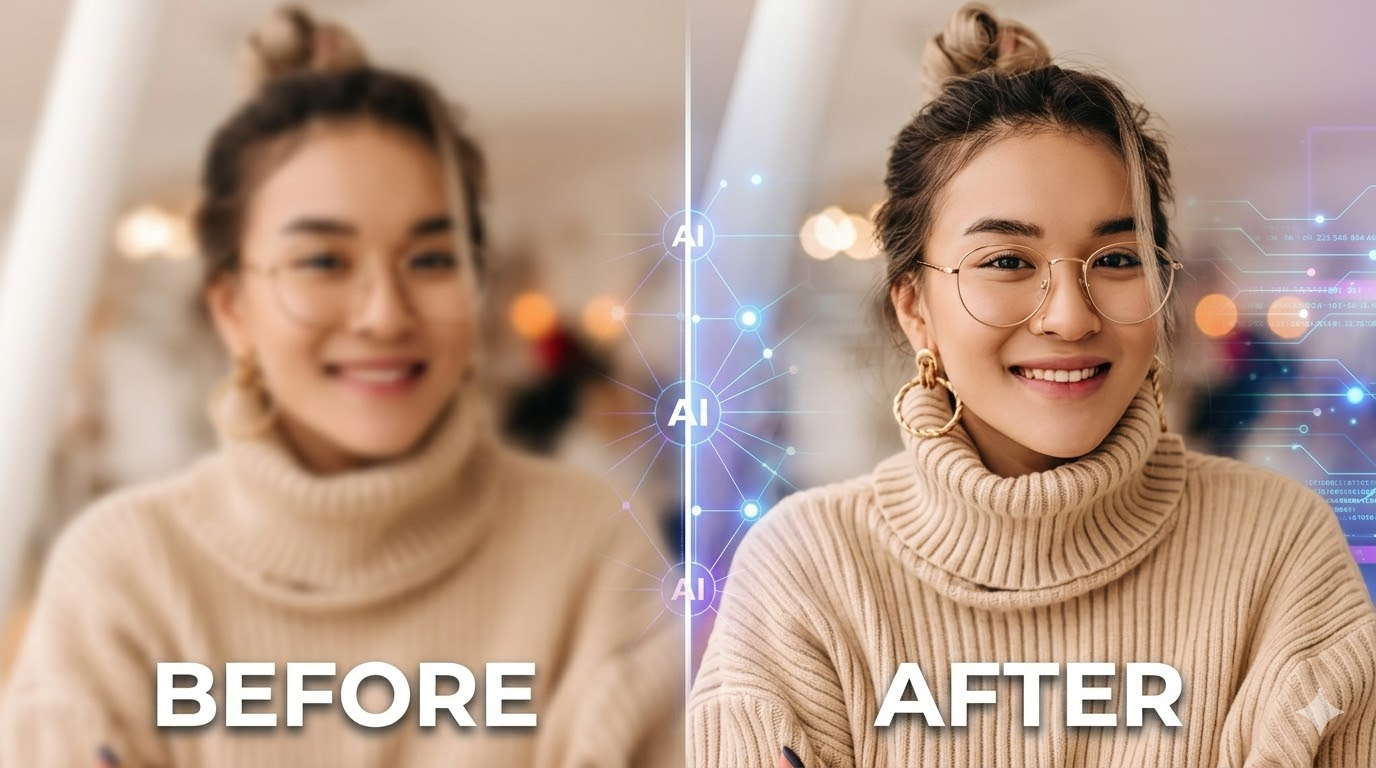
Digital content has never been more visual. From social media photos and YouTube videos to game clips, product shots, creator portfolios, and old family memories, image and video quality now plays a huge role in how people experience online content. Blurry photos and low-resolution videos can make even great moments look less appealing, but crisper, clearer, and more polished visuals can instantly make you look more professional.
This is where AI image and video enhancement tools are starting to make a big difference. Instead of relying solely on manual editing skills and expensive software, creators can now use deep learning technology to improve visual quality with just a few clicks. These tools can sharpen details, reduce noise, increase resolution, restore old photos, and make low-quality videos cleaner and easier to watch.
For creators, marketers, gamers, designers, and everyday users, AI enhancements are no longer new and are becoming a practical part of content workflows.
Why visual quality is more important than ever
The internet is full of visual content. On platforms like Instagram, TikTok, YouTube, X, Pinterest, and streaming communities, we often decide within seconds whether to continue watching or scroll. Clean, high-quality visuals help your content stand out.
Improving image and video quality improves:
-
First impressions on social media
-
Engagement with creator content
-
Product presentation for online stores
-
Viewability of older and lower resolution videos
-
Personal memorabilia such as family photos and travel clips
-
Edit game screenshots, thumbnails, and fans
The clearer the image, the more reliable it feels. The clearer the video, the more immersive it will be. For brands and creators, this can directly impact how professional their content looks.
In the past, improving quality often required advanced editing knowledge. Users had to manually adjust sharpness, contrast, noise reduction filters, color settings, and resolution. Today, AI tools can handle many of these tasks automatically by analyzing content and predicting which details need to be restored or improved.
AI enhancement mechanism
AI enrichment tools use deep learning models trained on large datasets of images and videos. These models learn the relationship between low-quality visuals and high-quality versions. Over time, it becomes better at predicting missing details, removing noise, and improving resolution.
For example, when an AI model recognizes a blurred portrait, it can identify facial features, hair texture, clothing edges, and background elements. Enhance your images by making your subject more sharp while maintaining a natural look.
For videos, the process is more complicated. A video is more than just a single image. It’s a series of frames. The AI video enhancer should improve each frame while keeping the motion smooth and consistent. If the emphasis changes too much from frame to frame, the results may appear flickering or unnatural. Advanced AI models are designed to maintain consistency across scenes, motion, lighting, and textures.
Common AI enhancements include:
-
Upscaling low resolution images or videos
-
Noise and particle reduction
-
Sharpen blurry details
-
Improving facial clarity
-
Restoring old or compressed visuals
-
Enhanced color and contrast
-
Make your videos look better on a larger screen
The goal is not just to make the visuals “bigger.” With the right AI enhancements, your content should become clearer, more natural, and more useful.

AI photo enhancement for everyday creators
Photos are often the first type of content people want improved. The photo may be slightly blurry, over-compressed, old, pixelated, or taken in poor lighting. Instead of retaking photos or spending hours manually editing them, users can enhance their photos with AI.
AI Photo Enhancer helps you improve portraits, product photos, travel images, social media posts, and old photos by sharpening them and restoring details. This is especially useful for users who want better-looking images without having to learn complex editing software.
For content creators, better photos can improve profile pictures, thumbnails, blog images, and marketing assets. For e-commerce sellers, clearer product images increase the credibility of their listings. For individual users, AI photo enhancement makes old memories feel fresh again.
Examples of best uses for AI photo enhancement include:
-
restore old family photos
-
Make your portraits clearer
-
Improving product image
-
Enhance your travel photography
-
Clean up compressed social media images
-
Preparing images for blogs, thumbnails, and online portfolios
AI photo tools are especially useful because they save you time. Creators who need to prepare a large number of images for a campaign or post can quickly enhance them instead of manually editing each one.
AI video enhancement for modern content
Video has become one of the most important forms of digital communication. From short-form social clips to tutorials, reviews, game highlights, and promotional content, the quality of your video can have a huge impact on how your audience responds.
Low-resolution or blurry video can be distracting, especially when viewed on modern phones, tablets, laptops, and 4K displays. Even if the content itself is great, poor quality can make it feel outdated or unprofessional.
AI Video Enhancer helps improve video clarity, increase resolution, reduce noise, and make your footage look cleaner. This is valuable for creators working with old footage, compressed clips, screen recordings, product videos, and social media content.
AI video enhancement is useful for:
-
Improvements to old personal videos
-
Enhance your YouTube or TikTok content
-
Clean up game clips
-
Upscaling low resolution footage
-
Improved product demo videos
-
Make archived content easier to view
-
Prepare your video for big screens
For creators, this can extend the lifespan of old content. Videos shot years ago may still have value, but the quality may not match today’s standards. AI enhancements can make your content more usable again.
Why deep learning is better than traditional upscaling
Traditional upscaling methods mainly enlarge pixels. Images and videos can be made larger, but they often don’t add meaningful detail. The results may look soft, stretched, or artificial.
Deep learning works differently. In addition to stretching the image, the AI model predicts what details should be present based on patterns learned from high-quality visual data. This allows the tool to more intelligently restore edges, textures, and details.
For example, in photos, AI might improve hair strands, facial features, fabric textures, and object edges. In video, compression artifacts are reduced, movement is clearer, and scenes appear more natural.
This does not mean that AI can perfectly recreate information that was never captured. However, modern enhanced models often give much better results than basic resizing and manual sharpening.
The biggest benefits of deep learning enhancement are:
-
Restore more natural details
-
Better noise reduction
-
Smarter upscaling
-
Speed up your editing workflow
-
Easy to use even for non-designers
-
Gets better results with compressed or low quality content
This is why AI enhancements are becoming increasingly popular not only among professional editors, but also among consumers and small businesses.
Benefits for different types of users
AI image and video enhancement is useful because it can be applied to a variety of creative needs.
content creator
Creators can use AI enhancements to improve thumbnails, social posts, short videos, profile photos, and behind-the-scenes content. Improved visuals make your content look more professional and increase your audience’s trust.
gamers and streamers
Game screenshots and clips are often compressed when uploaded or shared online. AI enhancements can sharpen details, improve thumbnails, and make highlight clips more visually appealing.
small business
Small businesses often need beautiful product images and videos, but may not have a full design team. AI tools can help improve product presentation on websites, advertising, and social media.
photographer and designer
Professional creators can use AI enhancements as workflow assistants. It’s not a replacement for creative judgment, but it can speed up repetitive tasks like upscaling, denoising, and restoring image sharpness.
daily users
Anyone with old family photos, travel videos, blurry portraits, or low-quality downloads can use AI enhancement to make their personal memories look even better.
Balance between hardening and reliability
One of the important parts of AI enhancement is maintaining a natural look. Over-enhanced images can appear too sharp or artificial, with unnatural skin textures and unrealistic details. Proper corrections will improve the quality of your photos and videos while preserving their original feel.
For creators, authenticity remains important. Viewers can often tell if an image looks over-processed. The best AI tools aim to increase clarity without changing the core identity of the subject.
This is especially important for portraits, product images, and documentary-style videos. The goal is to make your content look good, not to make it look fake.
Strengthening AI and the future of digital media
As AI models continue to improve, image and video enhancement may become a standard part of digital content production. Enhancements can be built directly into cameras, editing apps, social media tools, and content platforms rather than separate technology processes.
In the future, users may expect all photos and videos to be automatically optimized for the screen and platform on which they are viewed. Old content libraries may also be easier to restore and reuse.
For creators, this creates new opportunities. AI enhancements reduce technical barriers and make high-quality visual production more accessible. Small teams, independent creators, and everyday users can create cleaner visuals without the need for expensive equipment or advanced editing experience.
However, human preferences still matter. While AI improves quality, creators still need to decide what looks natural, what fits their style, and how they want their final content to feel.
final thoughts
AI image and video enhancers are changing the way people improve their digital content. These tools use deep learning to restore detail, reduce noise, sharpen visuals, and increase resolution, making high-quality editing accessible to everyone.
For social media creators, gamers, small businesses, designers, and individual users, AI enhancements can save time and improve the end result. Whether you want to restore old photos, clean up videos, improve product images, or prepare content for modern platforms, AI-powered tools are becoming an important part of your creative workflow.
As visual content continues to dominate the Internet, clearer, more sophisticated images and videos will become even more valuable. Powered by AI, more people can create better visuals without specialized editing skills.


