
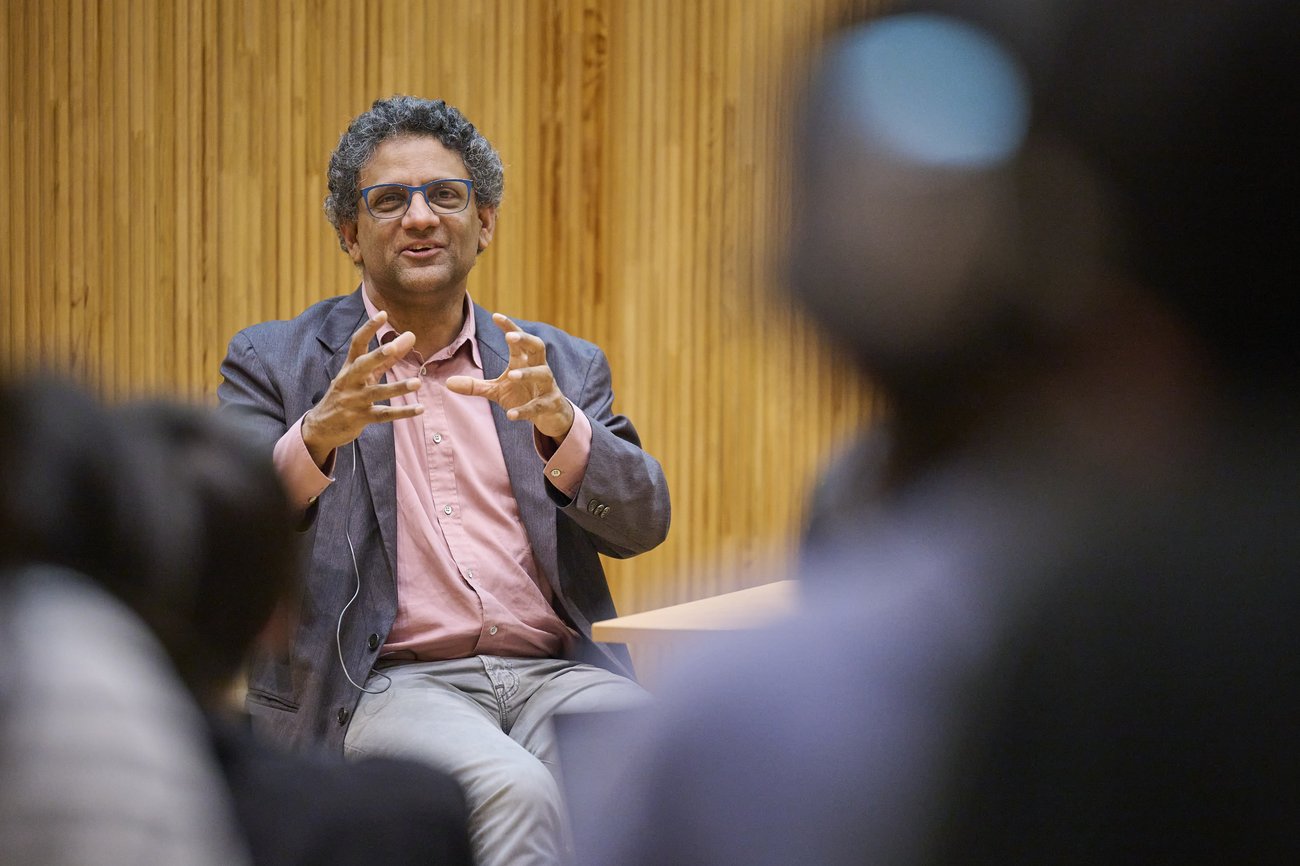
Ben Gomez, Google’s Chief Technologist for Learning and Sustainability, recently visited Japan and held a special discussion with President Teruo Fujii for University of Tokyo students, focusing on the future of AI and education. Both addressed students’ most pressing questions while discussing the universal nature of “authentic learning” and the essential human skills needed in an ever-evolving marketplace.
In this era of great change, how can AI improve the learning experience for everyone? Here’s what Ben discussed during this conversation, plus insights from our white paper, AI and the Future of Learning.
Amplify curiosity with AI
We often hear concerns that AI will become a shortcut that prevents true learning. Authentic learning requires challenging yourself, struggling, and exercising your brain’s predictive abilities. Simply asking AI for answers is not true learning.
Rather, AI should be a tool that amplifies our curiosity. We believe that in the age of AI, your questions will matter as much as your answers. When leveraging technology to solve the most pressing challenges facing the world, from sustainability to poverty, AI gives us the power to understand complex concepts across multiple disciplines. Use AI to simplify complexity and focus your energy on solving pressing real-world challenges that really matter. But the drive, passion and emotion to explore must always start with us humans.
Emphasize the importance of educators
A common question in discussions about AI is whether it will eventually replace teachers. The answer is clearly no. In fact, we believe that educators will be more important than ever.
Your desire to learn comes from interacting with human teachers and parents who see you, listen to you, and genuinely care about your growth. By leveraging AI, teachers can save a lot of valuable time and focus on direct engagement. Research shows that teachers can spend up to 10 hours a week on tasks thanks to AI. Teachers can use this valuable time to roam the classroom and focus on the relationships needed to facilitate group learning and motivate learners.
Bridging the digital divide with personalized learning
Equal access is essential if technology is to serve everyone equitably. We believe that by thoughtfully introducing AI into schools, we can actively reduce disparities rather than create new knowledge gaps. In any learning environment, some people improve quickly while others take a little longer. AI acts as a personalized tutor, understanding misconceptions and helping struggling learners catch up. For example, you can offer multimodal learning options, such as converting text into audio podcasts for people who process information better by listening.
Designing AI to guide you along the way
Our goal is to design AI that truly enhances the educational process by acting like a personal tutor. We support authentic learning experiences through the development of AI models such as LearnLM and Gemini.
We believe we have a responsibility to do more than just develop tools. It’s about continually investigating the impact these tools have on learner development. To achieve this goal, Google has begun a joint study with the University of Tokyo to evaluate the effectiveness of using AI in learning with university students across the country. The purpose of this research is to gain academic insight into how AI-assisted learning is most effective and where improvements are needed.
The world is full of great questions. We believe that by combining the innate human inquisitiveness with the tools of AI, we can open entirely new doors to problem-solving and discovery.


