
UNITED NATIONS, July 20 (IPS) – Throughout July 2026, various United Nations (UN) agencies and global experts emphasized the need to strengthen inclusive artificial intelligence (AI) governance. AI offers significant potential benefits for global development, but persistent structural barriers continue to impede equitable access and deepen the digital divide.
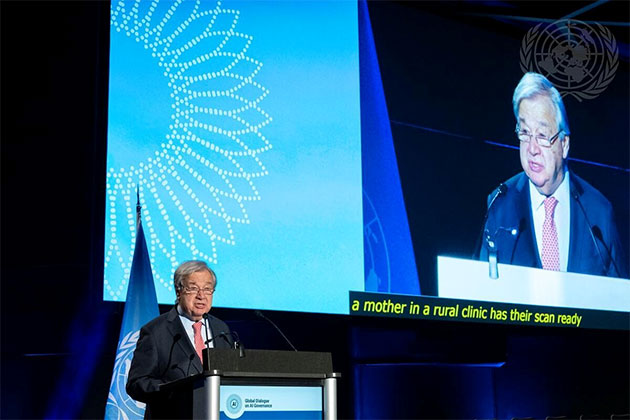
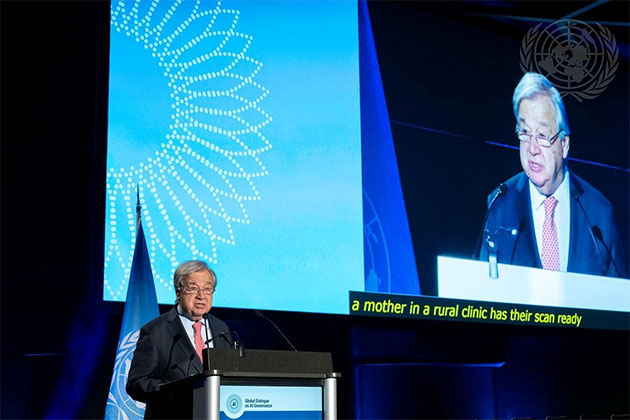
On July 6-7, the United Nations held the first meeting of the Global Dialogue on AI Governance, which included the presentation of the first report of the Independent International Scientific Panel on AI. The conference included testimony from global experts and leaders who emphasized the rapidly accelerating nature of AI and warned that without appropriate guardrails and transparency measures, the entire community risks falling behind.
“Artificial intelligence is advancing at breakneck speed. Technologies that can reshape economies, transform the world of work, sway elections and tip the balance of security are being deployed faster than anyone can keep up, including those who are building them,” UN Secretary-General António Guterres said in the opening session of the dialogue on July 6.
“The technologies we trust the most, like aviation, medicine and nuclear power, earned that trust because we took action to hold their makers accountable. For AI to be powerful, it must be managed. For AI to be trusted, those who build it must be held accountable. For AI to be global, it must be fair. And if AI is to serve the future, it must not consume the future,” he added.
According to Guterres, AI has tremendous potential to accelerate medical advances, revolutionize education systems, enhance food production and revitalize local economies, all of which will accelerate progress towards the Sustainable Development Goals (SDGs). Nevertheless, widening development gaps have been documented across communities in low-income countries, particularly in the Global South.
On July 17, Mr. Guterres spoke at the World AI Conference (WAIC) in Shanghai, urging governments and stakeholders to invest in international cooperation and monitor efforts to ensure fair access to the benefits of AI. Mr. Guterres noted that an astonishing “one-third of humanity” remains offline, with the bulk of technological expertise and investment disproportionately concentrated in just a few countries and companies.
“Hundreds of billions of dollars in private investment are pouring into artificial intelligence, but many developing countries are receiving only a fraction,” Guterres said. “AI risks pushing the world into greater inequality…widening disparities in income, opportunity, and security…widening gaps between North and South.”
At WAIC, Mr. Guterres outlined three main priorities for advancing global AI governance: making AI more environmentally sustainable, establishing critical safety guardrails, and expanding capacity across developing countries. He emphasized the need for AI testing and risk management to be firmly based on principles of international law, and confirmed that more than 20 countries, including China, have agreed to contribute to a UN-supported global network for exchange and cooperation on AI capacity building to help developing countries navigate this transition.
Throughout the conference, many UN experts emphasized that human rights must remain the basis of all AI decision-making processes, ensuring that the final judgment is always made by humans. Guterres also called on major AI companies to disclose their environmental footprint and commit to a full transition to renewable energy by 2030.
AI has the potential to accelerate the transition from fossil fuels to renewable energy by optimizing power efficiency and significantly reducing waste. Several countries, including China, are already leveraging these technologies to increase their annual dependence on renewable energy.
Several developing countries in the Pacific are taking steps to regain ownership over AI, prioritizing sustainability and putting in place frameworks to ensure their countries have control over the development and use of the technology. For example, the Kingdom of Tonga conducted a digital readiness assessment to explore the risks and potential benefits of expanding commercial 5G access and adjusting governance strategies. Similar assessments have been conducted in Samoa, Vanuatu and Fiji.
The Kingdom of Tonga is restructuring government services around a digital-first model by implementing AI tools that help citizens interact with the state in their native language. In Kiribati, AI surveillance technology in fishing helped recover nearly $2 million in illegal fishing fines.
“These are real victories, but they are victories in a system that the Pacific did not design. The region already knows what it means to be on the wrong side of the divide on climate, trade and debt vulnerabilities,” said Kanni Wignaraja, UN Assistant Secretary-General and UNDP Regional Director for Asia and the Pacific.
“AI follows the same logic at a faster rate. The difference is that the rules for AI are still being written, meaning the divergence is not fixed yet. That window will not be open for long. The time for the Pacific to shape outcomes is now, not once the framework has been agreed and the tools are already in place.”
IPS UN Secretariat Report
© Interpress Services (20260720163003) — All rights reserved. Source: Interpress Service


