

A couple of days ago, OpenAI released 722 mathematical manuscripts at once on GitHub (a few were later withdrawn), covering 17 fields including number theory, geometry, theoretical computer science, and mathematical physics, some of which are accompanied by Lean formal proofs that can be mechanically verified by computers. According to OpenAI, all of these outputs come from an unreleased internal cutting-edge model, and the computing power consumed per result on average is roughly equivalent to three hours of operation in ChatGPT Pro’s thinking mode.
This is not OpenAI’s first major move in the field of mathematics. On September 8, a month ago, it announced that its internal model had scheduled tens of thousands of agents and spent about 88 hours to produce a blowup proof related to the Navier-Stokes Millennium Prize Problem, which was soon mired in disputes over authorship and priority. After the 722 manuscripts were released, doubts also came one after another.
Apart from the controversies, one fact is rarely mentioned: the reason why mathematics has become the scientific field where AI is expanding its territory the fastest is largely that it comes with its own referee, that is, the correctness of a Lean proof is determined by the compiler.
However, once the problem shifts from paper to the physical world, such as whether a new material can achieve superconductivity at liquid nitrogen temperature, or whether a certain alloy will crack at high temperatures, no formal system can replace a real experiment.
This is exactly the viewpoint that Liam Fedus emphasized in the latest episode of the podcast The Frontier. This co-creator of ChatGPT, former vice president of OpenAI and head of post-training, is now building a physical laboratory in Menlo Park, trying to fill in the data that the Internet cannot provide for AI scientists.

In a 50-minute conversation with the host, Brendan Foody, founder of Mercor, he reviewed the internal details around the birth of ChatGPT, explained why ChatGPT and AI programming took the lead in achieving breakthroughs, and clarified why Periodic Labs had no choice but to build a laboratory.
From Rural Maine to ChatGPT: The Detour of a Physicist
Fedus grew up in rural Maine. He recalled that there was an assignment called “Science in the News” at school, which required students to write local science news. However, there were hardly any technological developments worth writing about in the rural newspapers, so he had to look for materials online, and was deeply attracted by a physics website. When he was in college, he wavered between physics, chemistry and economics, and finally chose Physics because it is “fundamental enough“.
While studying physics at MIT, he participated in a dark matter detection project called DMTPC. According to one theory, dark matter signals will show directional changes over time, and the team hopes to build a detector with higher sensitivity based on this.
It was also here that he first encountered the machine learning problem: to infer the direction and energy of particles from the raw data of the detector, it is essentially a machine learning task. After that, he briefly entered the financial industry, then pursued particle physics at the University of California, San Diego, and participated in CERN’s particle track reconstruction, where the same problem appeared again. “I realized that to push the frontier of machine learning, I had to stay in those cutting-edge institutions.”
The turning point came in the era when Generative Adversarial Networks (GAN) were booming. Fedus tried to apply GAN to language generation, but found that it was a double problem: GAN itself was unstable in training and prone to mode collapse, while the output of the generator was discrete tokens, and the gradient of the discriminator could not be backpropagated directly, so “you had all the problems of GAN and all the problems of reinforcement learning at the same time”.
He wrote an email to Ian Goodfellow, who was a Google researcher at the time, and the reply made him determined to join this group of people.
In 2016, he joined the Google Accelerated Sciences team as an intern, used convolutional networks to study the replication and division of yeast cells, then entered Google Brain, and completed his PhD in computer science under the supervision of Yoshua Bengio and Hugo Larochelle at Mila.
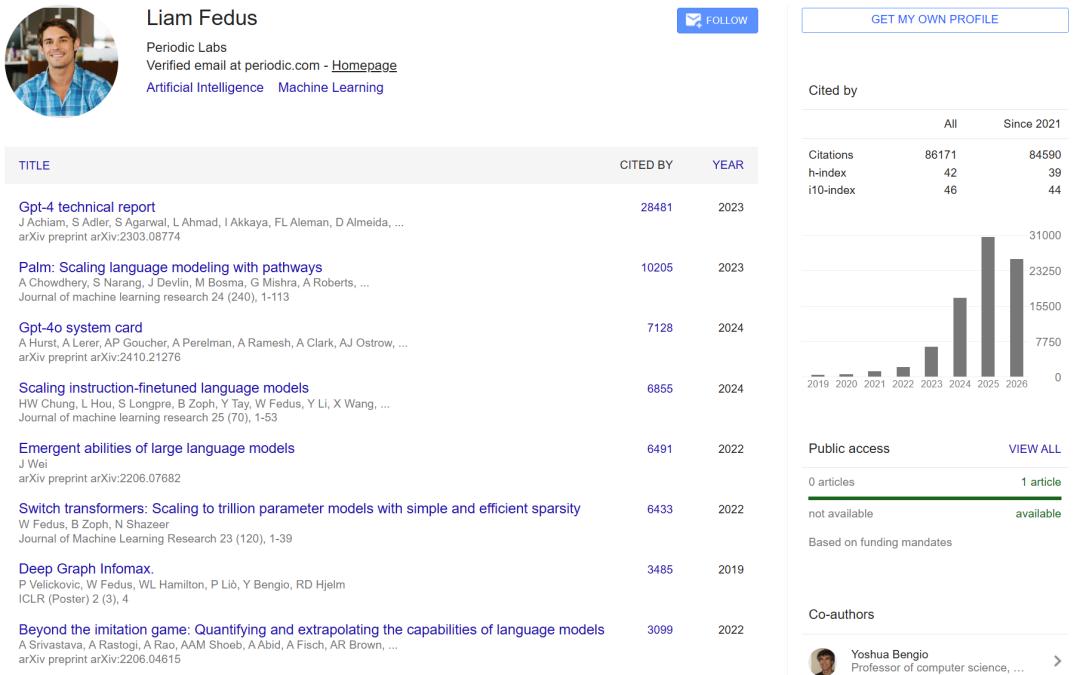
At Google Brain, Fedus collaborated with Barret Zoph and Noam Shazeer to propose Switch Transformer, pushing the Mixture of Experts (MoE) architecture to the trillion-parameter scale, and this work later became an important reference for open-source MoE models.
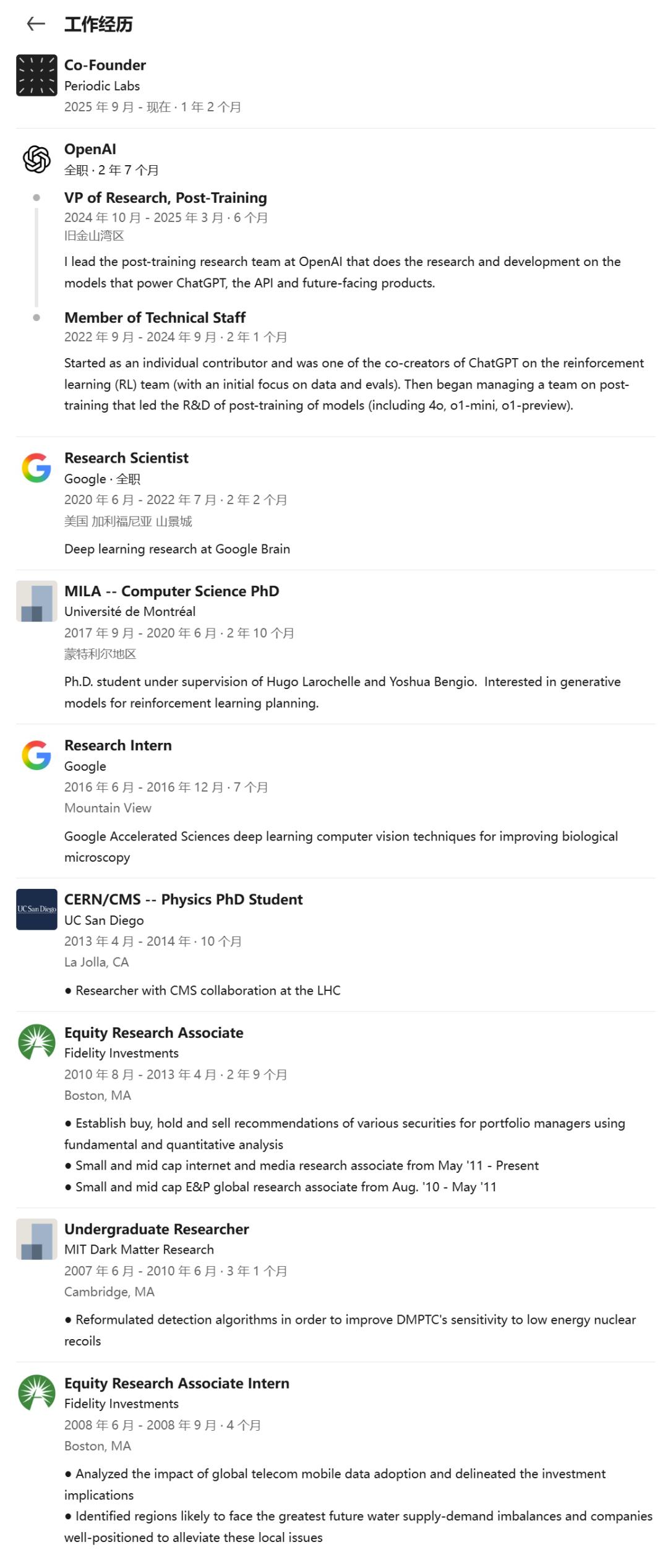
In 2022, he joined OpenAI and participated in the creation of ChatGPT. In October 2024, he succeeded Barret Zoph to lead the post-training team, and in March 2025, he left his job to start a business.
The Periodic Labs he founded has another co-founder, Ekin Dogus Cubuk. The two have known each other for nearly ten years since they met at Google Brain. Cubuk later led the chemistry and materials team at DeepMind and was one of the authors of the GNoME paper, a project that predicted a large number of new stable crystal structures in 2023. In 2025, Periodic Labs emerged from stealth with a $300 million seed round, with investors including a16z, DST, NVIDIA’s NVentures, Accel, as well as individual investors such as Jeff Bezos, Eric Schmidt and Jeff Dean.
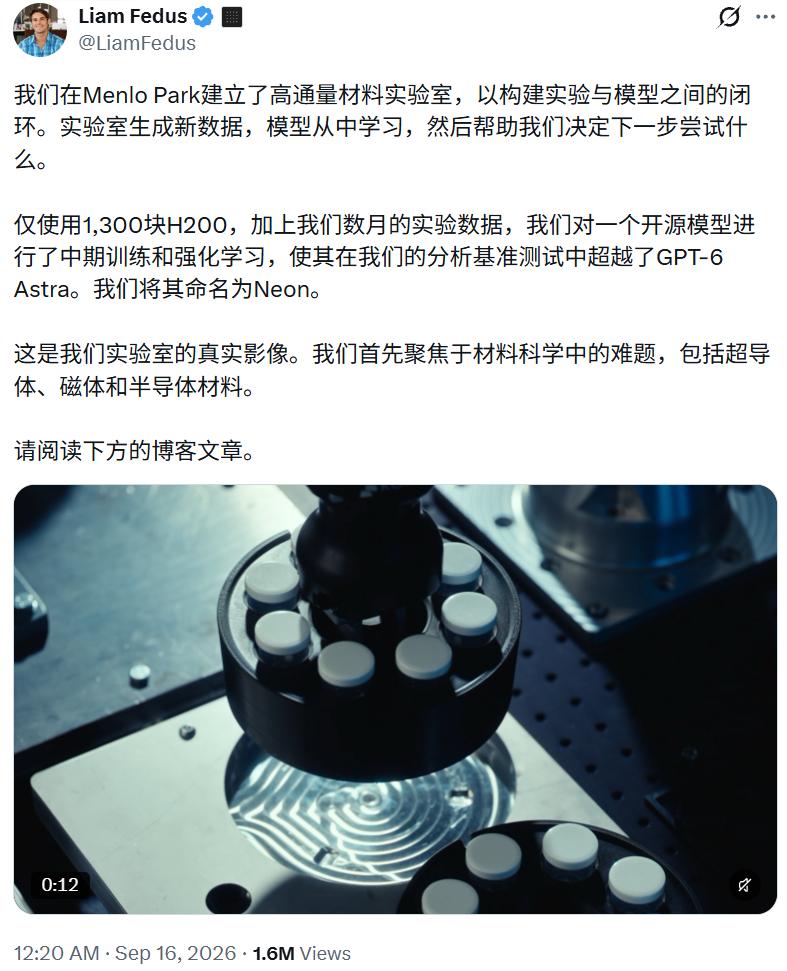
In mid-September this year, Periodic released its first model Periodic Neon, a model with about 1 trillion parameters post-trained on its own laboratory data, used to interpret X-ray diffraction patterns; the company said it outperformed GPT-6 Astra on its self-built benchmarks, but this result is currently only self-reported by the company.
ChatGPT Almost Became a Meeting Bot
On Fedus’s first day at OpenAI, Greg Brockman showed the new recruits the just-trained GPT-4. “It was about a year and a half ahead of any system I had ever seen.” But he also admitted that GPT-4 still made the mistakes common to other language models: it hallucinated and could not do math problems. It was obviously a huge leap, but no one knew how to turn it into something valuable to the world.
About half a year before the scheduled release of GPT-4, the team discussed various product forms, including writing bots, programming bots, and a meeting bot that some people were particularly fond of, which sat in the meeting software to take notes and send to-do items for you. The host joked that if they had really made the meeting bot at that time, the world would be very different. In the end, John Schulman made the final call, insisting on maintaining generality and making a chatbot.
Interestingly, the early internal signals were not optimistic. Fedus estimated that about 90% of the friends and family who had access to the GPT-4 internal test did not care much about it. As a researcher whose main focus was architecture research, he regarded it as a negative signal at that time. “But looking back, there was actually a very positive signal hidden in it: 5% to 10% of people loved it very much and used it every day. Every time we pushed an update, they would complain, ‘I prefer the previous version of the model’.”
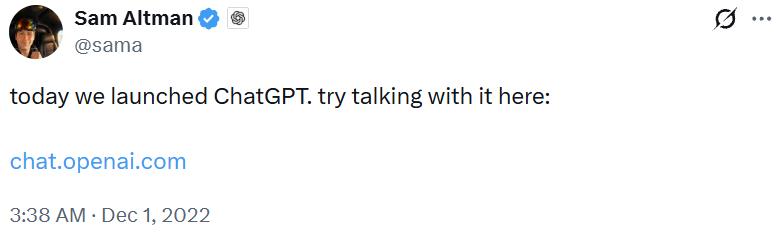
What was even more surprising was that the ChatGPT that took the world by storm did not even use GPT-4, but GPT-3.5, which had been open via API for several months. The real variable was the product form: changing from the “completion” interface to the “conversation” interface.
Fedus gave an example: in completion mode, if you want the model to write a poem in a certain style, you have to first write a paragraph like “A lost poem by a famous writer was recently discovered, and it starts as follows:”, while in conversation mode, you can just say “Please help me write a poem in this style”. “It’s a small thing, but it’s very natural.” In addition, it is a lot of tedious detail work around supervised fine-tuning and RLHF, “everything eventually comes back to the data, we keep staring at the data”.
When internally voting to predict the number of ChatGPT users, everyone guessed 10,000, 50,000, and the most daring person guessed 1 million. “We originally just wanted to make a low-key research preview, publish a blog post, and maybe 10,000 researchers would try it.” The result was total chaos, “all the dashboards were red”. In the summer of 2023, usage declined, and the team once fell into a “survival crisis”, worrying that the popularity of ChatGPT would end at that time, only to later find out: it was just that the students were on summer vacation.
When You Are Too Close to the Technology, All You See Are Its Flaws
In the later period at OpenAI, Fedus led the post-training team, and one of the works he was most proud of was bringing reasoning models into chat scenarios.
Reasoning models are good at mathematics and programming, but it is not easy to make them suitable for daily conversations. “If you just say ‘How are you?’ and the model thinks for three minutes, it is obviously not a good user experience.” The team needs to grasp the dynamic boundary of thinking, and design different reasoning strategies for different fields, because the reasoning method for solving math problems is completely different from the reasoning method for drafting an article.
Another work that satisfied him was the data flywheel: how to use user feedback to continuously improve the system. He fully agreed with OpenAI’s consistent iterative deployment philosophy, that is, to contact the real world as soon as possible and close the loop as soon as possible, “let the world gradually adapt to what is coming, and at the same time figure out where the system will go wrong”. In his view, establishing a predictable scaling law based on user feedback is an important achievement of the team.
Talking about his first impression of GPT-4, Fedus said a very researcher-like sentence: “When you are too close to the technology, all you can see are its flaws.” Researchers will not rejoice that the model got 80% of the questions right, but will only stare at the evaluation and ask why it can’t solve a certain math problem correctly, and why it can’t summarize according to the instructions. In the early days, everyone kept some private “intuitive test” questions. He himself had a quantum mechanics question that all previous models answered very poorly, until the reasoning model appeared, and it began to answer correctly for the first time. “I was really shocked. It showed very interesting features, such as self-correction.”
Why Chat and Programming Took the Lead in Breaking Through
The host threw out a key question: There have been two real breakthroughs in the past few years, one is ChatGPT, and the other is AI programming.
Why these two fields in particular? What is still missing for the physical world to usher in a similar breakthrough?
Fedus’s answer is that ChatGPT relies on a sufficiently strong pre-training base and RLHF.
He believes that ChatGPT could not have succeeded with GPT-3-level technology. GPT-3.5 has a much stronger ability to compress the Internet data distribution, providing a better base for subsequent fine-tuning and reinforcement learning. RLHF distills human preferences into the neural network, providing good optimization signals. But it has a fundamental limitation: the reward model trained by “do you prefer answer A or B” is not sensitive to correctness, whether it is mathematical correctness, code correctness or factual accuracy. “What they encode is actually style, intent and form.” ChatGPT does not need to be perfect at everything, it only needs to cross the threshold of product-market fit.
Programming is different. Today’s programming agents spend a lot of computing power on long-chain reasoning, interacting with the environment, and constantly adjusting according to failures and new evidence, which requires strong verifiability and error correction capabilities. Test-time computation plus verifiable rewards is the real key to unlocking programming capabilities. The host added that programming also has GitHub, this huge human knowledge base, which naturally contains a large number of unit tests, and the vast majority of scientific fields and knowledge work fields have no counterparts.
Fedus took AlphaFold as an example: the reason why it succeeded is that there are decades of accumulated protein structure data behind it. “Machine learning systems are not magic. They are good at whatever data you train them on and whatever tasks you let them do.” But materials science is extremely lacking in good data. The experimental data on the Internet is very noisy, and two research groups doing the same experiment may come to different conclusions; papers often omit key details, and the sentence “we synthesized this material” hides millions of degrees of freedom; what’s worse, there are almost no negative results. “Everything you see on the Internet is a success, which is obviously a highly biased data distribution.”
“To Build an AI Scientist, You Must Actually Do Science”
This is the fundamental reason why Periodic Labs wants to build a laboratory. Fedus envisioned a scenario: even if you have a superintelligent system that can overview the entire cutting-edge of human knowledge, it judges which knowledge is self-consistent, weeds out which claims, and then runs some simulations to come up with several hypotheses about the world, “but without the ability to put ideas into practice, you can only stay at the thinking stage. To collapse multiple possibilities into the only truth, you have to do experiments.“
Periodic’s idea is to combine three technical routes: the reasoning ability of language models, computational physics simulation, and high-throughput laboratories.


