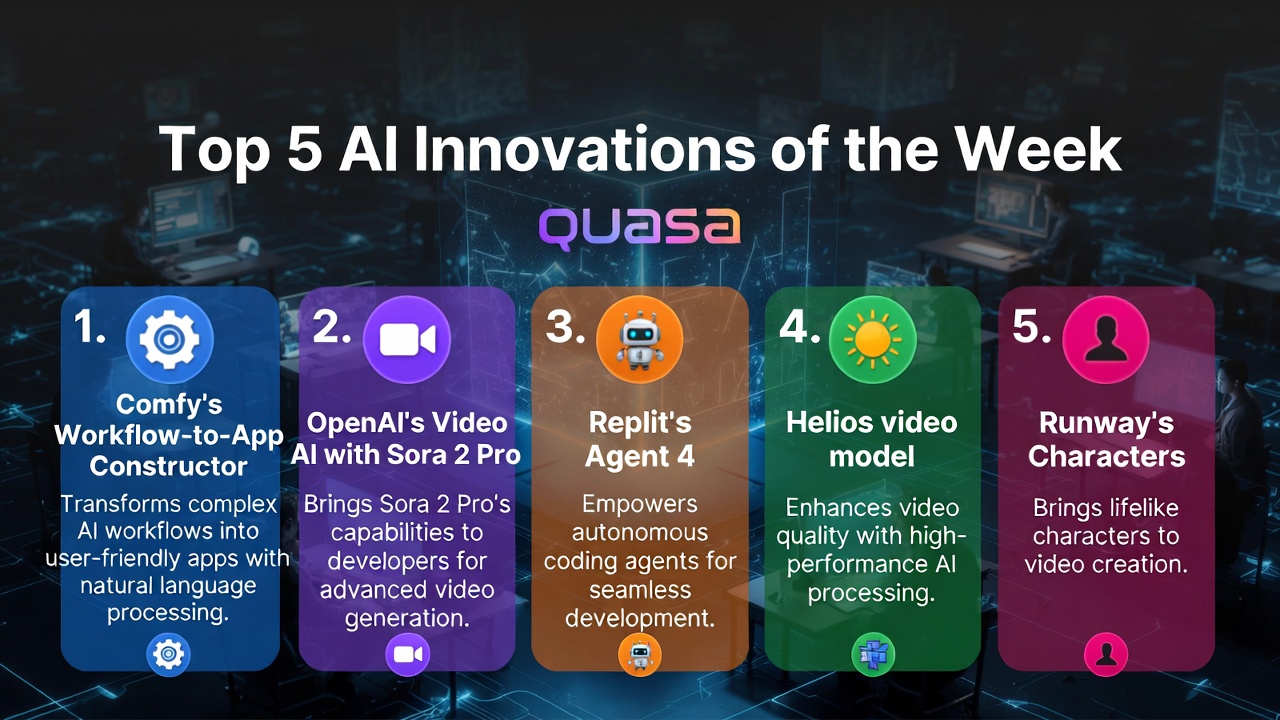
In the fast-paced world of AI, this week brought a slew of exciting updates to empower creators, developers, and innovators. At QUASA, we highlight these top five opportunities to reshape the way we interact with technology, from streamlined app building to advanced video generation. Let’s dive in.
1. Comfy’s Workflow-to-App Constructor and ComfyHub Showcase
Comfy introduces a revolutionary way to turn ComfyUI workflows into shareable apps with App Mode, App Builder, and Shareable URL Initiation. This allows users to create clean interfaces without exposing the underlying node graph, making it accessible to non-technical users. App Builder allows you to select, rename, and group inputs while your app runs seamlessly in the ComfyUI backend.
.jpg)
Complementing this is ComfyHub, a platform for sharing and discovering workflows and apps such as text to image conversion, image to video conversion, and editing tools such as Z-Image-Turbo and LTX-2.3. Creators can publish their work, build a portfolio, and reach a wider audience.
2. OpenAI video API updates with Sora 2 Pro enhancements
OpenAI leverages Sora 2 to expand its video API to introduce custom characters, clips up to 20 seconds, and video continuation with prompts. Developers can now upload short MP4 clips to create consistent non-human characters and use multiple extensions to extend videos up to 120 seconds to maintain motion continuity.
.jpg)
Sora 2 Pro adds HD export in 1920×1080 (horizontal) and 1080×1920 (vertical) formats, perfect for high-quality content in marketing and storytelling. Announced through X, this update focuses on efficiency for the studio and the brand.
3.Replit’s Agent 4: All-in-one AI for app creation
Replit announces Agent 4, the most versatile AI agent to date. It targets the “all-in-one” niche for building full-stack applications, presentations, and launch videos. Process authentication, database, and design in parallel to enable seamless web-to-mobile app conversion.
.jpg)
Agent 4 reduces context switching by consolidating tools into one environment, allowing users to iterate on an infinite canvas and apply changes directly to the code. This positions Replit as a comprehensive platform for rapid prototyping and deployment.
4. Helios: Peking University and ByteDance’s open source video model
Helios is a 14B autoregressive diffusion model developed by Peking University, ByteDance, and collaborators that produces over 60 seconds of video in real time at 19.5 FPS on a single H100 GPU. Tackle long-time video drift with innovative strategies and support text-to-video, image-to-video, and video-to-video tasks through integrated inputs.
.jpg)
Open source, with code and models available, Helios achieves efficiency without any acceleration tricks, fits large batches into 80 GB of memory, and outperforms baselines in quality and speed.
5. Runway Character: Real-time Conversation AI Avatar
Runway introduced Character, a real-time video agent API for creating conversational AI avatars from a single image and a specified mood. Powered by GWM-1, it provides natural facial expressions, lip sync, gestures, and fully customizable voice, personality, and actions. No fine-tuning required.
.jpg)
Ideal for enterprise applications such as customer support and interactive education, the API enables immediate deployment. Preset avatars are available in web apps so developers can experiment.
These innovations underpin the rapid evolution of AI, providing new tools for creativity and efficiency. Stay tuned for more information from QUASA as this field continues to evolve.
Join us — earn QUA tokens in exchange for visiting partner sites on the Quasa Rewards platform (https://quasa.io/rewards)