

BEIJING, March 15 (Xinhua) — From artificial intelligence (AI)-assisted diagnosis to smart health platforms, China is stepping up efforts to incorporate AI into its evolving digital healthcare ecosystem, aiming to further increase efficiency and expand access to quality medical services.
The outline of the country’s 15th Five-Year Plan, adopted by Parliament on Thursday, highlights the need to achieve a leading strategic position in AI industrial applications from 2026 to 2030.
This year’s Government Action Report also recognizes biomedicine as an emerging pillar industry, pledging to “advance and expand AI-plus initiatives” and “encourage large-scale commercial applications of AI in key sectors and fields.”
As part of the broader Healthy China Initiative, digitalization and smartization of healthcare is expected to facilitate in-depth health data analysis, support clinical decision-making and improve access to medical care, experts said.
Ge Minghua, national lawmaker and director of Zhejiang Provincial People’s Hospital, said, “Digital technology is an important means to reshape health care delivery and reduce the disparity between urban and rural medical resources.”
In recent years, China has made great achievements in the field of public health, with the average life expectancy reaching 79 years in 2024 and the basic medical insurance coverage rate maintaining over 95%. From disease prevention to treatment, rehabilitation and long-term care, the health service chain throughout the life cycle is continuously expanding.
At the same time, AI has made steady progress in China’s healthcare field; as of May 1, 2025, China has released about 300 large-scale medical models, and prefecture-level remote medical imaging services have processed more than 68 million cases, making AI an increasingly important tool for grassroots healthcare.
Medical large-scale models and health AI applications, such as Ant Group’s “Ant Afu”, are rapidly gaining popularity, reflecting the public’s strong demand for professional and convenient medical services.
Utilizing AI applications can improve medical delivery outside hospitals and improve public health, said Huo Yong, national political advisor and chief cardiology expert at Peking University First Hospital.
Experts believe that the tight integration of AI and medical services will also provide an important engine and focus for developing new high-quality production forces in the medical field.
Zhu Dongyu, national political advisor and vice president of Shanghai Medical College, Fudan University, pointed out that by using AI-powered portable diagnostic devices, doctors can monitor the health status of patients in local communities and remote areas.
Such technology can help facilitate step-by-step medical services and optimize the allocation of medical resources, Zhu added.
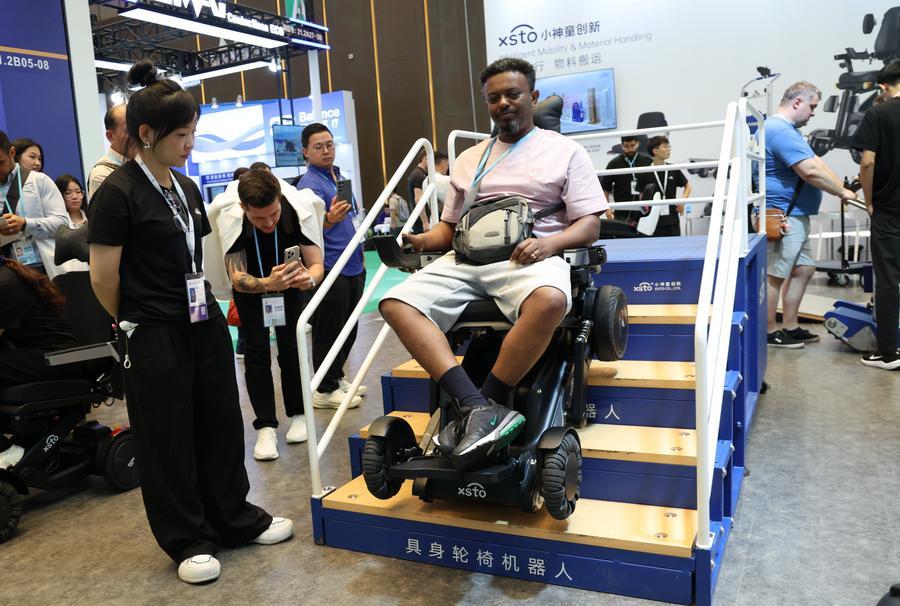
Interest in smart health products is already growing. Digital health management devices such as smart body fat scales are gaining popularity among younger consumers, and home rehabilitation exoskeletons can help paralyzed seniors walk independently.
Behind this expansion is China’s rapidly developing AI field. By 2025, the country’s AI core industry is expected to reach more than 1.2 trillion yuan (about 174 billion US dollars), and the integration of big data, AI, Internet of Things, 5G and medical services will promote the growth of the entire medical industry chain.
Ding Liming, national political advisor and member of the Peasant and Labor Democratic Party of China, said that a wise change in the research and development paradigm is accelerating the practical application of scientific and technological achievements.
“For the biopharmaceutical industry, which has long development cycles and high risks, AI can shorten R&D timelines and costs, and improve quality and efficiency,” Ding said.
However, Huo Yong noted that challenges persist at various levels, including technology, policy, and practical scenarios. He suggested breaking down siled models and “data silos” through national data interoperability, as well as considering a hierarchical governance system for large-scale healthcare models.
He further emphasized strengthening out-of-hospital medical services, focusing on high-demand areas such as patient examination, report interpretation, and personalized health management planning, to fully realize the applied value of AI.
Epidemiologist Zhang Wenhong, a national political advisor, told the media that the entry of AI into medicine should not replace human work, but complement it. “We cannot ignore investment in our people and infrastructure. AI should empower medical professionals, not replace them,” he said. ■


