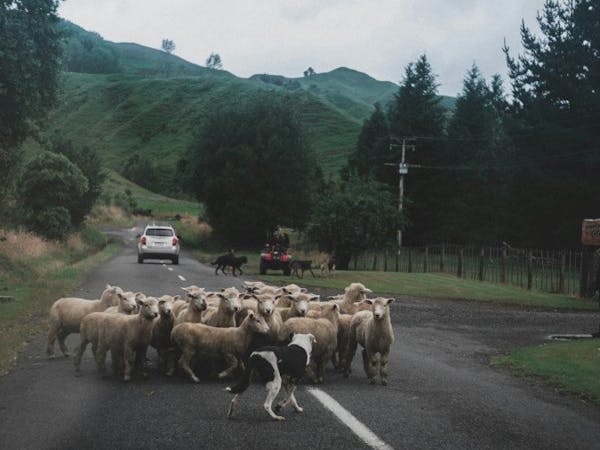
Georgia Tech researchers have devised a new approach to handling large numbers of autonomous vehicles, drones, and robots: sheepdog herding, a classic example of controlling herd behavior.
“Birds, insects, fish, sheep, and many other organisms move in groups because they provide individual benefits, such as protection from predators,” Associate Professor Saad Bumrah explains of his team’s research. “The puzzle is that the ‘group’ is not a single organism; it is composed of many individuals, each making local and imperfect decisions.”
Hours of testing sheepdogs provided inspiration for a new way to control a flock of autonomous robots. (📷: Chakraborty et al.)
In the case of sheepdogs, their ability to herd sheep is due to what Bumrah describes as “selfish herding behavior,” in which individuals near the edges of the herd instinctively move to the center for protection when threatened by predators. “Shepherds use trained dogs to exploit their instincts,” the researchers say.
Researchers looked at hours of footage from professional sheepdog trials and discovered something seemingly counterintuitive. The theory is that large herds are easier to control than small ones because the more members there are, the more protected they feel at the center of the group. In contrast, in small groups, members oscillate between “following the group” and “running away from the dog.” “That switching behavior makes the group unpredictable,” explains co-leader Tuhin Chakraborty.
The team’s breakthrough came by applying these lessons to autonomous robotics. Rather than take the typical approach of having members of an autonomous swarm absorb information from all the members around them, the researchers chose a simpler approach. In other words, it can be compared to a room filled with smoke where only one person can be seen and no one knows who it is. “That’s the counterintuitive part,” Bumrah explains. “If only one person has the correct information, the signal may disappear due to averaging. But if you follow one person at a time and keep switching between them, the correct information can spread to a large number of people.”
Researchers have found that a new swarm algorithm works even in noisy situations. (📷: Chakraborty et al.)
The control approach developed by the team, known as an “indecisive swarm algorithm,” shows promise. In noisy situations, when traditional algorithms fail, group members automatically switch between following a single neighbor or a guiding signal, reducing the effort required to follow a desired path. “Our findings suggest that the same dynamics that make groups of small animals unpredictable may provide new ways to control complexly engineered systems,” Bumrah concludes.
The team’s research is published in the journal under open access terms scientific progress.