BCG’s 4th Annual Global AI Workplace Survey reveals that nearly half of respondents spend more time managing and guiding AI than the work itself
Two-thirds of regular AI users report high job satisfaction, but 41% also report increased cognitive load, creating a “paradox of pleasure” in which AI makes their jobs both better and more difficult.
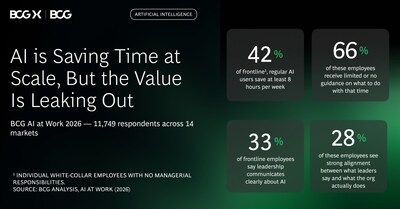
42% of frontline workers who use AI regularly report that AI saves them at least one full work day per week, but most organizations have yet to learn how to turn that time into value.
Your employee AI honeymoon will quickly disappear without clarity on your strategy. A clear strategy increased AI impact by 25 percentage points. Tool improvements received only 5 points
AI adoption surges among frontline workers. 74% became regular users, up 23 percentage points year over year
boston, June 3, 2026 /PRNewswire/ — New research data from Boston Consulting Group (BCG) shows that artificial intelligence is no longer just increasing productivity and saving time at work, but fundamentally reshaping the nature of work, leadership, and the employee experience.
AI operation report
Almost three-quarters (72%) of respondents now say that AI is already significantly changing the skills required in their roles, and almost half (47%) report spending more time managing and directing AI than doing the work itself. Two-thirds (67%) of regular AI users say AI has improved their job satisfaction, while four in 10 (41%) report an increase in cognitive load, creating a “paradox of joy” in which AI can make work both better and harder.
These are among the findings of BCG’s fourth annual report. Working AI The report is based on a global survey of 11,749 workers across 14 markets and a wide range of industries. This report examines how AI adoption, employee expectations, leadership, and organizational transformation are evolving as AI becomes increasingly integrated into daily work.
Adoption of AI by frontline workers (individual white-collar workers with no management responsibilities) is progressing rapidly, with 74% now using it regularly, an increase of more than 20 percentage points over the past two years. Geographically, Global South markets continue to lead the race to recruit front-line employees. India, the Middle East, Brazil and South Africa all report regular levels of AI usage above the global average, as do most of the Global North, with the US, France and Italy lagging behind.
However, despite its widespread use, many organizations struggle to translate the efficiency gains from AI into measurable value. While 42% of regular frontline users report that AI saves them at least a full day of work time per week, 66% report getting limited or no guidance on how to use that time, and more than half don’t direct that time toward strategic work. Without proper change, the time saved will leak out of your organization.
“The first wave of AI focused on individual productivity. The next wave will need to transform collective work,” said Vinciane Beauchene, managing director and partner at BCG and co-author of the report. “Everyone is talking about AI replacing jobs, but in reality, it is important to rethink the added value within humans. This is the role of leaders. Our research reveals a true management revolution in the AI era. 65% of managers and leaders now believe that at least half of their jobs will be taken over by agents in the next three years, and front-line employees believe their jobs are evolving more towards AI management and guidance.”
The survey also highlights the continued emergence and maturation of AI agents, with 30% of respondents saying agents are already integrated into their workflows, more than double the number in last year’s report (13%). Six in 10 (61%) respondents believe agents will be able to do at least half of their jobs within three years, but more than half (52%) still have limited understanding of what an agent is and governance (oversight, accountability) still lags far behind technology.
More broadly, this research reveals that the most important differentiator for organizations to sustain the impact of AI over time is to move beyond simply deploying AI tools in use case deployment initiatives. Increasingly, the focus has shifted to redesigning end-to-end workflows and processes and rethinking capabilities, as well as building and innovating new business models and products to drive growth, which has nearly doubled year over year.
This creates what the authors call a “reshaping/invention dividend” that captures more value and improves the employee experience. A clear strategy increases measurable business impact by 25 percentage points. In contrast, a better tool would change by only about 5 points without such strategy or redesign. Additionally, respondents from companies redesigning their workflows were 24 points more likely to see measurable operational improvements, 22 points more likely to say they saved at least one day a week, and 20 points more likely to report increased job satisfaction.
“The joy equation is rewritten within a year of using AI. Early on, the novelty and cognitive stretch of AI stimulated enjoyment, but that ‘AI honeymoon’ will fade if the strategy is not clear,” said Sylvain Duranton, global leader at BCG X and co-author of the report. “Employees don’t resist AI enhancements. They thrive when the strategy is clear, the direction is real, and the message is heard. There is no trade-off between business value and employee enjoyment. The organizations that capture the most business value are the ones whose employees enjoy their work the most.”
Download the publication here: https://www.bcg.com/publications/2026/ai-at-work-why-strategy-matters-more-than-tools
Media contact: Eric Gregoire gregoire.eric@bcg.com
About Boston Consulting Group Boston Consulting Group bridges the gap between ambition and performance for the world’s leading companies and organizations. We are built for this era of unprecedented change, combining strategic clarity rooted in over 60 years of deep domain knowledge with applied AI shaped by practitioners. BCG works side-by-side with CEOs across industries and geographies to deliver transformative impact at scale: stronger profits, transferred capabilities, and change that sticks. For more information, please visit bcg.com.
Boston Consulting Group logo (PRNewsfoto/Boston Consulting Group)
Sision
View original content to download multimedia: https://www.prnewswire.com/news-releases/ai-is-reshaping-jobs-faster-than-companies-are-reshaping-work-302789481.html