The White House on Monday launched a new program that will enable the Department of Energy’s national laboratories to collaborate with technology companies and academics to use AI to advance scientific research.
Under the new Genesis mission created by executive order, the Department of Energy will develop a new AI platform that uses federal scientific data to train AI models and agents created for scientific research. This underscores President Donald Trump’s focus on AI in his second term, following his introduction in July of a comprehensive package of initiatives and policy recommendations called the AI Action Plan.
The Genesis mission aims to take advances in AI from the technology and business industries and apply them to scientific research in health, energy, manufacturing and other areas, Energy Secretary Chris Wright said in a call with reporters on Monday. He also said the program will lower energy prices for consumers, a key challenge as investment in AI increases this year.
DoE laboratories have been conducting research in everything from energy to health, applied materials and quantum science for decades. But the initiative’s new platform will allow DoE laboratories, private companies, and academic institutions to share information more easily. This will help researchers apply AI to fields such as physics and chemistry.
“The private sector has adopted artificial intelligence at scale, but with a slightly different focus: language, business, process, and consumer services,” Wright said. “What we’re doing here is just focusing these efforts on scientific discoveries and engineering advances.”
A key part of achieving that goal, Wright said, is opening up access to datasets from the Department of Energy’s national laboratories, including facilities such as Ames National Laboratory, Argonne National Laboratory and Lawrence Berkeley National Laboratory.
According to a White House fact sheet, the platform will enable “multiple federal research agencies” and the “private sector” to collaborate to “win and stay ahead of the AI race.”
The program’s main focus areas include biotechnology, critical materials, nuclear fission and fusion energy, space exploration, quantum information science, and semiconductors and microelectronics.
The tech giant is already working more closely with the Department of Defense. Nvidia and Oracle announced a partnership in October to build a supercomputer for Argonne National Laboratory. According to an announcement in May, PC maker Dell is also developing a supercomputer for use at Berkeley Lab. Genesis Mission is designed to further facilitate these types of transactions.
Technology companies and academics have also been researching the use of AI in health for years. In 2023, Google introduced a family of AI models fine-tuned for the healthcare industry.
But the push to use AI in scientific research also comes as the technology still faces hallucinations and a tendency for technology to make things up.
The directive also addresses significant challenges posed by the AI boom, including potential challenges to the energy grid. Household electricity costs are on the rise, with the average electricity bill in the U.S. increasing by 13% from 2022 onwards. Data centers, which are essential to running AI services and training AI models, are expected to consume about 6.7% to 12% of U.S. electricity in 2028, up from 4.4% in 2023, according to a Department of Energy report.
Wright said the program would “improve the efficiency of our power grid and reverse the price increases that are infuriating Americans.”
But doing so is not easy. Power grids are already in need of updates and maintenance, especially in the face of severe weather events. And the speed at which AI advances could make it increasingly difficult for the energy industry to keep up as tech giants pour billions of dollars into new data centers.
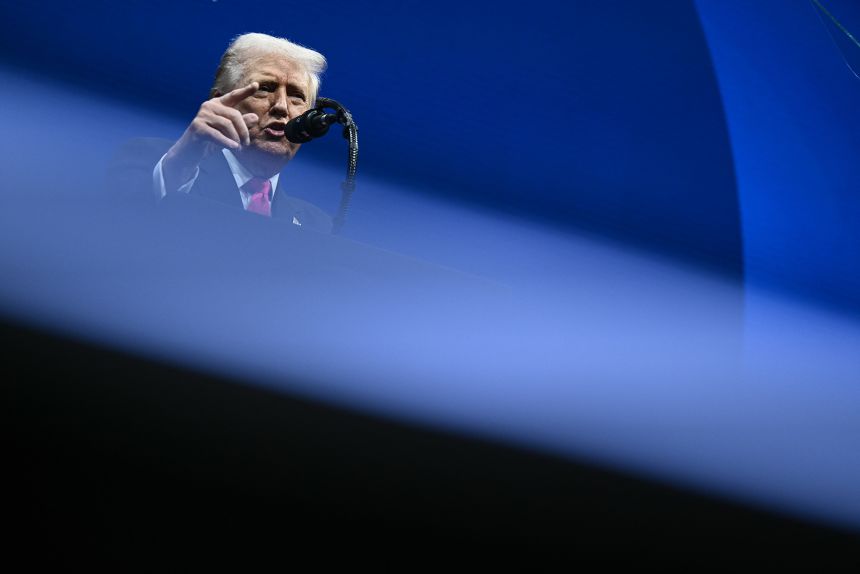
This executive order is just President Trump’s latest effort to accelerate U.S. AI development. Just last week, President Trump spoke at the Saudi-U.S. Investment Forum in Washington, where a series of partnerships between American tech companies and Humane AI, a tech company backed by Saudi Arabia’s sovereign wealth fund, were announced.
The White House also introduced an unusual arrangement involving deals between the government and private companies as part of President Trump’s push for American AI dominance. In August, the U.S. government acquired a 10% stake in chipmaker Intel and entered into an agreement with AMD and Nvidia to receive 15% of chip sales to China in exchange for export licenses.
At the heart of President Trump’s AI blitzkrieg is a desire to stay ahead of China in the AI race. Trade tensions are brewing between the two economic powers. Chinese tech startup DeepSeek shook the U.S. market in January with the introduction of its R1 model, raising concerns that China was further ahead in AI than previously expected.
Mr. Trump and some tech giants, including OpenAI, argue that state-level regulations can slow innovation. After previous efforts to block state-level AI regulation were defeated in Congress, President Trump recently drafted another executive order aimed at blocking such regulation.
But the loosening of regulations has raised safety concerns from lawmakers and online safety advocates following a series of reports this year showing that AI can cause self-harm and psychological distress.