

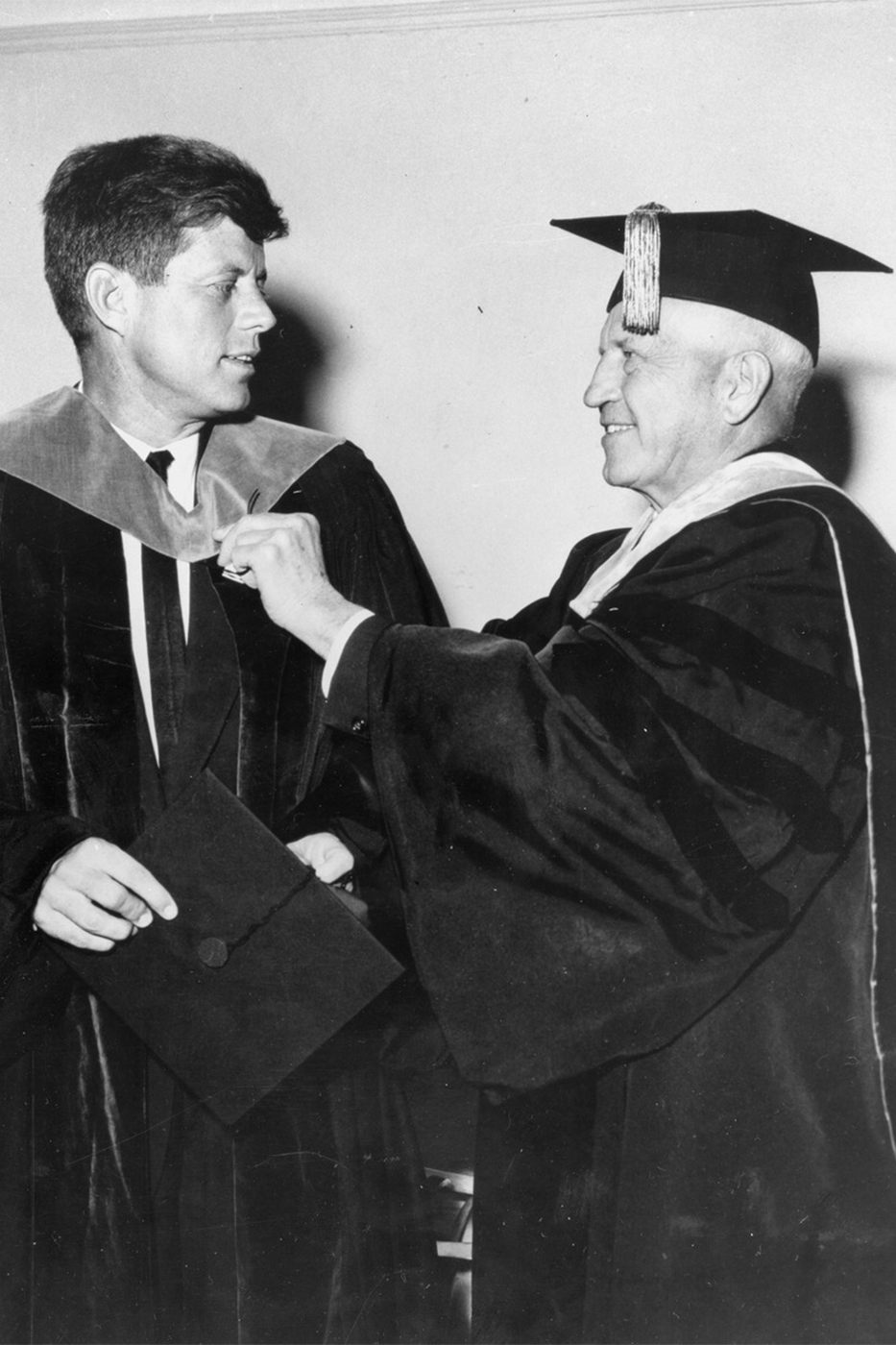
On June 17, 1956, then-U.S. Sen. and future President John F. Kennedy spoke at Northeastern University’s commencement ceremony, proclaiming the atomic age and the transformation of new industries and processes.
“We stand on the threshold of the atomic age,” Kennedy told the Class of 1956 at the Boston Garden. It will be a time of truly fundamental changes, from the expansion of nuclear energy to the acceleration of the space race to the rise of automation that powered postwar economic growth.
Seventy years later, the age of artificial intelligence is upon us. The world is once again in the midst of major technological change, as AI begins to transform the way people work, learn, create, and solve problems.
“You’re going to shape the future of this society, and you’re going to shape AI,” Northeastern University President Joseph E. Aoun told new students at the beginning of the 2026 academic year, calling the class members of the “first generation of AI.”
Kennedy became one of a long line of historic commencement speakers to take to the stage on graduation day to deliver a farewell message to the next generation. Kennedy defeated then-Vice President Richard Nixon in the 1960 presidential election and would soon become the 35th President of the United States.
Kennedy’s “It’s Your America Now” speech in the Northeast preceded events such as the Cold War arms race, which would culminate in the Cuban Missile Crisis by the early 1960s. Expansion of nuclear power generation through civil energy programs and weapons development. The following year, the Soviet Union launched the world’s first artificial satellite, Sputnik 1, officially marking the beginning of a new technological and scientific horizon.
With so many global challenges at hand, modern readers of Kennedy’s commencement address may find his advice to the class of 1956 counterintuitive. Kennedy urged them to “stay home,” put down roots in Massachusetts, and direct their talents to reviving local industry. Doing so, Kennedy said, was also meant to combat concerns that New England’s economy would decline as manufacturing and industry moved south and west.
“He’s starting to put together language that will inspire a generation to join the Peace Corps, join the civil rights movement, join the space program,” said Ted Miller, a history professor at Northeastern University. “But instead of reaching for the stars, he’s telling people to stay home and get Massachusetts moving again.”
While perhaps appropriate on this day, this sentiment does not fit with the university’s global focus and subsequent global campus expansion. Now, Aoun frequently tells graduates to “make the world their classroom.”
Today, the Northeast has been fundamentally transformed into a global center of innovation, research, and real-world problem-solving. With 13 campuses around the world, we have co-op students in more than 100 countries as part of our global network.
Until the mid-20th century, it was still unclear “what atoms could do,” Miller said, and today, too, there is a mix of excitement and anxiety about what artificial intelligence and emerging technologies will ultimately mean for society and the future.
The unrest comes against a backdrop of new geopolitical tensions and active conflicts, from deep ground warfare in Europe and the rise of China to a cycle of conflicts and proxy skirmishes unfolding across the Middle East involving Israel, Iran, Lebanon, and the United States. It is an echo of the great power competition between the United States and the Soviet Union during the Kennedy era.
But there is optimism, reminiscent of bygone eras of accelerating technological progress, such as the National Aeronautics and Space Administration’s recent successful return of a manned space capsule to the moon. Expanding public-private cooperation in space. and plans to establish a continued human presence on the moon and eventually send astronauts to Mars.
Miller said the challenge of pioneering these frontiers and the opportunities for scientific and technological breakthroughs they create will help define the role of higher education institutions such as Northeastern University.
In a recent interview with Northeastern Global News, Aoun said the university’s growth is part of efforts to chart a path forward in a higher education landscape beset by challenges, from declining enrollment and changing workforce demands to the disruptive effects of artificial intelligence.
Aoun said the global network will provide students and faculty with access to a variety of international campuses, co-op placements and research partnerships, allowing for “increased mobility for undergraduates, lifelong learning opportunities in collaboration with industry, and unparalleled opportunities for faculty to globalize their teaching and research.”
Miller said there are clear signs that Kennedy knew exactly what kind of audience of Northeastern alumni he was speaking to. If there’s one thing that stands out about Tohoku’s graduation speeches, it’s the recognition that graduates can easily translate their education into real-world impact.
“I think most Northeastern graduates know what they’re going to do,” said Kennedy, who was awarded an honorary Doctor of Laws degree at the ceremony. “And when I look at the career accomplishments of past Northeastern graduates and meet them in Washington, Boston, and across the state, I feel doubly proud to even be an honorary member of that distinguished group.”


