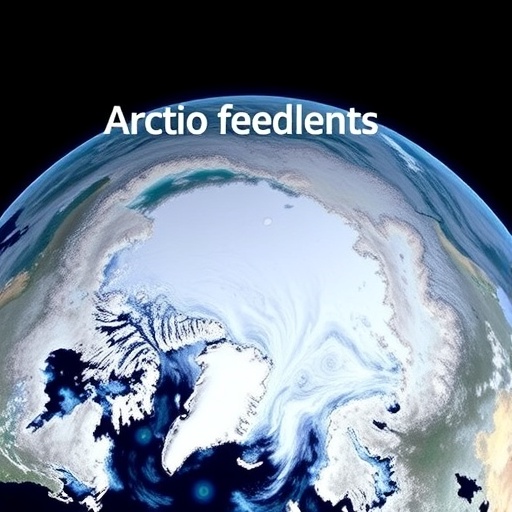
As the Arctic continues to warm at an unprecedented rate, understanding the delicate feedback mechanisms governing its climate system has become critical. Among these mechanisms, surface albedo feedback stands out as a particularly powerful force influencing regional and global climate. Recently, groundbreaking research led by Yu, Leng, Yao and colleagues used advanced machine learning techniques to further our understanding of this feedback across the Arctic landmass. Their study, published this year in Nature Communications, leverages new constraints to reduce uncertainty and shed new light on how changes in surface reflectance affect the trajectory of Arctic warming.
Surface albedo refers to the proportion of incoming solar radiation that is reflected back into space from the Earth’s surface. In the Arctic, snow and ice have very high albedo and reflect most of the sunlight, but exposed land and open water absorb more heat. As global warming melts snow and ice, more and more of the dark surface is exposed, absorbing more solar energy and intensifying local warming. This is a classic positive feedback loop. Despite decades of research, accurately quantifying how strong this albedo feedback is over the terrestrial Arctic region remains difficult due to the complex interaction of snow dynamics, vegetation changes, soil moisture, and atmospheric conditions.
Yu et al.’s innovative approach includes what climate scientists call “emergency constraints.” This technique exploits patterns in observational data and Earth system model outputs and combines them with rigorous statistical learning algorithms to identify robust relationships that can narrow the uncertainty in climate sensitivity estimates. By training a machine learning model on multiple climate simulations and an extensive observational dataset, researchers uncovered previously unrecognized relationships within the climate system that set more precise boundaries on the magnitude of surface albedo feedbacks.
Their method begins by analyzing a set of outputs from coupled climate models that participate in the latest generation of climate projections. These simulations include the future evolution of Arctic snow cover, soil conditions, and vegetation under different greenhouse gas scenarios. In addition to this, observation records from satellite remote sensing equipment and measurements on the ground will also serve as real-world benchmarks. The machine learning framework then identifies statistical features that link current observations to future feedback strengths, effectively using the current climate as a “fingerprint” to predict impacts on warming dynamics.
One notable outcome of this study is the identification of important biophysical variables that serve as proxies for albedo changes. For example, seasonal snowfall changes were shown to strongly predict feedback strength. Similarly, patterns in vegetation phenology, such as the timing and extent of shrub expansion across the tundra, also contribute further predictive power. By integrating these diverse datasets, the machine learning model provides a constrained estimate of albedo feedback that is significantly narrower than previous evaluations that rely solely on the raw model output.
This refined feedback estimation has important implications for future projections of Arctic climate. This suggests that surface albedo feedbacks over land may be stronger than shown in many previous studies, and local warming rates may accelerate beyond current expectations. Enhanced feedback strength means that increased Arctic temperatures may cascade more aggressively through terrestrial ecosystems, affecting local hydrology in ways that amplify permafrost thaw, carbon release, and global climate change.
This research not only makes predictions more accurate, but also provides practical guidance to improve climate models. By pinpointing which biophysical processes and observable metrics exert significant control over albedo sensitivity, this study reveals how model parameterizations can be better tuned. This feedback between data-driven constraints and model development is important to reduce systematic biases and increase confidence in future climate projections.
Moreover, the methodology pioneered by Yu et al. represents a powerful paradigm shift in climate science. Machine learning, when combined with physically grounded emergent constraints, forms a versatile toolkit that can elucidate nonlinear and multifaceted phenomena where simpler statistical or deterministic approaches cannot. This study thus demonstrates how modern artificial intelligence techniques can accelerate breakthroughs in understanding Earth’s complex climate interactions.
The paper also emphasizes the importance of continued and expanded observation efforts in the Arctic. Satellite missions that monitor snow cover, vegetation, and soil moisture with higher resolution and longer time spans will be invaluable in adjusting for urgent constraints. Ground-based field campaigns to characterize ecosystem responses and surface properties provide essential validation data. Together, these observational pillars power data-intensive machine learning algorithms that are essential to providing actionable climate insights.
In a broader perspective, the enhanced surface albedo feedbacks documented in this study highlight an urgent challenge for climate mitigation and adaptation efforts. The Arctic is a region at the forefront of the effects of global warming spreading throughout the world. Quantifying feedback more accurately will improve policymakers’ ability to assess tipping points and set more effective emissions reduction targets. It will also provide information to indigenous peoples and communities whose livelihoods are vulnerable to the effects of rapid environmental change across the northern landscape.
In conclusion, the integration of state-of-the-art machine learning and emergent constraint frameworks represents a tremendous advance in climate research, as vividly demonstrated by Yu et al.’s elucidation of the Arctic surface albedo feedback. Their findings not only provide a clearer window into the mechanisms of Arctic warming, but also establish a template for future research aimed at reducing uncertainties in other important climate feedbacks. As our planet faces increasing climate risks, interdisciplinary innovations like this are essential to providing the precise knowledge needed to put humanity on a more sustainable trajectory.
Yu et al.’s work is a stark reminder that complex environmental problems require equally sophisticated scientific tools. By leveraging a large observation network and the power of artificial intelligence, this study achieved a level of accuracy and reliability previously unattainable. This breakthrough sets a new benchmark for how new constraints and machine learning can work together to uncover the paths of Earth’s climate change, offering hope that science can keep up with the planet’s changes.
The techniques refined here can also be applied to other high-impact climate feedbacks, such as cloud dynamics, changes in ocean circulation, and tropical forest responses, so their impact extends far beyond the Arctic. As these machine learning frameworks mature and incorporate richer datasets, they promise to transform the fidelity of climate predictions around the world. This heralds a new era in which uncertainty is systematically eliminated through intelligent algorithms based on physical insights.
Finally, the study by Yu et al. This reaffirms the role of the Arctic as a critical climate nexus and shows extraordinary promise that emergent constraints based on machine learning can improve our understanding of important climate feedbacks. This pioneering research not only advances scientific knowledge but also provides society with more reliable tools to predict and respond to the accelerating changes unfolding in the coldest regions of the planet.
Research theme: Emergency constraints of machine learning on surface albedo feedback in the Arctic land region.
Article title: Emergency constraints of machine learning on surface albedo feedback in the Arctic land region.
Article references:
Yu, L., Leng, G., Yao, L. et al. Machine learning emergent constraints on surface albedo feedbacks in the Arctic land region. Nat Commune (2026). https://doi.org/10.1038/s41467-026-71779-0
image credits:AI generation
Tags: Advanced climate prediction techniques Arctic land albedo feedback New constraints in climate modeling Machine learning in climate scienceNature Communications Arctic researchPositive feedback loops in Arctic warmingSnow and ice melting feedback loopsInfluence of soil moisture on surface albedoSurface reflectance and Arctic warming in polar regionsArctic climate mechanisms around the globeInfluence of vegetation on Arctic albedo