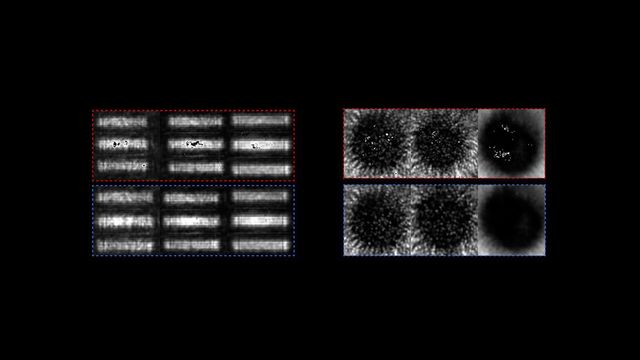
A research team led by UCLA and the University of Rochester has demonstrated a promising evolution in an imaging system designed to capture details within “complex media” that scatter light, from depicting structures inside body tissues to viewing obstacles through dense fog. The system uses physically-based machine learning to improve existing imaging techniques.
In tests using standard calibration images obscured by complex media, the new system more than doubled the signal-to-noise ratio compared to previous generation technology. The system also produced images in near real time (1/1000th of a second).
background
Currently, traditional applications for seeing inside complex media rely on expensive cameras that detect just beyond the limits of visible light, into the near-infrared.
In contrast, the researchers’ improved basic method uses relatively inexpensive silicon-based cameras, such as those found in smartphones. The technology, introduced a decade ago by study co-authors at the University of Rochester, relies on a special film that allows some photons to pass through and blocks others, converting scattered light from the near-infrared to the visible.
However, this method tends to produce vignetting effect shadows that darken the edges of the image and narrow the field of view. Images may also contain artifacts as light or dark spots.
method
The researchers integrated existing imaging techniques with a machine learning framework called DeepTimeGate. This involves two stages, starting with an algorithm trained to mathematically reconstruct the image. An important addition is a second algorithm developed at UCLA. This algorithm quickly performs a reality check and limits the results based on fundamental rules of physics.
impact
Near real-time sensing inside complex media using silicon-based cameras will be a boon for biomedical imaging. DeepTimeGate could lead to cheaper and more effective image processing to guide surgery, including endoscopic surgery. Laboratories testing for dangerous microorganisms or abnormal cells in cloudy liquids such as blood could use such technology to analyze samples without diluting or filtering them.
Another potential application is for cameras in self-driving cars to detect their surroundings through spaces covered in rain, fog, dust, or sand. In industry, imaging systems may one day be useful for quality control in manufacturing and waste removal plants that involve cloudy liquids or matte packaging.
reference: Zhang H, Xu Y, Zhang W et al. Hybrid deep reconstruction for vignetting-free upconversion imaging due to scattering in epsilon near-zero materials. light science application. 2026;15(1):327. doi: 10.1038/s41377-026-02375-6
This article has been reprinted from the following material: Note: Materials may be edited for length and content. Please contact the citation source for details. You can access our press release publishing policy here.