Agriculture accounts for 11% of Southeast Asia's GDP and provides a third of jobs, and AI has the potential to revolutionize agritech and increase climate resilience and food security, among other challenges that require investment and government support.
Agriculture is a pillar of Southeast Asia's economies, accounting for around 11% of ASEAN's GDP and roughly one-third of total employment in the region in 2022. The importance of the agriculture sector is particularly large in agriculture-based countries such as Myanmar and Cambodia, where it accounts for more than 20% of GDP and roughly 35% of total employment. In Laos, the figures are even more striking, with agriculture-related jobs accounting for 70% of total employment.
Agriculture plays a key role in ensuring ASEAN's economic stability and at the same time is central to the region's food security. With Southeast Asia's population expected to grow by more than 780 million people by 2050, the region's food supply chains will come under significant pressure, especially as the impacts of climate change loom.
Source: United Nations Department of Economic and Social Affairs, Population Division
Compared to other regions of the world, Southeast Asia is particularly vulnerable to the adverse effects of climate change, with a surge in extreme weather events causing heavy losses in the agricultural sector. According to a 2021 study by the Asian Development Bank, climate-related disasters caused crop and livestock production losses of US$21 billion in Southeast Asia between 2008 and 2018. Rising temperatures are also affecting yields, with production of cereals such as rice, wheat and other staples projected to decline by 7% to 9% by 2050.
Not addressing food insecurity could limit Southeast Asia's long-term economic potential, but new solutions are emerging to tackle these challenges.
The Transformative Impact of AI
For example, artificial intelligence (AI) has recently emerged as a powerful tool that could contribute as much as $1 trillion to local economies by 2030, even though the technology is still in its infancy. Able to quickly process large amounts of data and introduce automation into routine processes, AI has the potential to play a transformative role in agriculture and agritech, enhancing local climate resilience and food security.
There are already many examples of how AI is revolutionizing various aspects of the agricultural sector, including farming and livestock management. In Indonesia, for example, the AI-powered application “Dokter Tania” helps farmers identify and manage plant diseases, and also provides expert advice on crop cultivation and fertilizer use. A similar AI app has been developed in Vietnam to help local smallholder farmers identify and address pest and disease issues that are devastating their dragon fruit crops, which account for 32% of the country's agricultural exports.
AI is also improving the efficiency and productivity of livestock management through data-driven insights. Indonesian startup Pitik is using AI to provide broiler farms with suggestions on improving feed efficiency, monitoring animal health, and streamlining overall farm management.
Similar capabilities can be extended to crop monitoring and disease prediction using AI-enabled drones for aerial reconnaissance. These drones can not only identify pest-infested areas but also spray pesticides more efficiently, minimizing crop damage and saving 99% on pesticide usage.
AI is also being used in other parts of the food supply chain, such as quality grading and food waste management. Easyrice, a Thai deep tech startup, is using an AI-based solution to inspect the quality of 25 varieties of locally grown rice. The tool is reportedly 10 times faster than traditional methods and has helped reduce the cost and time of rice inspection by 30%, with an accuracy rate of 95%.
Southeast Asia: A hotbed of AI-driven agritech innovation
While the positive impacts that AI can have on ASEAN's agriculture sector are manifold, challenges remain: low digital literacy among farmers, small land holdings, and limited access to capital are major obstacles to AI adoption.
To this end, ASEAN governments have launched national strategies to encourage the adoption of AI in various sectors, including agriculture. Indonesia's Stratnas AI Plan, for example, prioritizes food security as a focus area for technology development. In Vietnam, the Ministry of Agriculture and Rural Development aims to enable the use of AI applications in high-tech agricultural production and standardize the use and sharing of open agricultural datasets necessary to ensure a transparent and clean food supply system.
These efforts are just a few of the ways ASEAN is exploring AI's potential to enhance regional food security to support future economic development, but they are shining examples of the region's long-term commitment to incorporating cutting-edge technology into economic policy.
To realize the full potential of AI in agritech, we need more investment in promising agritech startups and funding to support adoption by smallholder farmers through grants and innovative financing mechanisms.
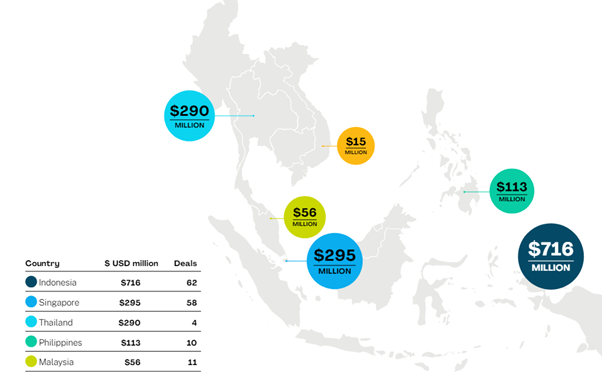
Agritech startups are the bedrock for new innovations that can directly address the unique needs of ASEAN's agriculture sector. Investment in agrifoodtech startups in Southeast Asia reached US$1.7 billion across 192 deals in 2022. This is a significant achievement, but much more investment is needed to drive new solutions into this large and complex sector.
Figure: Agrifoodtech startup investment in Southeast Asia in 2022
Source: Asia Pacific AgriFoodTech Investment Report 2023
At the same time, smallholder farmers need financial support to take advantage of these costly innovations, especially in countries like Laos and Cambodia, where there are large numbers of unbanked or underbanked communities. In these markets, a six-year study by National University (supported by the Australian government) is investigating the potential impact of mobile financial services to support farmers' financial needs.
Venture capital (VC) could be the right solution for innovative agritech startups, especially those specializing in niche technology areas. One example is AgFunder, a global venture capital firm that provides essential capital to innovative agrifoodtech startups developing sustainable, efficient and safe food production technologies.
Recognizing the funding needs of startups, ASEAN is also increasingly opening up its capital markets as a potential venue for fundraising within the region. For example, the Securities and Exchange Commission of Thailand (SEC) has launched LiVE Exchange (LiVEx), a secondary market where startups can raise capital through private placements and crowdfunding. Malaysia is also considering a similar initiative.
As the climate crisis progresses, AI in agritech will become increasingly important. That's why it's crucial to come up with new solutions that help communities adapt to changing weather patterns, maintain crop productivity levels, and strengthen overall food security. Adequate funding is essential for this, but fully realizing this potential will require concerted efforts to address digital literacy, build partnerships, and establish supportive policy frameworks. With strategic investments and supportive government policies, ASEAN can position itself as a global leader in agritech innovation, ensuring food security and sustainable growth in the region for years to come.
Samantha Che is an editor and writer with over 7 years of experience. She specializes in researching and writing on technology, digitalization, sustainability, energy transition and supply chain resistance. With experience covering the Southeast Asian technology scene, she has contributed extensively to media outlets such as South China Morning Post (SCMP), New Naratif, VICE Indonesia and Salam Gateway (Reuters). From 2021 onwards, she will be working with Stonebench on thought leadership content with leading brands in the Asia Pacific region.
sauce ASEAN Agritech: Key Beneficiaries of the AI Revolution