

Alphabet stock is hovering around a key technology support zone ahead of second-quarter results, with investors watching to see whether Google Cloud’s accelerated growth can justify the company’s rapidly increasing AI infrastructure investments and support further gains in the stock price.
GOOG stock entered one of the most important earnings reports in recent quarters as Wall Street looks for new evidence that Alphabet’s aggressive investments in artificial intelligence are starting to translate into strong cloud growth and expanded profitability.
Alphabet’s earnings could set the tone for AI trade
Alphabet will be the first of the major hyperscalers to report earnings this season, making its results particularly important for the broader technology sector.
Investors have come to view Google’s numbers as an early indicator of demand for enterprise AI, spending on cloud infrastructure, and the pace of capital spending across the semiconductor ecosystem.
The earnings release comes at a time when enthusiasm around artificial intelligence remains strong, but it’s becoming more selective.
While semiconductor companies continue to outperform, investors are becoming increasingly wary of companies funding AI development.
The central question is no longer whether there is a demand for AI.
Rather, investors are looking for evidence that hundreds of billions of dollars in infrastructure investments are generating sustainable revenue growth and improving returns.
This puts Alphabet’s earnings front and center this reporting season.
Wall Street expects another strong quarter from Google
Consensus estimates project Alphabet’s second-quarter revenue to be about $116.9 billion to $117 billion, representing more than 20% year-over-year growth.
Adjusted earnings per share are expected to be approximately $2.95, and sales excluding traffic acquisition costs are expected to be approximately $101.5 billion.
Google Cloud is once again expected to be the company’s fastest growing business.
Analysts expect cloud revenue to reach about $22.4 billion, representing more than 60% year-over-year growth.
This achievement will strengthen Google’s position as one of the fastest growing hyperscale cloud providers.
But investors are likely to be looking at more than just the headline numbers.
Management’s outlook on cloud margins, remaining performance obligations, enterprise AI adoption, and future investment plans could ultimately have a bigger impact on stock prices than quarterly profits alone.
AI capital investment remains the biggest debate
Alphabet’s massive AI spending program continues to divide investor opinion.
The company previously raised its 2026 capital spending outlook to $180 billion to $190 billion and signaled that spending could rise further in 2027 as it continues to expand its AI data centers and computing capacity.
Some analysts now believe Alphabet could raise its capital spending outlook again toward $190 billion to $200 billion as demand for AI infrastructure accelerates.
This will be another positive signal for semiconductor companies.
Companies that supply GPUs, networking equipment, servers, advanced memory, and AI infrastructure rely heavily on continued spending from hyperscalers like Alphabet.
But investors are increasingly looking at the other side of the equation.
Large AI investments are already straining free cash flow, and shareholders are starting to question when these spending commitments will translate into stronger profit growth.
Any sign that Alphabet intends to rein in spending could trigger a broader rerating of semiconductor and AI infrastructure stocks overall.
Conversely, further increases in capex guidance could reinforce expectations that enterprise AI demand will remain very strong.
Google Cloud and Gemini are in the spotlight
Cloud remains Alphabet’s most important growth driver outside of its core advertising business.
Last quarter, Google Cloud continued to achieve rapid revenue growth and expanded operating margins, demonstrating that scale is driving profitability.
Investors now want to know whether that trend continued into the second quarter.
Strong cloud margins will help justify Alphabet’s AI investments and strengthen the view that enterprise customers will continue to adopt Google’s AI services at an accelerated pace.
At the same time, Gemini continues to receive attention.
Recent reports of Gemini 3.5 Pro model delays and the departure of several leading AI researchers have raised questions about Alphabet’s competitive position vis-à-vis OpenAI, Anthropic, and other leading AI developers.
Alphabet pushed back against reports suggesting significant development delays, saying it continues to test upgraded models while expanding its consumer and enterprise product rollout.
Nevertheless, investors will likely expect management commentary regarding Gemini’s commercialization, corporate adoption, and future product releases.
Even if cloud growth remains strong, any signs that Alphabet is falling behind in developing its underlying model could weigh on sentiment.
Advertising still provides economic stability
Despite the increased attention surrounding artificial intelligence, Alphabet’s advertising business remains the company’s financial foundation.
Search ads continue to generate significant cash flow, and YouTube ads and AI-powered marketing tools offer further growth opportunities.
Recent efforts to integrate Gemini into search, conversational ads, and new commerce features aim to improve advertising efficiency while maintaining Google’s dominant position in digital advertising.
Strong advertising performance should provide further confidence that Alphabet can continue to fund its aggressive AI investments without significantly weakening its broader financial position.
GOOG Technical Analysis: $345 support will be the main battleground
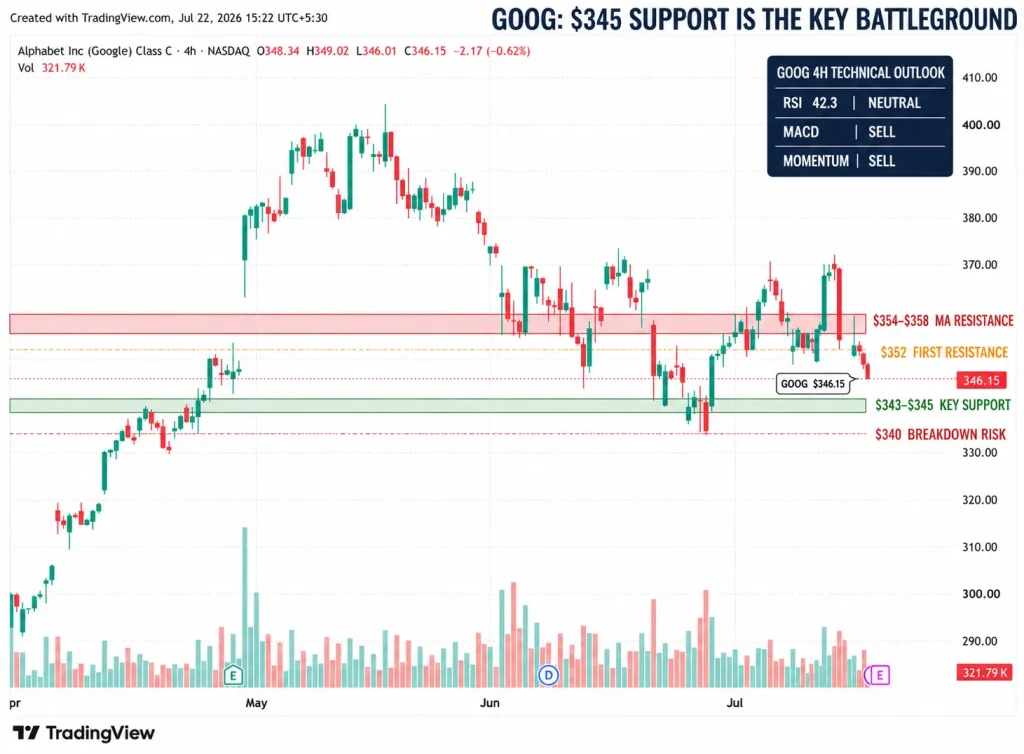
GOOG’s near-term technicals remain cautious ahead of earnings, with the stock trading below nearly every major moving average on the 4-hour chart.
Initial resistance lies at $352, and stronger selling pressure is likely between $354 and $358, where the 20, 30, 50, 100 EMA, VWMA, and Ichimoku reference line are concentrated.
Momentum also favors the bears. MACD and momentum still maintain sell signals, but the RSI of 42.3 indicates momentum is weakening without reaching oversold territory.
The main support is the $343-$345 zone where the 200 EMA and 200 SMA converge. Holding this area could support an earnings recovery, while a break below this area could expose the psychological $340 level.
For conditions to improve, the bulls need to recover $352-$358 and push the resistance zone back to support.
What to expect from GOOG stock after Alphabet earnings
Alphabet’s profits have far exceeded its quarterly sales and earnings per share.
Investors have come to view the company as one of the clearest indicators of the sustainability of the massive infrastructure investment cycle driving enterprise AI demand and technology markets.
Google Cloud’s strong growth, margin expansion, and continued adoption of enterprise AI should strengthen Alphabet’s confidence that its spending strategy is producing tangible benefits.
Similarly, steady growth in advertising will continue to provide the financial flexibility needed to fund long-term AI expansion.
But investors will also be watching for signs that rising capital spending is starting to weigh on profitability, free cash flow and future earnings.
Commentary on Gemini’s product roadmap, cloud profitability, and AI investment plans may ultimately prove more important than the key revenue numbers themselves.
For now, Alphabet remains one of the most powerful long-term AI platforms on the market, but expectations are also very high.
With GOOG sitting just above key support around $345, this earnings report could determine whether buyers regain control or whether investors become increasingly cautious about the next stage of the AI investment cycle.


