
January 29, 2026
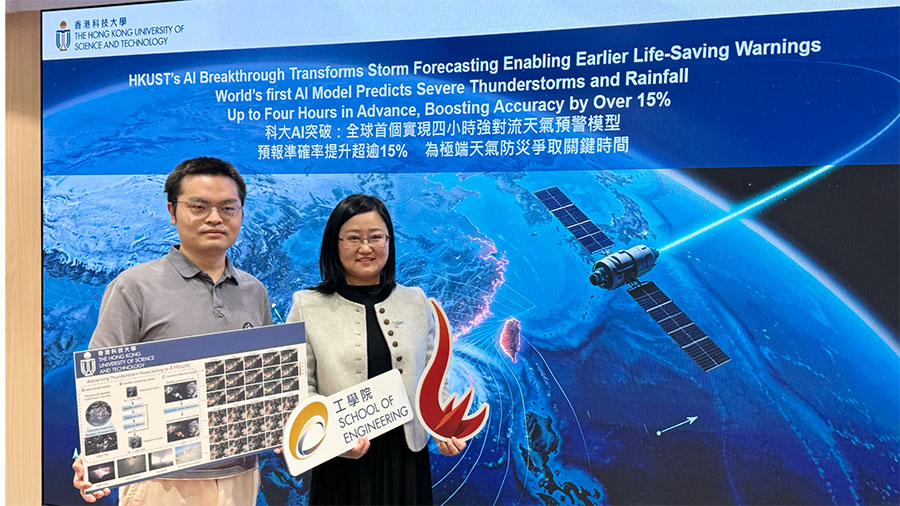
Hong Kong – A locally developed artificial intelligence-powered storm forecasting system is being tested by the national and Hong Kong meteorological authorities, which can improve forecasts of thunderstorms and sudden rain up to four hours in advance, up from the current two hours.
The system, developed by a research team at the Hong Kong University of Science and Technology (HKUST), can increase accuracy by more than 15 percent at a spatial scale of 48 kilometers.
In a media briefing on Wednesday, the research team said the breakthrough would strengthen the country’s forecast accuracy, transform early warning systems for vulnerable communities across Asia, and give emergency services and the public more time to prepare for the dangers of extreme weather.
The China Meteorological Administration and the Hong Kong Observatory are testing the warning system, the research team said.
A key feature of the new AI computational framework, the Satellite Data Deep Diffusion Model, is that its training is based on data collected by China’s Fengyun 4A satellite between 2018 and 2021 and incorporates expertise in the meteorological field. Using satellite sequence data, we can accurately capture the evolution of convective cloud structure and observe surface changes hours or days in advance, much earlier than using data from radar or automated weather stations. This makes it particularly valuable for predicting extreme weather events in areas with limited radar or automated weather stations.
Research on this predictive model was published in December 2025 in the Proceedings of the National Academy of Sciences.
Also read: Cross-border data sharing benefits 300,000 patients in Hong Kong
Dai Kuai, lead author of the paper, explained that traditional weather prediction models mainly rely on ground-based radar, but radar signals are sensitive to terrain and precipitation composition, and often detect changes only after convective clouds have already formed. By leveraging satellite data that monitors cloud evolution from space, new AI models can detect earlier signs of convective development, enabling more timely warnings.
Dai added that the new model, with faster and more accurate predictions, will help strengthen regional disaster preparedness and response. He highlighted the increasing frequency of extreme weather events in Asia, citing four black storm warnings with heavy rainfall exceeding 70 millimeters per hour issued in Hong Kong over an eight-day period last summer.
Su Hui, head of climate change and extreme weather direction at the National Key Research Institute for Climate Resilience of Coastal Cities, said the model is currently being tested by the China Meteorological Administration and the Hong Kong Observatory, which are also providing satellite data for the study. The observatory and the HKUST team plan to combine this with traditional radar-based forecasts to improve regional accuracy and provide a more complete weather forecast.
Meanwhile, HKUST startups are commercializing the technology through custom solutions for enterprise customers. Organizations and companies from around the world have already expressed interest in cooperation, including insurance companies, power plants, and a Vietnamese ride-hailing company.


