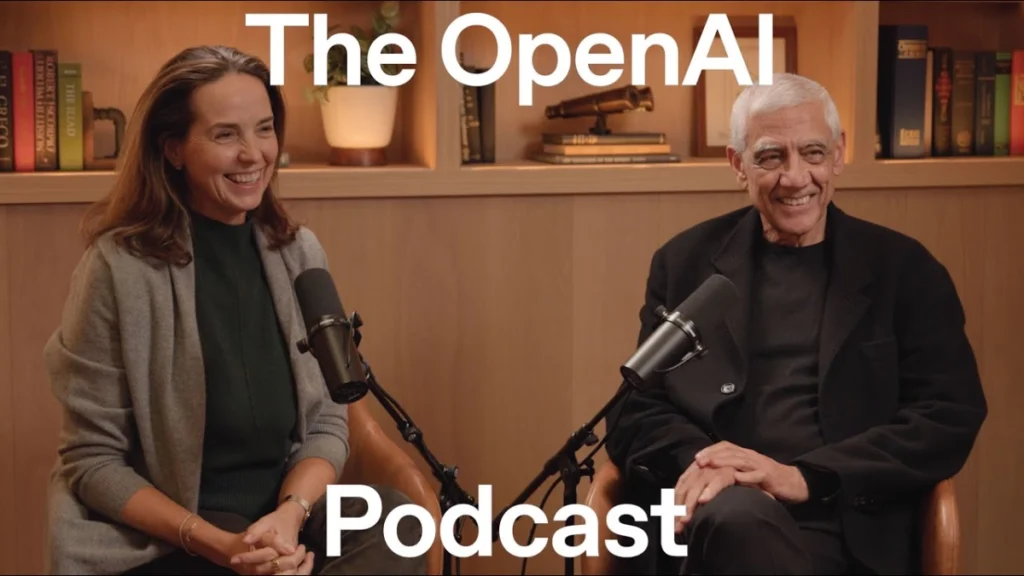
“Today’s demand is limited by nothing other than the availability of computing.” This scathing assessment by legendary venture capitalist Vinod Khosla cuts directly to the core challenge facing the artificial intelligence industry, one that is also a huge opportunity. Khosla, founder of Khosla Ventures and an early investor in OpenAI, discussed the current state of the AI ecosystem with OpenAI Chief Financial Officer Sarah Friar on the OpenAI Podcast, arguing that the current stage is less a speculative bubble and more an infrastructure revolution limited only by the physical resources needed to sustain its explosive growth.
Khosla and Friar’s conversation provided a rare high-level perspective on the technological and financial dynamics driving the current AI boom. Their central consensus was that the industry has definitively moved capacity issues behind it and now faces two constraints. It’s about scaling the massive computational infrastructure needed to meet demand, and helping consumers and businesses learn how to make the most of the intelligent tools they currently have.
Discussion quickly focused on the staggering scale of investment required for truly frontier AI development. Friar provided hard numbers showing that OpenAI’s infrastructure needs are growing rapidly, noting that the company’s compute consumption is growing rapidly along with its revenue. She explained that this growth is not just linear. The momentum is accelerating to keep up with insatiable market demand. “We ended 2023 with ARR of 2 billion…Last year, ARR was just over 20 billion,” she said, correlating this revenue growth with a corresponding significant increase in computing, moving from megawatts to gigawatts of required capacity. This level of investment signals a fundamental change. AI is not just a functional layer, it is a new utility, similar to electricity, requiring an underlying infrastructure that must be provisioned years in advance.
This commitment to expanding computing capacity is essential as the capabilities that are unlocked are moving from simple question-and-answer interactions to complex multi-step operations performed by intelligent software agents. Khosla emphasized that the true impact of AI will not come when models become slightly smarter, but when these agents are mature enough to perform complete and complex tasks autonomously. He predicts that 2026 will be a key year for this change, especially in multi-agent systems that can manage entire enterprise functions. He envisions a world where AI agents handle complex workflows. “It’s like running an ERP system…every day you reconcile everything, you calculate accruals every day, you track contracts every day.”This evolution moves the value proposition from simple automation to deep operational transformation.
The current challenge lies in bridging the gap between the incredible capabilities of current models and the actual usage patterns of the masses. Khosla points out that only a “single-digit percentage” of users are currently taking advantage of 30% or even 50% of AI’s capabilities, suggesting that there is a huge amount of latent demand waiting to be unlocked as usability improves and agents become truly task-oriented. Friar highlighted the flaws in this implementation compared to the early mobile revolution, which initially only replicated desktop websites before users took advantage of native features such as GPS and cameras. AI is currently in the “desktop website” stage of mobile adoption. The power is there, but users are still learning what they can do with AI.
Nowhere is this transformation more important than in a highly regulated, high-stakes industry like healthcare. Frier cites remarkable internal data showing that “230 million people ask ChatGPT health questions every week,” and criticizes that “66% of U.S. physicians say they use ChatGPT in their daily practice.” This suggests that AI is already serving as a powerful cognitive augmentation for both patients and healthcare professionals. Khosla emphasized this, saying that AI will “revolutionize health by turning expertise into a commodity.” He acknowledged that regulatory hurdles such as FDA and AMA institutional controls are slowing the process. For example, while AI cannot legally prescribe prescriptions yet, the underlying cost of medical intelligence has fallen year-on-year for the first time, a trend that cannot be ignored.
This real, measurable usefulness is why Khosla dismisses the frequent comparisons between the current AI boom and the dot-com bubble. He argues that observers are confusing stock prices with underlying technology adoption. “Bubbles should be measured by the number of API calls,” Khosla argued, distinguishing between market excitement caused by “investor fear and greed” and the actual exponential growth in actual usage. The potential computing power and productivity gains for companies that successfully deploy AI agents (for example, one that manages $150 million in annual recurring revenue with just one human controller overseeing an AI-driven ERP system) are the tangible realities that underpin current valuations.
The eventual consensus was that AI will revolutionize the way value is created, driving productivity gains by automating menial tasks and freeing up human capital for growth-oriented tasks. For companies, this means moving talent from mundane tasks like reading contracts with non-standard terms to high-value areas like business strategy. For startups, success lies not in building a foundation that is currently dominated by giants like OpenAI, but in building specialized, sophisticated applications on top of the foundation model to solve serious vertical problems in a way that aligns with the core mission of democratizing intelligence. The future of AI is not a fragile bubble waiting to burst, but an infrastructure that requires sustained and significant investment, driven by the unprecedented utility it brings across all sectors of the global economy.