

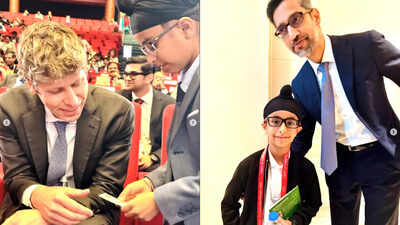
India AI Impact Summit 2026 was packed with CEOs, leaders and senior policy makers from technology companies from around the world, but one speaker stood out. That person is Ranvir Sahadeva, an eight-year-old programmer who calls himself a technologist. He became the youngest person to address the ongoing summit at the Bharat Mandapam in New Delhi. Ranvir took to the stage to discuss how ancient Indian philosophy connects with modern artificial intelligence (AI).“I am here as the youngest keynote speaker at the India AI Impact Summit. I am talking about how we are connecting ancient Indian philosophy with modern technology. I am also highlighting the different approaches that other countries are taking in building AI,” Ranvir Sachdeva told news agency ANI.“I’m talking about how India is building AI. I’m sharing my own use case of the just-released Indian AI model and how I’m using it to contribute to India’s GDP and increase AI literacy,” he added.
Ranvir Sahadeva: Inspiring tech giants
Ranvir’s talent brought him face to face with some of the biggest names in the industry. He met with Google CEO Sundar Pichai and OpenAI’s Sam Altman at the summit, and shared a photo on his Instagram. Sachdeva also met with Salesforce CEO Marc Benioff and International Telecommunication Union (ITU) Secretary-General Doreen Bogdan-Martin at the AI for Good Global Summit in Geneva last year. In 2024, he met with UN Secretary-General Antonio Guterres.
Perhaps his most famous encounter was with Apple CEO Tim Cook in 2023. Cook visited New Delhi in 2023 to open the Delhi store. Ranvir showed off his coding skills in a one-on-one session. He was 5 years old at the time and started coding at 3 years old. He and his parents lined up outside the store waiting for it to open. Won a gold medal as a “Super Presenter” at the 2022 Global Reading Challenge. Additionally, at the age of six, he became the world’s youngest TEDx speaker, speaking about technology and innovation. He reportedly created a prototype rocket ship for Mars exploration and was recognized by NASA’s Jet Propulsion Laboratory.


