The theme of a new exhibit at the Swedish Embassy in Washington is “Artificial Intelligence for Good,” showcasing how Swedish companies and organizations are using AI for a more open society, a healthier world and a greener planet.
Speaking at the embassy reception, Ambassador Urban Ahlin said that through extensive collaboration between industry, academia and government, Sweden has become a leader in applying AI in areas of public interest such as clean technology, social sciences, medical research and green food supply chains, including tracking the mood and health of cows.
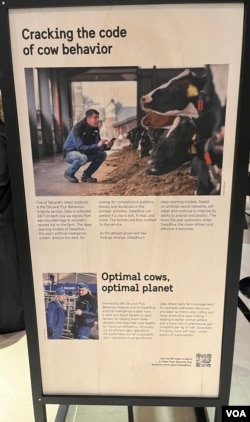
Fitbit for cows
The technology was developed by dairy and agricultural machinery maker DeLaval, which says its North American market solutions manager Joaquin Azocar, a small, earring-sized wearable device that fits in a cow's ear and tracks the cow's movements 24/7, like a Fitbit.
Ear-worn tags send signals to receivers throughout the farm. DeLaval artificial intelligence systems analyze the data, looking for correlations between patterns, trends and deviations in animal activity to predict whether cows are sick, in heat or not.
Azocar, a trained veterinarian, says the sooner farmers notice changes in their animals' behavior, the sooner they can administer treatment, shortening the recovery time.
AI to help with childbirth
There are also advances on the human health front: the Pelvic Floor AI project under development is an AI-based solution to identify high-risk cases of pelvic floor injury and intervene in a timely manner to prevent and limit harm.

It was developed by a team of gynaecologists and women's health care specialists at Sahlgrenska University Hospital in Sweden to help the approximately 20% of women who experience pelvic floor injuries during childbirth.
The expo “is a great opportunity to showcase the many different ways AI is being adopted and used in healthcare and many other sectors,” said Jessica Lindgren, general counsel at international consulting firm Blue Star Strategies, who attended the expo. “It's important to know how AI is evolving and impacting our daily lives.”
AI-based green solutions
The exhibit includes examples of what AI can do to combat climate change, including rising sea levels and declining biodiversity.
Air Forestry is developing technology for “precision forestry that selects and harvests trees completely autonomously.” The company says that “harvesting the right trees in the right places can significantly improve overall carbon sequestration and resilience.”
AI and the Defense Industry
The exhibit, outlining developments in artificial intelligence for the defense industry, acknowledges that it “may be controversial.”
“AI has great potential to solve problems that traditional algorithms cannot solve due to their complexity and limited computational power,” the exhibit states, “but we need to thoroughly consider how AI should and should not be used. Being actively involved in AI research is essential to understand the capabilities and limitations of the technology and to contribute to shaping its ethical standards.”
AI and Privacy
Expo attendee Quentin Black, an engineer at Axis Communications, an industry leader in video surveillance, said the project was born out of the General Data Protection Regulation (GDPR), a European Union policy that protects the privacy of citizens in public places who may be captured on video surveillance cameras.
Black said privacy regulations are stricter in Europe than in the United States.
“In the US, people don't have much of an expectation of privacy. There are cameras everywhere. It's different in Europe,” he explained. This regulation is what prompted Axis Communications to develop AI that provides privacy.
Black pointed to a large monitor divided into four windows to show how AI was being used to set up four different filters for privacy.

Axis Live Privacy Shield protects your privacy in real time while remotely monitoring both indoor and outdoor activity. The technology is free to download and uses a range of filters to provide privacy for people and environments.
Black explained the four quadrants on a monitor on display at the exhibition hall, with the top right window showing a full-color privacy screen blocking out the entire human body, using AI to distinguish between humans and the environment.
The top left window provides privacy for the person's head, the bottom left corner shows the person's entire body and a pixelation, or mosaic, of the environment surrounding the person, and the bottom right corner blocks out the environment, “the opposite of personal privacy,” Black explains.
“So this technology could be applied in cases of secret facilities, or when you want to see people approaching your door but can't see your neighbors.”
The tip of the iceberg
“I think AI is on everyone's mind, and what I appreciate about House of Sweden's approach to the show is that it emphasizes a thoughtful, scientific, business-oriented and human-oriented view of AI in today's society,” said Molly Steenson, president and CEO of the American Swedish Institute.
While AI and machine learning have been around since the 1950s, she said it's only now that we're seeing “the modern rise and acceleration of AI, particularly generative AI such as large-scale language models.”
“So while big companies and tech companies may be asking us to speed up and trying to convince us that it's only a terrible thing or only a good thing, I think it's actually a lot more nuanced than that,” she said.