
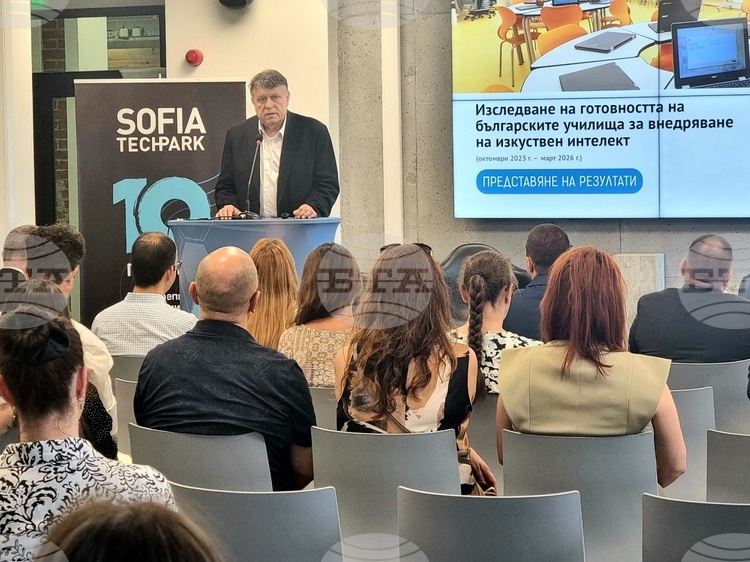
According to a survey on the AI readiness of Bulgarian schools conducted by the Bulgarian Association of Software Companies (BASSCOM), nearly 95% of Bulgarian students use artificial intelligence (AI) for educational purposes, and nearly half of them use it daily or several times a week. The findings were announced on Tuesday in the presence of Minister of Education and Science Georgi Valchev. BASSCOM representatives Dobroslav Dimitrov and Alexander Angelov appeared at the event, and the research was presented by Rachezar Afrikanov.
One of the study’s key conclusions is that Bulgarian schools are not starting from scratch. Accumulated experience, a willingness to experiment, and good practice examples already exist. However, schools progress at different rates and have unequal access to resources.
The survey surveyed 10,038 students, 1,767 teachers and over 210 principals from 63 schools across Bulgaria. The results aim to support the development of clear guidelines on the use of AI and data protection, reduce disparities in access to technology, and support the design of new education and assessment models.
This study shows that AI is becoming a part of students’ daily lives. 56% of respondents said they learned how to use AI completely on their own, while only 6.5% said they learned the skill at school. According to the study, this suggests that student adoption of AI is outpacing formal education and that schools are under pressure to establish frameworks for the responsible and sustainable use of technology.
Teachers have basic AI literacy. They are now ready to use AI for administrative tasks where it is easiest to measure the benefits of AI.
Teachers most commonly use AI for lesson preparation, especially lesson planning and assignment creation. Systematic integration of AI into classroom education remains limited. The study found a gap of 0.58 points between teachers’ self-assessed theoretical readiness (4.20) and their actual use of AI in the classroom (3.62), indicating the need for more practical support, including methodological guidance, clear steps, and dedicated staff to help with implementation.
Minister Valchev, responding to questions from the media, said that AI should serve as a supporting tool in education. He said it could help analyze each student’s progress, personalize learning, and help teachers identify learning gaps and suggest ways to address them. AI also has the potential to significantly reduce administrative workload for teachers, he added, explaining that these are the two main directions for AI integration in the coming years.
Valchev also acknowledged that there are significant challenges with the use of AI, particularly the temptation for students to submit AI-generated work as their own. The ministry said it would address this issue through teacher training and by ensuring students understand that presenting someone else’s work as their own ultimately undermines learning.
Asked whether teachers would receive AI training, Valchev said the ministry plans to establish an initial network of schools that are already experienced and ready to use AI. These schools will serve as pilot projects and their experience will be used to develop training programs to gradually expand AI integration across the education system.
Teachers will play a leading role in introducing AI into the classroom, he added. The task of the education system is to establish clear rules and provide the necessary support to ensure that new technologies are used responsibly and in the best interests of students, the minister said.


