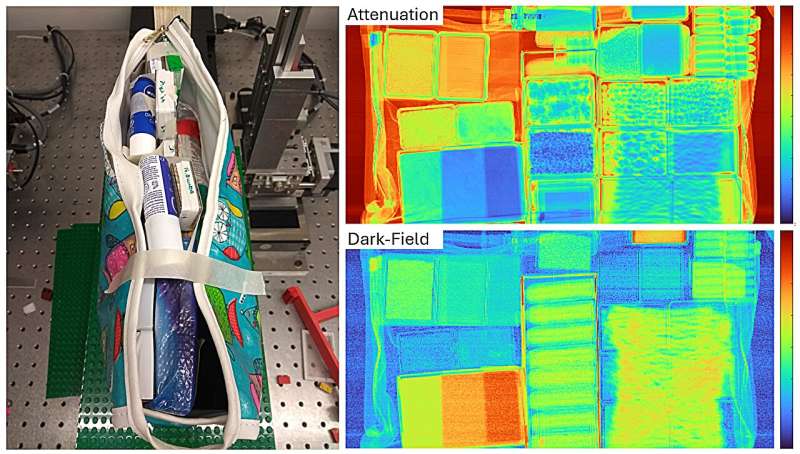
Researchers believe that by combining X-ray imaging techniques, multiple contrast images containing complementary information (such as attenuation and dark field) can be obtained, allowing detection of hazardous materials hidden in bags and other complex applications. It was revealed that it can be used in various scenarios.Credit: Thomas Partridge, University College London
The researchers combined different X-ray imaging techniques to create multi-contrast images that can be used to detect threat materials such as explosives in thousands of complex scenarios. The new approach also leverages readily available machine learning procedures for materials classification, which could be useful for security screening as well as applications in the life and physical sciences.
“The method is particularly well suited to identifying objects with very similar elemental composition,” said research team leader Thomas Partridge of University College London, UK. “It could be used for airport security or in-line scanning operations to examine materials that are flagged as suspicious by initial rapid scans such as conventional X-ray systems.”
In the journal OpticaAfter conducting nearly 4,000 scans of threatening and non-threatening materials hidden inside bags and in a variety of objects, the researchers show that their new technique is highly effective at accurately detecting and identifying explosives. They achieved a near-perfect 99.68% recall rate, with only one false positive from the threatening cases.
“Although further research is needed, this approach could also be useful in medical imaging,” Partridge said. “Traditional x-ray imaging has difficulty distinguishing healthy from diseased tissue, but other research suggests that phase-contrast imaging may be able to capture textures that can be used to distinguish healthy from benign tissue.”
Uncovering the secrets of materials
X-ray machines found in airports and medical facilities are based on X-ray attenuation, which images the decrease in intensity of X-rays after they pass through a material. This new technology creates multi-contrast images by combining traditional X-ray attenuation data at different X-ray energies with X-ray phase information consisting of refraction and dark field channels.
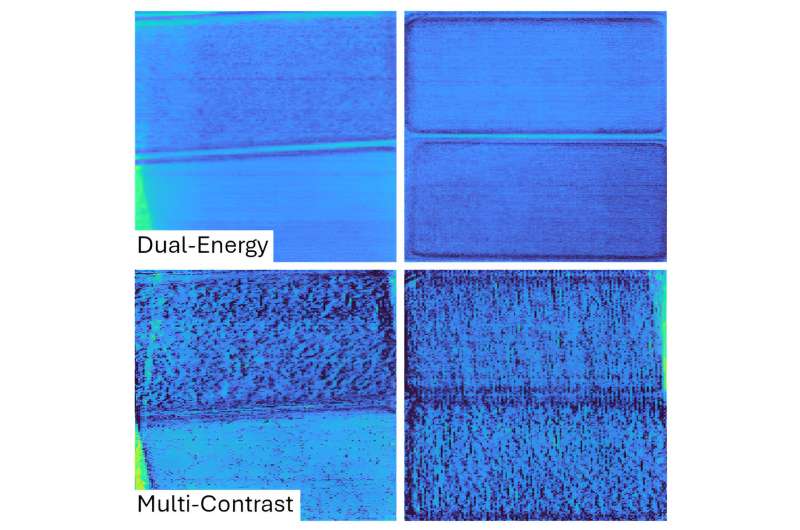
This new technique produces multi-contrast images by combining conventional X-ray attenuation images at a range of X-ray energies (two shown above) with X-ray phase information from refraction and dark field channels. This allows for a significant enhancement of texture and grain, as shown in the example composite image at the bottom, making it possible to distinguish between materials with very similar elemental composition. Credit: Thomas Partridge, University College London
“Many explosives and common everyday items are composed primarily of carbon, hydrogen, nitrogen and oxygen, and this similarity makes them difficult to separate using X-ray attenuation alone,” Partridge said.
“The additional channels significantly enhance not only the texture and grain of the material, but also the edges, making it possible to distinguish between objects with very similar elemental compositions.”
The study builds on the researchers' previous efforts to use multicontrast X-ray phase-weighted imaging with a machine learning approach to detect threats from small numbers of explosives and benign objects.
In the new experiments, we significantly scaled up the number of materials investigated and the number of imaging scenarios to better mimic real-world situations. They also created a more effective scanning system that can change the resolution by changing the scan speed and applying edge-illumination phase contrast.
In edge illumination, masks are placed in front of and behind the sample to create the sub-pixel X-ray “beamlets” required to make the system sensitive to phase signals. One of the main advantages of this illumination method is that it works with incoherent X-ray sources, broadening its range of applicability.
Increasing complexity of imaging scenarios requires more sophisticated protocols, so the researchers applied machine learning with a hierarchical structure that separates cluttered objects before distinguishing between material types. . This allows us to quickly identify subtle differences in shape and texture and differentiate materials based on key identifying features.
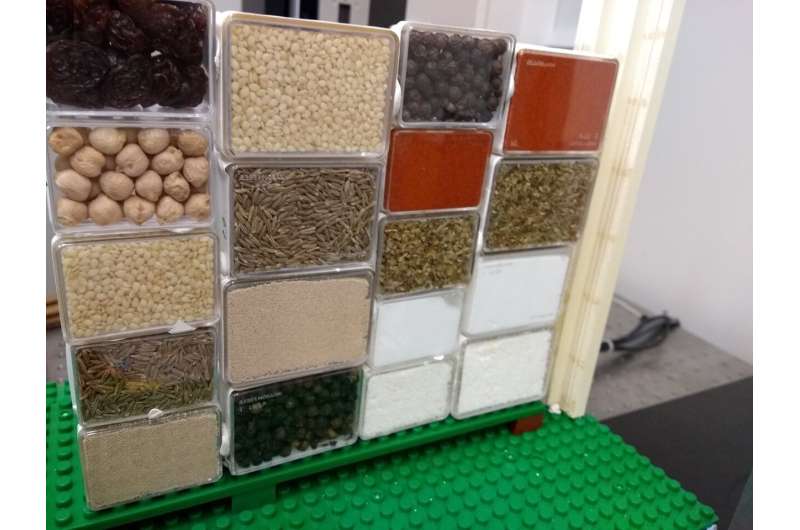
The researchers tested the new technology on 19 threat and 56 non-threat substances, some of which are pictured. Courtesy of Thomas Partridge, University College London.
Threat detection
To test their new technology, they used 19 different hazardous and 56 different non-threatening materials, all in three different thicknesses, which were concealed by a variety of cluttered objects, such as brushes, face wipes, socks, and other items that passengers would put in their carry-on bags.
By using all the acquired contrast channels, the researchers demonstrated not only the discrimination, but also the identification in some cases, of the substances. Using deep learning, he analyzed the signals from the combination of X-ray contrasts, and the results were very encouraging: he missed only one out of 313 threat cases.
The researchers say the system needs to be further optimized to increase scanning speeds before the technique can be commercialized. The robustness of material identification also needs to be tested on larger datasets.
One area the team is actively researching is combining this technique with 3D computed tomography scans. This method is being investigated for security purposes because it can provide detailed three-dimensional images of objects.
For more information:
Tom Partridge et al., Multicontrast X-ray identification and identification of heterogeneous materials using a deep learning approach; Optica (2024). DOI: 10.1364/OPTICA.507049
Quote: Researchers Detect Hidden Threats with Advanced X-Ray Imaging Technology (May 23, 2024) Retrieved May 23, 2024 from https://techxplore.com/news/2024-05-hidden-threats-advanced-ray-imaging.html
This document is subject to copyright. It may not be reproduced without written permission, except for fair dealing for the purposes of personal study or research. The content is provided for informational purposes only.