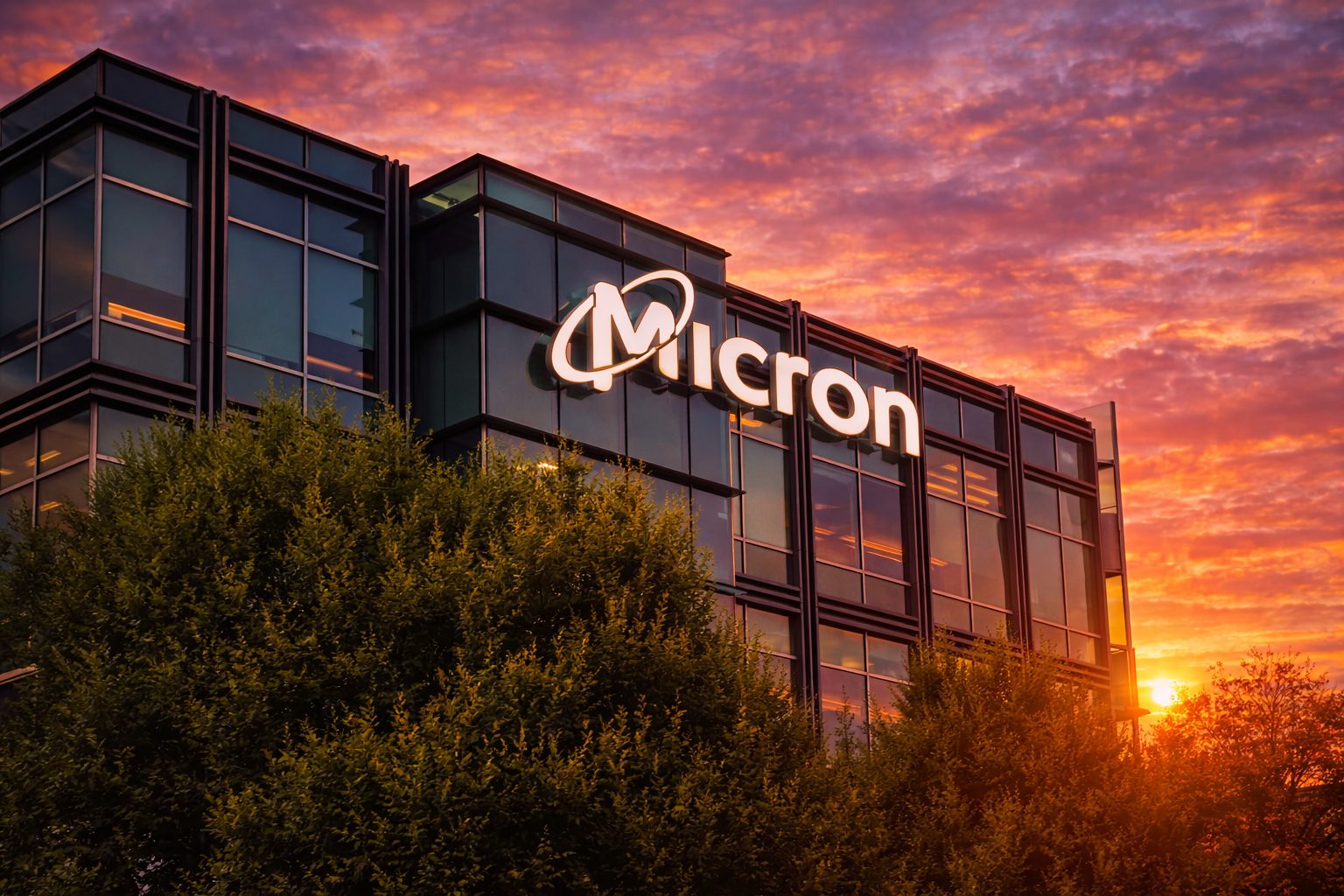
Micron Technology, Inc. (NASDAQ: MU) enters the holidays on December 25, 2025, with its stock at the center of the rapidly escalating “AI memory” story. This reshapes the way investors think about the traditionally cyclical memory chip industry. With U.S. markets closed for Christmas, the latest trading records show Micron stock $286.68 (Last trading time: December 24, 2025 (Universal Time Coordinated)) After a strong move following Micron's impressive first-quarter results and outstanding outlook for the current quarter.
The difference this time is not just in “good numbers.” While a combination of record revenues, skyrocketing profit margins, years of tight supply, and increased capital spending designed to chase high bandwidth memory (HBM) demand from AI data centers has combined, consumer markets are feeling the pinch in the form of rising prices for RAM and storage.
Micron Stock Today: Vacation Vacation, New Highs, Market Reassessment
above December 25, 2025one notable “same day” headline about Micron was that the stock hit new highs (some market trackers are publishing Christmas Day updates even though markets are closed). For example, MarketBeat highlighted Micron's recent move to a new 52-week high, summarizing the wave of analyst target hikes and the bullish consensus stance. [1]
This holds true for the broad pattern in December. Micron is on a strong upward trend until the second half of 2025, and Reuters notes that the company's stock price is rising. More than 160% in 2025 Amid global memory shortages and AI-driven price hikes. [2]
Key factors: FY2026 Q1 earnings shattered expectations.
Fiscal year reported by Micron Q1 2026 result of December 17, 2025and the headline numbers were such that they forced analysts to redraw their models rather than tweak them.
Key metrics reported (Q1 2026):
- Revenue:$13,643 million [3]
- Non-GAAP gross margin:56.8% [4]
- Non-GAAP EPS (diluted):$4.78 [5]
Micron also highlighted strong cash generation and shareholder returns during the quarter. $4.5 billion net capital expenditure and $3.9 billion Adjusted free cash flow. [6]
Guidance in the spotlight: Outlook for Q2 2026
micron's 2nd quarter of 2026 The guide was the real accelerator:
- Revenue:$18.7 billion ± $400 million [7]
- Non-GAAP gross margin:68.0%±1.0% [8]
- Non-GAAP EPS:$8.42 ± $0.20 [9]
Reuters highlighted how much the outlook was ahead of Wall Street expectations at the time, linking it directly by framing the expected earnings as almost twice the consensus estimate. Soaring memory prices, supply is tightand Demand for AI data centers is rapidly increasing. [10]
Why Micron says this cycle is different: Supply is tight through 2026 (and beyond)
Memory is always cyclical, and periods of short supply and pricing power often require building capacity that later overshoots demand. Micron's current argument is that AI has changed the “shape” of supply and demand.
In comments and company documents prepared in connection with the Dec. 17 financial results, Micron repeatedly pointed out that: Tough requirements across DRAM and NAND and said that tight conditions were expected. Continue beyond 2026. [11]
Reuters added more from management: CEO Sanjay Mehrotra said he expects the memory market to remain tight beyond 2026 and expects Micron to barely make it in the medium term. Approximately half to two-thirds of demand From some major customers. [12]
That's a surprising statement in an industry where customers are used to flexible sourcing and suppliers are used to battling oversupply.
The HBM effect: AI data centers are competing for the most valuable memory on the planet
High Bandwidth Memory (HBM) has become one of the most strategically important components in modern AI infrastructure. It is also a product category with limited supply, strict certification cycles, and only a handful of vendors able to offer products at scale.
Micron's Dec. 17 earnings investor presentation provides an aggressive outlook for growth across the HBM market.
- forecast HBM TAM CAGR ~40% until 2028
- From approx. $35 billion (2025) around $100 billion (2028)
- $100 billion milestone arrives 2 years ago than Micron's previous outlook. [13]
In plain language, Micron is telling investors that HBM is no longer a niche “AI bump” but is becoming a fundamental memory category that could match or exceed historic market segments sooner than expected.
Strategic pivot: Micron exits critical consumer business to prioritize supply
One of the most notable “this is serious” moves occurred in early December. Micron announced the following: Withdraw from Crucial consumer businessThis includes selling Crucial-branded consumer products through major retail and e-commerce channels.
Micron's press release (December 3, 2025) announced that it will continue shipping Crucial to consumers. Until the end of the second quarter (February 2026) The focus will then be on larger strategic customers and rapidly growing segments while providing warranty/support. [14]
Reuters characterized this as a direct response to global supply shortages and the economics of AI memory, noting Micron's move into higher-margin HBM and reporting that the consumer division was not a key driver of overall performance. [15]
The broader implication for investors is that Micron is choosing margins and strategic demand over consumer shelf presence, an unusually clear trade-off that shows how constrained supply is.
Industry context: Low memory headlines are a signal of demand, not just noise
Micron's stock price isn't moving in a vacuum. A series of reports in late December confirm the same theme: memory is becoming a bottleneck across consumer electronics, PCs, and gaming hardware.
Reuters: Supply chain strains spread across sectors
A Reuters investigation on Dec. 3 said a severe global shortage of memory chips is forcing AI companies and consumer electronics companies into a scramble for supplies, with ripple effects ranging from purchasing restrictions at electronics retailers to smartphone makers warning of price increases. [16]
Reuters also reported on Dec. 22 that AI-driven memory shortages could squeeze the economics of video game consoles and cause prices to soar for consoles and PCs, explicitly condemning Micron's decision to pull the Crucial brand from the consumer market. [17]
IDC: Supply growth will be constrained in 2026
IDC argues that the supply shortage is being amplified by strategic reallocation of capacity to AI-centric products such as HBM and high-capacity DDR5, limiting the supply of traditional DRAM/NAND and driving up prices. What IDC specifically predicted DRAM supply in 2026 will increase by up to 16% compared to the previous year and NAND supply growth is up to 17% compared to the previous yearbelow historical standards. [18]
From a stock price perspective, this type of industry framework tends to favor the bulls. This means sustained pricing power and sustained tightness can dramatically increase margins.
Wall Street Reaction: Target Revised Significantly Upwards
Micron's December results were not just better. These have caused a widespread reset in analyst thinking.
Business Insider reports that Morgan Stanley called the results one of the biggest upside surprises in U.S. semiconductor history (excluding NVIDIA) and lowered Micron's price target. $350other companies have also raised their targets and revised their revenue models upward. [19]
Other market trackers show how widespread the debate is.
- Fintel reported. Average price target for one year by analysts revised to $294.82, Ranges from ~$87 to $525 (Highlighting the wide disparity in outlook). [20]
- MarketBeat's Dec. 25 update quotes: Consensus target price is $282.61 and consensus “buy” On the other hand, it lists multiple companies with targets near or above $300. [21]
Bottom line: Analysts generally agree that fundamentals have improved significantly, but they disagree sharply on how long this pricing regime will last and what “normal” profitability will look like post-AI.
What are Micron bulls betting on in 2026?
The optimistic theory for Micron stock heading into 2026 generally stacks up like this:
- HBM remains sold out/supply limitedkeeping pricing firm.
- Data center demand remains strongEven if consumer demand is unstable.
- Expanding the margins This is because premium products (HBM, data center SSDs, advanced DRAM) will account for a larger share of the total.
- Expansion of Micron's capital investment It helps expand demand without collapsing prices.
On that last point, Micron's financial statements pointed to expected sales growth. Capital expenditures for fiscal year 2026 will be approximately $20 billionmainly aimed at extending HBM functionality and supporting the provision of advanced DRAM nodes. [22]
There are also signs that the industry may explore faster capacity routes. TrendForce reported on December 22 (citing local news reports) that Micron is in talks with Taiwan's PSMC to produce memory at a facility with a lot of unused capacity. However, TrendForce also cautioned that equipment lead times and process gaps could limit the short-term impact. [23]
For bears: the memory cycle never dies, it just gets creative.
Even in what appears to be a “supercycle” market, there are real risks that investors are paying attention to.
- Cycle risk/demand destruction: If memory prices rise too quickly, device manufacturers could cut specifications, raise prices, or delay launches, hurting unit demand. Reuters cites Counterpoint Research Project Global smartphone shipments will decrease by 2.1% in 2026likely due to pressure from rising chip costs. [24]
- Supply response delay: Large capital investment plans may eventually ease the strain, but they will take a long time to build. Reuters noted that new production capacity could take years and the industry remains wary of overproduction. [25]
- competition: Micron is one of only three major HBM suppliers, along with Samsung and SK Hynix, with rivals also investing and negotiating long-term contracts. [26]
- Policies and fees: Micron's document notes that the impact of potential tariffs is not included in the guidance, adding one more uncertainty to the 2026 modeling. [27]
In other words, Micron's current structure is strong, but it sits at the top of a global supply chain, and small mismatches can lead to big swings up or down in prices.
Micron (MU) stock final profit on December 25, 2025
As of December 25, 2025, Micron stock has been driven by a rare correction. record the results, explosive short-term guidanceand the industry environment as follows AI data centers are consuming scarce memory supplies faster than factories can keep up. [28]
That's why the price target is rising and the discussion is shifting from “Is this a regular memory upcycle?” “How long will this new AI-driven pricing regime last? If it does, what will Micron’s profitability look like?”
References
1. www.marketbeat.com, 2. www.reuters.com, 3. Investors.micron.com, 4. Investors.micron.com, 5. Investors.micron.com, 6. Investors.micron.com, 7. Investors.micron.com, 8. Investors.micron.com, 9. Investors.micron.com, 10. www.reuters.com, 11. Investors.micron.com, 12. www.reuters.com, 13. Investors.micron.com, 14. investors.micron.com, 15. www.reuters.com, 16. www.reuters.com, 17. www.reuters.com, 18. www.idc.com, 19. www.businessinsider.com, 20. fintel.io, 21. www.marketbeat.com, 22. Investors.micron.com, 23. www.trendforce.com, 24. www.reuters.com, 25. www.reuters.com, 26. www.reuters.com, 27. Investors.micron.com, 28. Investors.micron.com