On-device intelligence (ODI) is an emerging technology that combines mobile computing and AI to enable real-time, network-independent, customized services. ODI holds promise in the Internet of Everything era for applications such as medical diagnostics and AI-enhanced motion tracking. Despite ODI's potential, challenges arise from distributed user data and privacy concerns.
Some researchers have proposed ways to balance AI training needs and device limitations to optimize ODI potential. The cloud-based paradigm requires data to be uploaded for centralized training, but the device shares raw data with the cloud, raising privacy concerns. Federated learning (FL) enables collaborative model training without leaving the device, but faces the challenge of intermittent connectivity. Transfer learning (TL) trains a base model in the cloud and fine-tunes it on the device, a process that requires significant device resources. FL and TL ensure model performance and privacy while addressing the hurdles of connectivity and computational efficiency. Existing paradigms struggle to balance privacy and performance constraints.
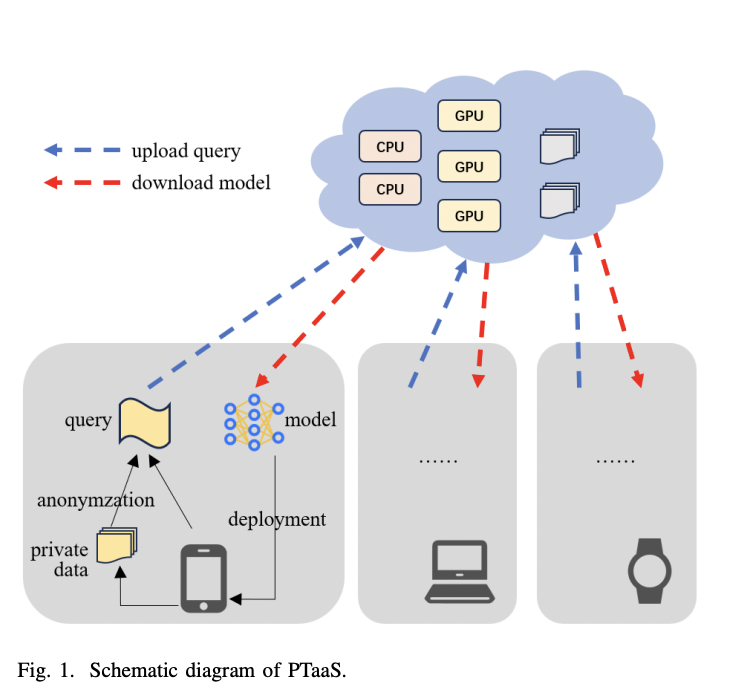
IEEE researchers have introduced Privacy-Preserving Training-as-a-Service (PTaaS), a robust paradigm for providing privacy-preserving AI model training for end devices. PTaaS delegates core training to a remote server and generates customized on-device models from anonymous queries to maintain data privacy and reduce the computational load on the device. Researchers take a closer look at the definition, purpose, design principles, and supporting technologies of PTaaS. His architecture scheme with open challenges is outlined, paving the way for his future PTaaS research.

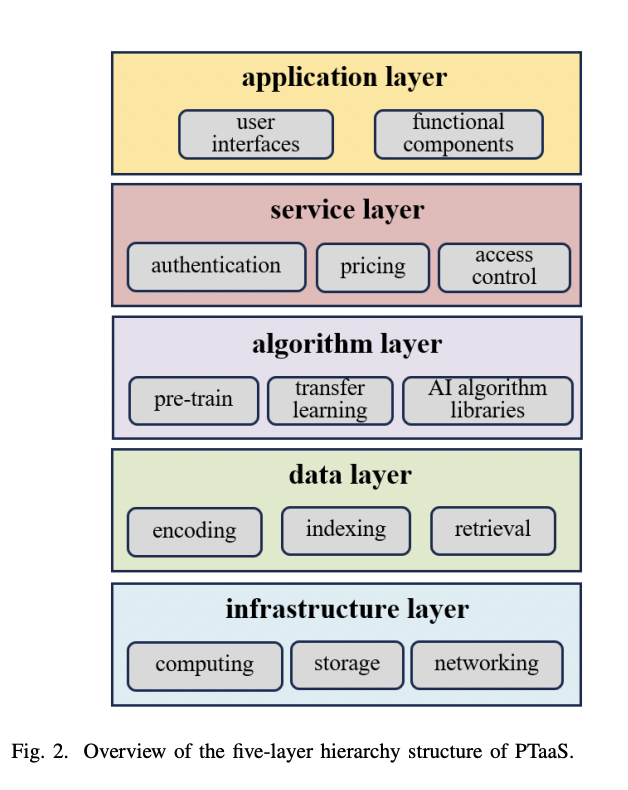
The PTaaS hierarchy consists of five layers: infrastructure, data, algorithms, services, and applications. The infrastructure provides the physical resources, and the data layer manages remote data. The algorithm layer implements a training algorithm that integrates transfer learning. The service layer provides APIs to manage tasks, and the application layer acts as a user interface to facilitate model training queries and real-time monitoring. This hierarchical structure allows the PTaaS platform to have a standardized design, unique evolution, and adaptation to technology and user needs.

PTaaS has several advantages.
- Privacy protection: The device only shares anonymous local data, ensuring user privacy without exposing sensitive information to remote servers.
- intensive training: Utilizing powerful cloud or edge servers for model training improves performance based on device-specific queries and reduces end-side computation and energy consumption.
- simplicity and flexibility: PTaaS simplifies user experience by moving model training to the cloud, allowing devices to request model updates as needed and adapt to changing application scenarios.
- Cost fairness and profit potential: Service costs are based on consumed resources, ensuring fairness and encouraging device participation. This pricing model allows service providers to earn reasonable profits and promotes PTaaS adoption.
In conclusion, this paper introduces Privacy Preserving Training as a Service (PTaaS) as an effective paradigm for on-device intelligence (ODI). PTaaS addresses the challenges of on-device model training by outsourcing to a cloud or edge provider and sharing only anonymous queries with a remote server. Facilitate high-performance, customized on-device AI models, ensure data privacy, and reduce end-device constraints. Future research will focus on strengthening privacy mechanisms, optimizing cloud edge resource management, improving model training, and establishing standard specifications for sustainable PTaaS development.
Please check paper. All credit for this study goes to the researchers of this project.Don't forget to follow us twitter.Please join us telegram channel, Discord channeland LinkedIn groupsHmm.
If you like what we do, you'll love Newsletter..
Don't forget to join us 40,000+ ML subreddits


Asjad is an intern consultant at Marktechpost. He is pursuing a degree in mechanical engineering from the Indian Institute of Technology, Kharagpur. Asjad is a machine learning and deep learning enthusiast and is constantly researching the applications of machine learning in healthcare.