
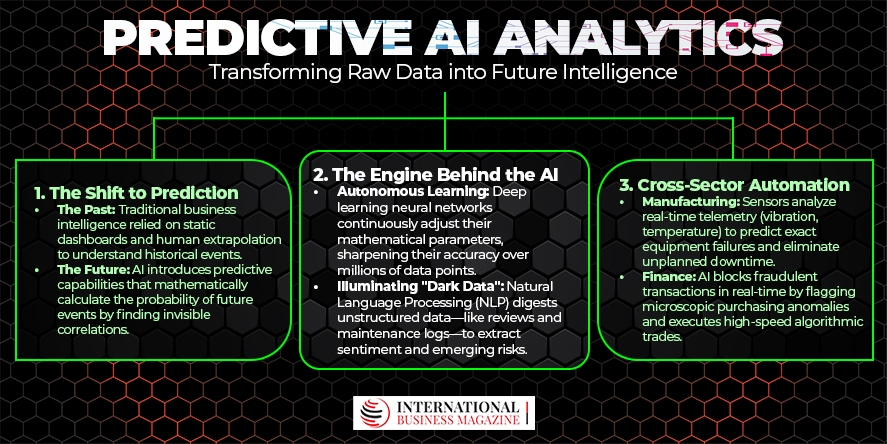
The modern digital economy operates on an endless flow of data. For years, organizations have used traditional analytics to collect vast amounts of information to understand what happened in the past and why it happened. However, this retrospective approach is no longer sufficient. The advent of artificial intelligence has brought about a major change in the way data is used, shifting the focus from reporting the past to predicting the future. This evolution is driven by AI analytics, a sophisticated framework that transforms raw, unstructured data into predictive intelligence. By leveraging advanced machine learning algorithms and deep neural networks, systems can predict future outcomes, enabling proactive approaches to strategy and operations that were previously unattainable.
Beyond descriptive analysis
Understanding the magnitude of this change requires understanding the limitations of traditional data analysis. Traditional business intelligence primarily relies on descriptive and diagnostic analytics that organize historical data into static dashboards and reports. While these tools can help identify historical trends, they require human analysts to interpret the data and manually estimate future trajectories.
AI analytics fundamentally disrupts this paradigm by introducing predictive and prescriptive capabilities. Predictive intelligence is more than just presenting past conditions. Mathematically calculate the probability of future events. By ingesting vast datasets, from consumer behavior patterns to global supply chain fluctuations, AI models identify subtle and complex correlations that are completely invisible to the human eye. This allows the system to predict demand, predict equipment failure, predict market changes with incredible accuracy, and operate continuously without fatigue.
Mechanism underlying prediction
The engine powering this predictive power is machine learning, specifically deep learning neural networks. Unlike traditional software programming, which relies on rigid rule-based logic hand-coded by engineers, machine learning algorithms learn and adapt autonomously. Once historical data is input, these models adjust their internal mathematical parameters to minimize the difference between their predictions and actual historical results. Over time, prediction accuracy increases exponentially as millions of data points are processed.
Additionally, natural language processing (NLP) integration allows AI analytics platforms to digest unstructured data such as text from customer reviews, financial reports, and maintenance logs. Previously, this unstructured information was considered “dark data” and lacked a strict database structure, making it largely unusable by standard analytical tools. Today, AI can extract sentiment, identify emerging risks, and incorporate these abstract variables into predictive models to create a truly holistic view of operating conditions.
Cross-disciplinary applications and automation
The introduction of predictive intelligence is completely reshaping operational frameworks across multiple sectors. In manufacturing, AI analytics powers predictive maintenance. Rather than servicing machines on a fixed calendar schedule or waiting for catastrophic failure, sensors continuously monitor equipment’s vibration, temperature, and acoustic properties. AI algorithms analyze this real-time telemetry against historical failure data to accurately predict when a particular component will fail. This facilitates targeted maintenance, eliminates costly unplanned downtime, and extends the lifespan of industrial hardware.
In the financial sector, predictive intelligence is revolutionizing risk management and fraud detection. By analyzing transaction speed, geographic data, and micro-purchase anomalies in real-time, AI can flag and block fraudulent transactions before they are approved. Similarly, algorithmic trading models use predictive analytics to predict market movements based on complex economic indicators and execute trades at speeds that take advantage of temporary market inefficiencies.
Data integrity requirements
Despite the extraordinary power of AI analysis, the underlying mathematics is still bound by a fundamental principle of computer science: garbage in, garbage out. A predictive model is only as intelligent as the data it is trained on. When historical data is incomplete, fragmented across separate servers, or has many inaccuracies, the resulting AI predictions are fundamentally flawed.
Successful adoption of predictive intelligence therefore requires a rigorous commitment to data hygiene and modern data architecture. Organizations need to break down fragmented data silos and establish a unified data lake where information is standardized, continuously cleaned, and easily accessible from machine learning pipelines.
Additionally, developers must always pay close attention to algorithmic bias. If the historical data used to train AI models contains inherent biases or biased demographics, predictive intelligence will inevitably amplify those biases, leading to biased results and system failures. Ensuring mathematical transparency and conducting continuous audits of AI models is absolutely essential to maintaining the integrity and fairness of predictive outputs.
conclusion
The transition from raw data to predictive intelligence represents one of the most important technological advances of the 21st century. As computing power continues to expand and machine learning algorithms become increasingly sophisticated, the precision and scope of AI analysis will only increase. Entities that thrive in this new era will be those that view data not just as a static record of the past, but as a dynamic strategic asset to illuminate the future. By fully embracing predictive intelligence, we can decisively move beyond the limitations of reactive decision-making. Ultimately, AI analytics provides the ultimate competitive advantage. It’s the unprecedented ability to know what’s coming next and the practical insight you need to confront it head-on.
Blog written by Charan MS


