Companies promote AI replacement
ClickUp, an employment management software company with a market capitalization of about $4 billion, recently gained attention by reducing its headcount by 22% while promoting the use of AI in its operations. ClickUp CEO Zeb Evans said the company has deployed about 3,000 in-house AI assistants to handle many tasks previously performed by humans.
Under the new model, employees will primarily be responsible for coordinating, supervising, and checking the results produced by AI, rather than being directly responsible for the entire business as before. ClickUp CEO believes that people who know how to leverage AI effectively can be highly productive and earn very high incomes.
In addition to ClickUp, many other technology companies are accelerating automation with AI. According to a study by Gartner, a research, consulting and technology market analysis firm, approximately 80% of companies implementing AI automation have made some level of headcount reduction.
Some emerging startups are testing operating models with far fewer employees, thanks to AI handling most of the work. The reality is that AI no longer just supports simple tasks, but is gradually replacing many jobs in offices, data entry, customer care, marketing, content design, or basic programming.
This trend is also putting significant pressure on the global labor market, as companies prioritize efficiency and automation to reduce operating costs.
AI will eliminate people who are slow to adapt
The wave of AI that replaces some human jobs is no longer limited to American technology companies. In Vietnam, too, many companies are starting to apply AI to operations, customer care, content creation, and data processing, increasing pressure for change on workers and students.
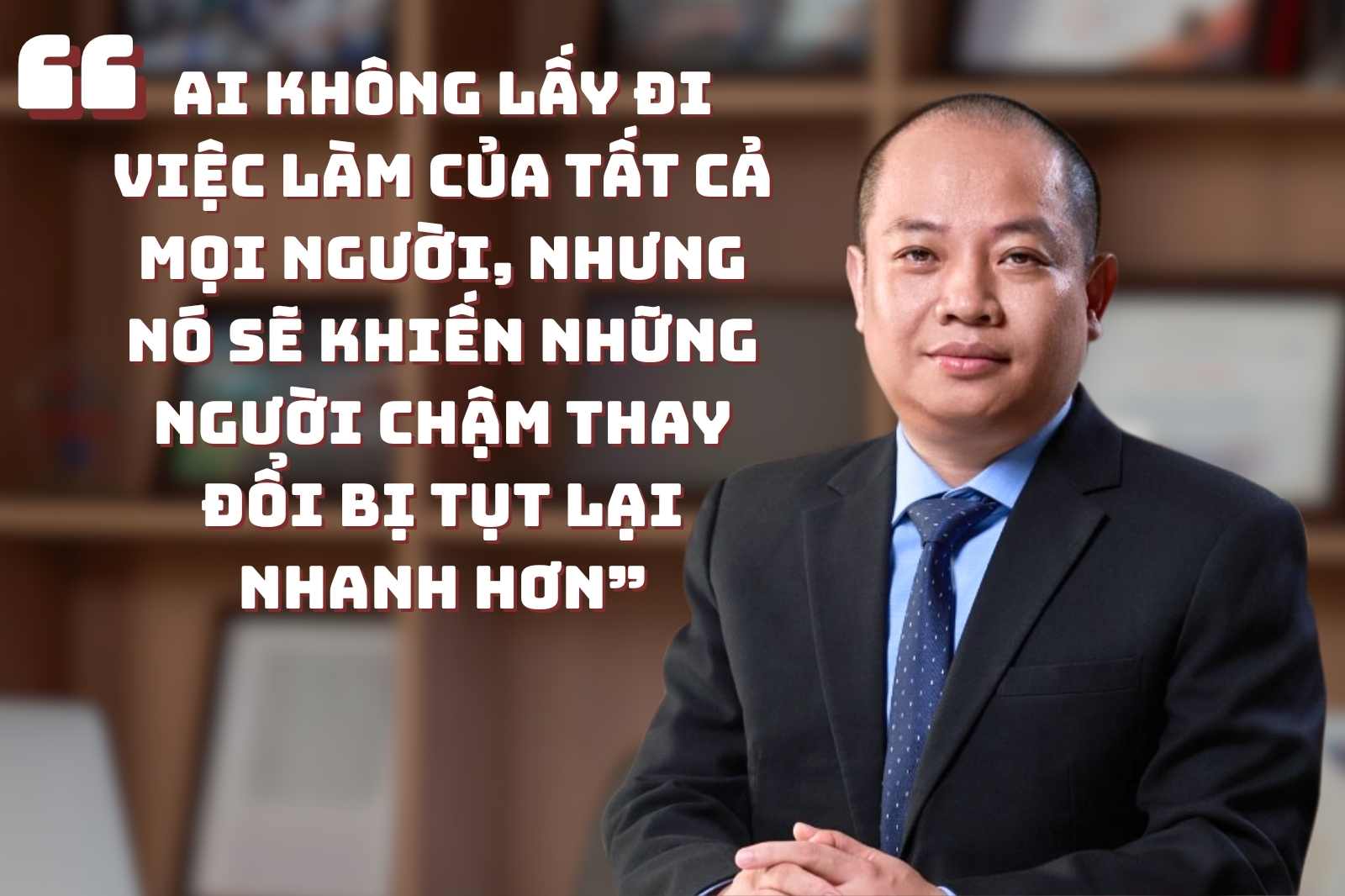
AI expert Vu Thanh Thanh, Chairman of AIZ Development Unit, spoke to Lao Dong about this issue and said that the AI wave will have an increasingly obvious impact on Vietnam’s labor market in the coming years.
Tan said many domestic companies are now starting to apply AI to customer care, data processing, content creation, sales management and business operations. While this helps companies speed up business operations, it also puts many repetitive positions at risk of replacement.
No longer just a support tool, AI is directly changing the way companies hire and utilize talent. Jobs with established procedures will be affected first,” Mr Tan said.
But according to the head of AIZ development, employees shouldn’t see AI as a competition, but rather as a must-know tool.
Tan believes that in the future, talent will have an advantage in working with AI to improve work efficiency, rather than doing everything the traditional way. “AI is creating new selection in the labor market, and adaptability to technology will determine employment opportunities,” Tan said.
Tan believes that for students, simply studying theory or relying on traditional expertise no longer provides a competitive advantage. He said young people need to quickly become familiar with AI and learn how to use this tool in their studies, research and practice.
In addition to technology skills, students also need to develop critical thinking, creativity, communication, and problem-solving skills, which remain difficult to fully replace with AI.
Experts say AI is putting huge pressure on the labor market, but the technology also presents new opportunities for those who know how to adapt. As companies increasingly automate, the ability to learn and update technology and work with AI could be a key advantage that determines a person’s place in the future labor market.