image:
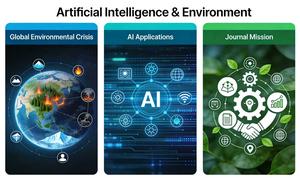
Artificial Intelligence and the Environment – Tackle the environmental crisis for a sustainable future with AI
view more
Credit: Lewis James P., Chen Chang-Er, Ying Guang-Guo
A newly launched scientific journal is calling for deeper integration of artificial intelligence into environmental research, arguing that AI could be one of the most powerful tools available to tackle climate change, pollution and resource sustainability.
First editorial of Artificial intelligence and environment Outlines how environmental problems are interconnected and globally expanding. The authors note that these pressures, from worsening climate change and biodiversity loss to pollution and energy insecurity, threaten ecosystems, public health, and economic stability around the world.
“Humanity faces a complex, systemic, and deeply intertwined environmental crisis,” the authors write. “Addressing them requires new scientific approaches that can extract meaning from vast and diverse data sources.”
According to the editorial, artificial intelligence provides just that capability. Machine learning and related tools can process large datasets from satellites, sensors, and environmental monitoring networks, allowing scientists to detect patterns that would otherwise remain hidden. This ability could improve pollution tracking, climate modeling, ecosystem monitoring, and agricultural planning.
“AI allows us to simulate complex environmental systems with much higher accuracy than traditional statistical tools,” the authors said. “This opens new possibilities for predicting climate impacts, modeling pollutant transport, and designing effective interventions.”
The editorial highlights several areas where AI is already transforming environmental science. Algorithms can enhance real-time monitoring of air and water quality, optimize waste management systems, and improve renewable energy planning. In agriculture, AI-based models can predict crop yields, assess soil health, and guide precision farming strategies that increase productivity while reducing environmental impact.
AI can not only improve scientific understanding but also help bridge the gap between research findings and policy decisions. Environmental regulations often lag behind scientific evidence, and in some cases can lead to preventable health and ecological damage. AI-driven modeling can generate transparent predictions of policy outcomes, helping decision makers evaluate trade-offs and predict unintended consequences.
“Evidence alone does not always guide policy,” the authors point out. “AI can provide tools to clarify the consequences of different choices and support more informed and fair decision-making.”
The launch of this journal reflects the growing recognition that environmental sustainability challenges cannot be solved within traditional disciplinary boundaries. Instead, the authors emphasize the need for collaboration between data scientists, environmental researchers, engineers, and policy makers.
They also highlight the importance of ethical data practices and reproducible methods to build public trust in AI applications. Ensuring that AI models are transparent, fair, and trustworthy is essential if they are to support global sustainability goals.
“With rapid advances in artificial intelligence, we are entering a new scientific era,” the authors conclude. “Used responsibly, AI can help transform environmental data into actionable knowledge and lead humanity to a more resilient and sustainable future.”
The journal invites researchers from around the world to contribute to research applying AI to environmental forecasting, resource management, pollution reduction, and sustainability policy, with the aim of accelerating innovation at the intersection of technology and earth management.
===
Reference magazines: Lewis JP; Chen CE; Yin GG. Artificial Intelligence and the Environment – Leverage AI to address environmental crises for a sustainable future. AI environment. 2026, 1(1): 1−3. DOI: 10.66178/aie-0026-0001
https://www.the-newpress.com/aie/article/doi/10.66178/aie-0026-0001
===
About the journal:
Artificial intelligence and environment is an international interdisciplinary platform for communicating basic and applied research advances at the intersection of environmental science and artificial intelligence (AI). It serves as an innovative, efficient and professional platform for researchers around the world across the fields of geoscience, environmental science, big data science and AI, and is dedicated to delivering discoveries from this rapidly expanding field of science. It is a peer-reviewed open access journal that publishes critical reviews, original research, rapid communication, perspectives, commentaries, and perspective papers.
follow us above facebook, ×and blue sky.
Research method
news articles
Research theme
not applicable
Disclaimer: AAAS and EurekAlert! We are not responsible for the accuracy of news releases posted on EurekAlert! Use of Information by Contributing Institutions or via the EurekAlert System.