
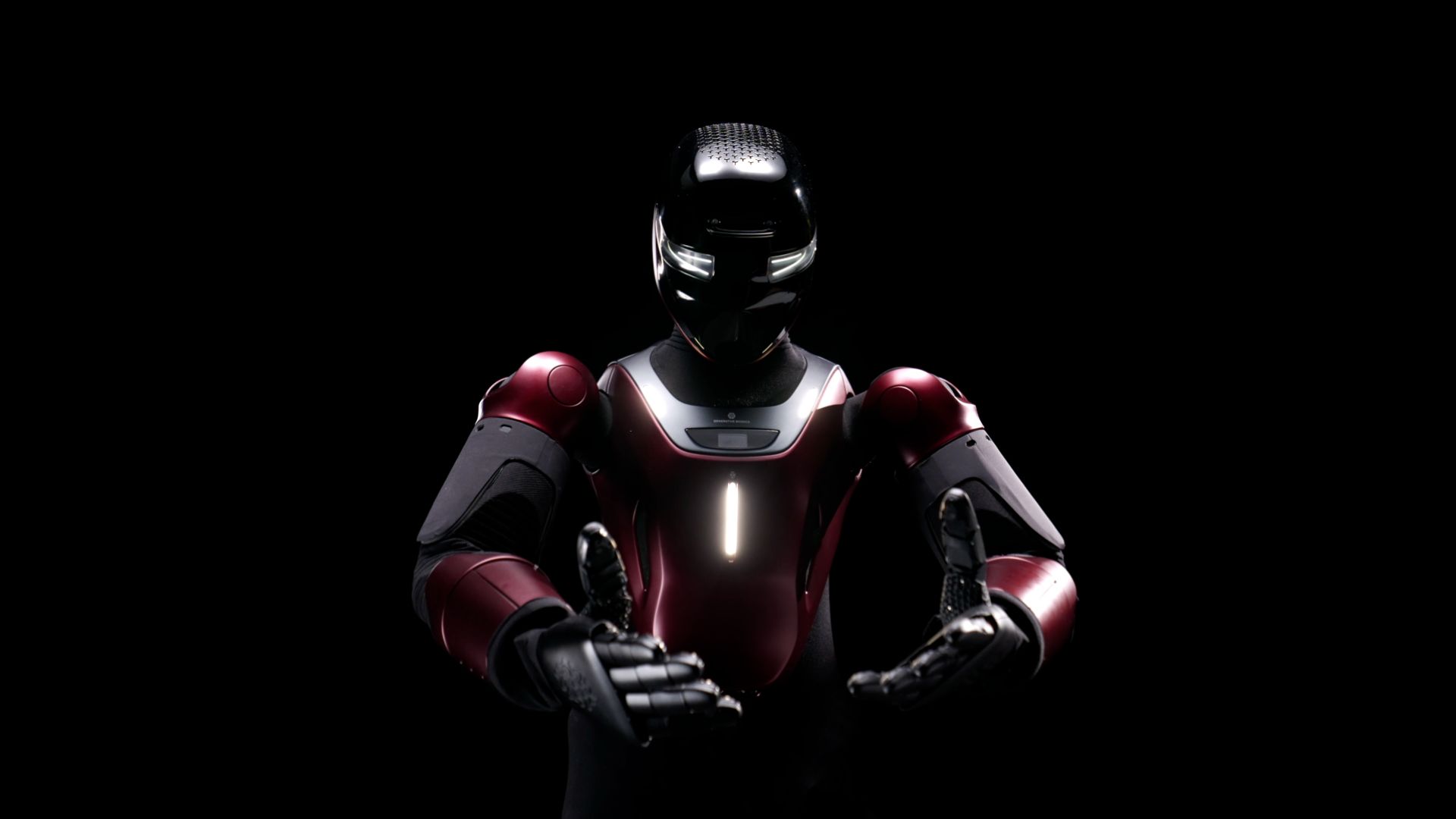
Italian deep technology company Generative Bionics has announced a major update to Gene.01, a humanoid robot designed for industrial applications.
Developed in just six months, the robot combines whole-body tactile sensing with a physics-native AI system that integrates the body, mechanics, and intelligence to better perceive, interpret, and respond to the physical world.
Unlike general-purpose humanoids, Gene.01 is designed as a scalable platform that can be customized at the AI, mechanical, and end effector levels to meet specific industrial requirements.
The company says the system was built from the ground up to bring human-aware, physics-native intelligence to real-world industrial automation.
In January 2026, Generative Bionics first unveiled its GENE.01 humanoid robot concept at CES 2026, featuring body-integrated sensing and computing for physical interaction.
Humanoid robot that senses touch
Gene.01 is a fully featured humanoid robot platform designed for industrial applications and will debut at AMD Advancing AI 2026. The robot combines whole-body tactile sensing with a physics-native AI architecture that integrates its body, mechanics, and intelligence into a single system for safer and more effective human-robot collaboration.
Unlike traditional humanoids that rely primarily on vision, Gene.01 features a decentralized multimodal “smart skin” that covers its body. Haptic systems detect touch, proximity, force, and temperature, allowing robots to sense humans before and during physical contact. The company says this enables more natural interactions while making shared workspaces more secure.
Force-sensing capabilities also allow workers to physically guide the robot and teach it tasks by demonstrating the force required for operations such as grasping and handling objects. This addresses the limitations of visual-only learning systems, which often struggle to infer the physical forces required for complex operations.
At the core of the platform is Generative Bionics’ proprietary physics-native AI that collaboratively optimizes a robot’s hardware, mechanics, sensing, and motion intelligence rather than treating them as separate systems. AI uses digital models of both robots and their human partners to optimize movement, ergonomics, balance, and gait stability, enabling efficient and safe collaboration in industrial environments.
This architecture is nature machine intelligence We describe an embodied intelligence framework for human awareness, originally developed through the ergoCub humanoid project. According to the company, Gene.01 is the first industrial humanoid to apply this peer-reviewed methodology to a fully sensorized commercial platform.
open physical AI
Generative Bionics is releasing the Gene.01 digital twin as open source and making it available through standard software distribution ecosystems such as PyPI, conda-forge, and official ROS build farms.
Developers can install robot models directly into existing robotics, AI, and simulation environments using standard package managers without having to manually configure repositories. The company says this gives physical AI developers a common foundation for simulation, application development, and testing before deploying robots in the field.
Rather than selling Gene.01 as a general-purpose humanoid, Generative Bionics designed Gene.01 as a scalable platform for multiple industries. The system can be customized by adapting the AI model, exterior design, and end effectors, including hands and feet, for specific tasks in manufacturing, logistics, inspection, healthcare, and public safety.
The first industrial deployment of this platform is being developed through cooperation with the Italian shipyard Fincantieri, with Gene.01 being adapted into a welded humanoid for shipyard work.
To support manufacturing, the company is also building a European supply chain through a partnership with German actuator specialist Synapticon and will develop an integrated actuator stack with assembly, calibration and safety testing in Europe for future Gene.01 production.


