
From zero to enterprise AI projects
According to the Vietnam AI Potential Unlocking Report 2026, 54% of Vietnamese businesses identify a lack of AI and digital skills as the biggest barrier to AI adoption. Notably, 52% of businesses stated that the talent shortage prevents them from being ready for the next generation of AI technologies such as Agentic AI or Physical AI.
These figures show that the AI challenge in Vietnam lies not only in technology, infrastructure, or investment capital. An increasingly clear “bottleneck” is in the human resources: businesses need personnel who can understand technology but also know how to apply it to solve specific business problems.
In its national AI human resource development goals for 2030, Vietnam aims to train 10 million skilled workers in Cloud and AI, including 15,000 experts with advanced AI skills. To realize this goal, the issue is not just about training a large number of people, but more importantly, about training the right skills and creating connections between schools, the technology community, and businesses.
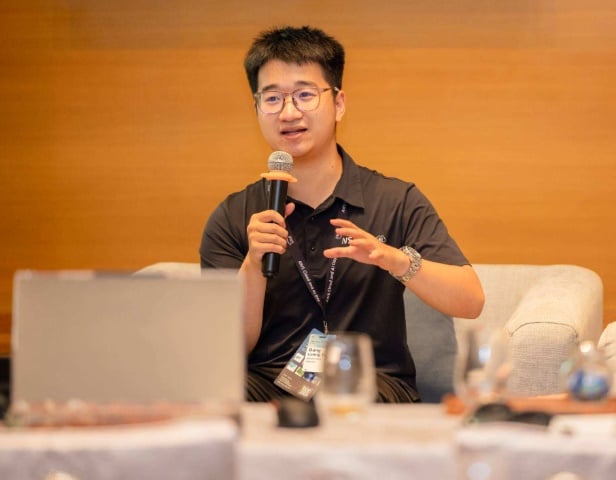
Luong Tien Dung, a fourth-year student majoring in Information Technology at the University of Transport and Communications.
For Luong Tien Dung, a fourth-year Information Technology student at the University of Transport and Communications, his journey to Cloud began with a very practical question.
Studying Data Engineering, Dung quickly realized that as data grows, especially Big Data, the problem is no longer simply building algorithms or processing data on a personal computer. Data needs to be stored, processed, and operated on a suitable infrastructure.
From there, Dung began learning about Cloud and joined the AWS Study Group community. It was also there that the student learned about FCAJ and was introduced to his future mentor.
“I registered immediately because I wanted the opportunity to exchange ideas and learn from experienced Cloud professionals, while also further developing my expertise in the field of Data Engineering that I am pursuing,” Dung shared.
According to Dung, a notable aspect of FCAJ is that students not only gain theoretical knowledge but are also guided through a relatively structured learning path. Starting from almost zero, Dung gradually learned about networking, security, and core AWS services such as EC2, S3, and IAM, then delved into services related to data engineering, real-time data processing, and data analysis.
But the real turning point only came when that knowledge was integrated into the business environment.
After applying for a position at Cloud Kinetics, Dung was accepted as a Cloud Engineer intern. Just three months later, the fourth-year student was offered a full-time position.
One of the projects that impressed Dung the most was a system that collects data from news websites, social media, and Google, then aggregates the information, summarizes news, and creates weekly slide reports.
This is no longer a classroom exercise. The system must read, filter, and synthesize large amounts of content based on requested keywords, combining AI, data processing, and cloud infrastructure.
Dung’s story illustrates a crucial point: the gap between “knowing the technology” and “making a product” sometimes doesn’t lie in the learner’s lack of knowledge, but rather in their lack of an environment to experiment, make mistakes, and receive guidance from experienced individuals.
For Dung, his journey at FCAJ holds another meaning. Initially, he joined the community to learn and find opportunities for self-development. But the guidance of his mentors and the spirit of sharing from those who came before him inspired him to continue his involvement, transforming from someone who received support into someone who supports other young people.
Currently an admin of FCAJ in Hanoi , Dung participates in supporting the community, sharing knowledge, and guiding those who are just starting to learn about Cloud computing. Having experienced the challenges of learning himself, Dung hopes to help others gain direction, confidence, and opportunities to access a real-world environment, just as he did.
Therefore, the job opportunity was not the end of Dung’s story. What he received from FCAJ became the motivation for him to give back to the community, hoping that those who come after him can also find their opportunities and continue to inspire others.
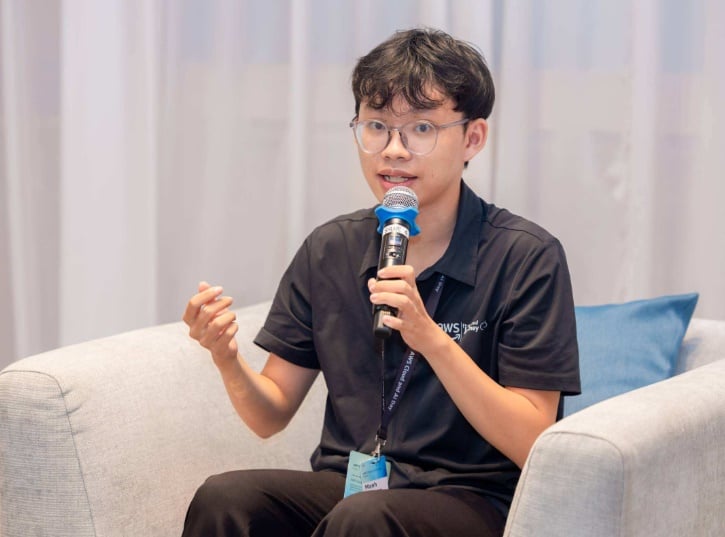
Student Nguyen Duc Manh.
The case of Nguyen Duc Manh, a fourth-year student at the same university as Dung, also clearly illustrates this shift.
Mạnh’s initial focus was on theoretical AI research, concentrating on building models from neural networks and basic mathematical operations. However, when he took the models out of the research environment, Mạnh realized a different reality: a model might work well in the lab, but it didn’t necessarily create a good user experience. That’s when Mạnh realized the role of the Cloud.
“Cloud can help bring the results of theoretical research closer to users and practical applications,” Mạnh shared.
After about two years of working with FCAJ, Mạnh is currently both a PhD student at VinUni and a teaching assistant for the infrastructure module. From being a learner, Mạnh has become someone who imparts knowledge to other students.
During this process, Mạnh noticed that many students still faced a familiar problem: building AI models on personal computers but struggling when it came to bringing those models to a real-world environment.
Therefore, in the tutorials, Mạnh introduces AWS services such as SageMaker and Bedrock to help students better understand the process of bringing an AI model from a research environment to a real-world infrastructure.
Interestingly, the project that Mạnh is most passionate about didn’t stem from a massive technological problem, but from a very ordinary, everyday issue.
Back in his hometown, Mạnh noticed that many elderly people struggled with administrative procedures due to their unfamiliarity with technology and filling out forms. From this, Mạnh developed “Voice Form”—an application that allows users to provide information using their voice, which the system then automatically extracts and fills into the form. The project won first prize at a Hackathon competition and is now being used by Mạnh in his own family.
From an AI model, “Voice Form” has become a product that solves a specific problem. And that’s the gap that the next generation of AI professionals needs to bridge: from knowing how to build models to knowing how to ask the question, “What problem does this model solve for whom?”.
Businesses always need people who can “get the job done”.
From a business perspective, Ms. Nguyen Vy, Human Resources Director of Cloud Kinetics Group, believes that the need for personnel with knowledge of Cloud and AI is becoming increasingly urgent.
Cloud Kinetics is a top-level Managed Service Partner of AWS, with over 10 years of experience in the Vietnamese market. The company currently employs over 400 people across Southeast Asia, India, and the US, with approximately 50 based in Vietnam, and more than two-thirds of them are technical staff. The company serves over 500 clients in the digital transformation and AI transformation sectors.

Ms. Nguyen Vy – Human Resources Director of Cloud Kinetics Group.
Given these specific characteristics, finding personnel with an AWS background has become a necessity. According to Ms. Vy, AWS training programs are creating a significant talent pool for businesses.
“The young people from FCAJ have a significant advantage in that they have already been exposed to and have had practical experience with AWS’s services, products, workflows, and culture,” Ms. Vy commented.
This is a significant advantage in a rapidly changing technological landscape. While businesses could previously dedicate considerable time to retraining fresh graduates in fundamental skills, the requirement to be able to start working immediately is now increasingly evident.
At Cloud Kinetics, the internship program used to last 12 months, but was later reduced to 6 months to shorten the assessment period and expand job opportunities.
During the first month, interns receive specialized training, complete AWS online certifications, and become familiar with the workflow. Afterward, their ability to participate in real-world projects is assessed.
From the second month onwards, interns can participate in projects under the guidance of senior staff. The company not only assesses technical knowledge but also monitors their ability to communicate with clients, work in teams, solve problems, and receive and respond to information.
Dung’s case demonstrates how this model can produce results very quickly. After three months, the Team Lead and the Head of Project Delivery recommended promoting Dung to a full-time employee.
However, according to Ms. Vy, it should not be understood that a training program can instantly transform students into “combat-ready” personnel.
Each customer has different requirements. Each business has a different culture. Even within the same company, the Sales, Marketing, HR, or Operations departments face completely different challenges. Therefore, technological capability is only the starting point.
Especially with AI, businesses need more than just an engineer who can build models. They need someone who can understand business processes, identify departmental barriers, listen to customer needs, and explain why an AI solution can create value.
According to Ms. Vy, communication skills, presentation skills, problem-solving skills, and consulting abilities are becoming increasingly important competencies.
“Expertise will get you there in the short term, but soft skills like presentation, communication, problem-solving, and consulting are what will help you go further in the future,” Ms. Vy shared.
This is also a key point to consider when discussing Vietnam’s AI workforce challenge. If we only focus on the number of people trained, the goal of millions of skilled Cloud and AI workers might just be a statistic. But if training is linked to projects, mentors, the community, and the actual needs of businesses, then those numbers have the potential to translate into economic capacity.
In fact, FCAJ is built by AWS as a free, self-learning platform with a community where members support each other in developing their knowledge and skills in Cloud and AI. In addition, AWS also deploys AWS Skill Builder and initiatives for students such as AWS Student Rewards.
Such programs, if more closely linked to universities and businesses, could form a continuous chain: learning – practice – mentoring – project participation – internship – recruitment.
That is probably the most effective way to transform technology workforce training into a truly competitive advantage.
Another noteworthy point is that the advantages of the Vietnamese workforce lie not only in technical knowledge.
According to Ms. Vy, compared to technical personnel in some countries in the region such as Singapore , Malaysia, India, or Indonesia, Vietnamese personnel have good technical skills, a high level of self-learning spirit, and a proactive attitude. The most obvious area for improvement is communication skills.
This is a thought-provoking paradox in the age of AI. As machines increasingly take over technical tasks, the value of human beings lies in abilities that machines find difficult to replace: asking the right questions, understanding people, persuading, collaborating, problem-solving, and transforming technology into business value.
AI is changing the way we learn, work, and even hiring standards. Therefore, the question is no longer “Will AI take my job?” but rather “Can I use AI to do my job better, faster, and create more value?”.
In the case of Dung and Manh, the answer begins with not waiting. Dung believes that students shouldn’t wait until they have enough knowledge before starting to try. While still in university, students have a huge advantage: they have time to learn, experiment, and make mistakes. Manh also believes that there’s “nothing to lose” while still a student. If you make a mistake, you can correct it; if you encounter difficulties, you can seek help from the community, mentors, and those who have gone before you.
And from a student who started exploring Cloud computing because of Big Data problems, Dung embarked on a real-world AI project and became a full-time employee after a three-month internship. From a purely theoretical AI researcher, Manh became a mentor for other students, guiding them in transferring models from personal computers to Cloud infrastructure, while also developing an application to solve a problem in his own community.
These two individual stories may not represent the entire AI labor market in Vietnam, but they clearly demonstrate one thing: the gap between schools and businesses is not too large if the right direction is chosen and perseverance is maintained.
If students have early access to real-world technology, guidance from a community of experts, opportunities to test their skills from businesses, and most importantly, are placed in real-world problem-solving situations, the transition from “learner” to “worker” can happen much faster.
Hoang Phuong
Source: https://doanhnghiepvn.vn/tin-uc/thu-hep-khoang-cach-tu-giang-duong-den-doanh-nghiep-nho-ai-va-cloud/20261006102926387