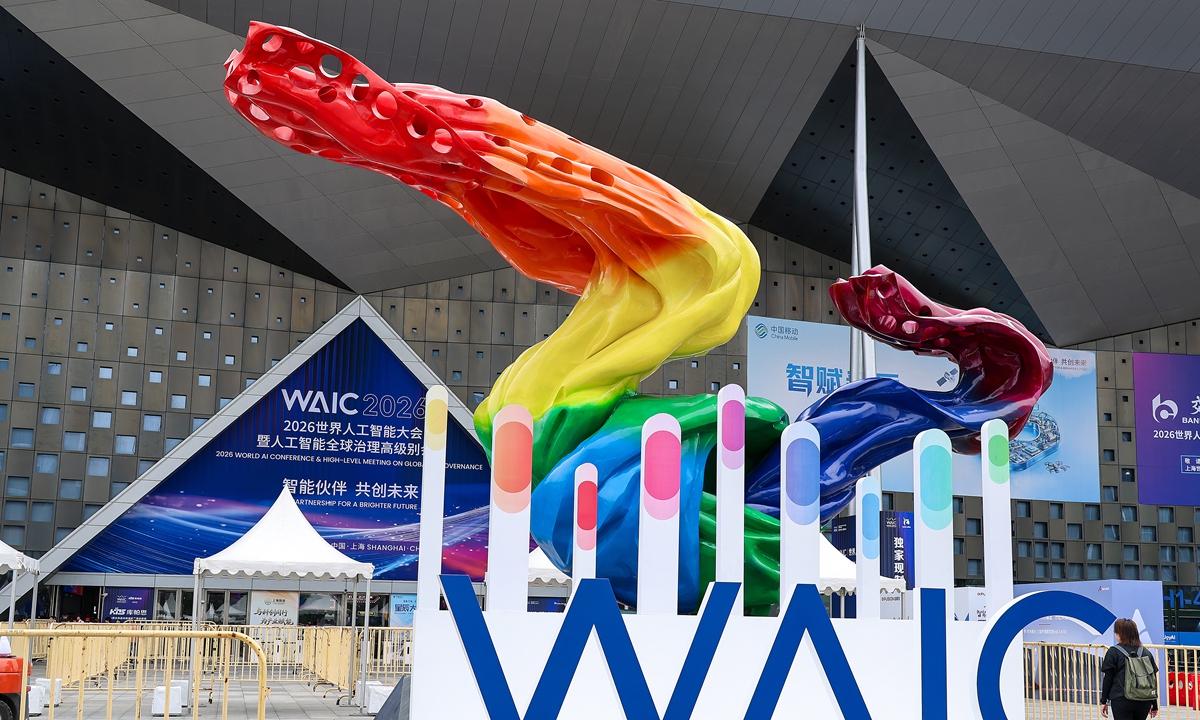
This photo shows a street installation for the 2026 World Congress on Artificial Intelligence in Shanghai. The conference is scheduled to open on July 17, 2026 and will attract more than 1,100 companies and more than 3,000 exhibits. Photo: VCG
In Shanghai, the final countdown to the world’s largest artificial intelligence (AI) event has entered its final stages. Inside the exhibition hall, interactive screens are being tested, robotic arms are being repeatedly adjusted, and engineers are making final preparations before thousands of AI products meet visitors from around the world, Global Times observed while walking through the exhibition halls on Thursday.
The 2026 World AI Conference (WAIC) and High-Level Conference on Global AI Governance offers a vivid glimpse of how AI is evolving, from being perceived as a ruthless industrial machine to becoming an intelligent companion increasingly integrated into work, daily life, and entertainment.
Under the theme “Intelligent Partners, Co-Creating the Future”, the most striking feature of this year’s conference is its focus on practical application, exhibition organizers told the Global Times on Thursday.
Twenty-nine countries signed an agreement to establish the World Artificial Intelligence Cooperation Organization (WAICO) in Shanghai on Thursday, Xinhua News Agency reported.
According to the agreement, WAICO will be an independent intergovernmental international organization headquartered in Shanghai.
According to the agreement, the organization will support the purposes of the United Nations Charter, strive for broad consultation and collective contribution for the common good, and adhere to a people-centred approach. It aims to promote international cooperation and global governance on AI, ensure that AI is beneficial, safe and fair, and thereby promote the healthy and orderly development of AI to benefit all humanity, according to Xinhua News Agency.
WAIC 2026, which opens in Shanghai on Friday, will attract more than 1,100 companies and more than 3,000 exhibitors, and make the world debut of more than 300 AI products, according to the latest official data.
Organizers say visitors will not only get an up-close look at the latest AI breakthroughs, but also learn how these technologies are being applied to real-world scenarios across manufacturing, healthcare, education and elderly care.
Hundreds of application-driven exhibits will focus on broader transformation. AI has become a new type of productive force, creating new momentum across industries.
Global debut close to everyday life
Ahead of the conference, some of China’s leading intelligent manufacturing companies exclusively shared with Global Times details of their cutting-edge AI products that will be unveiled to the public at the event.
Rapid improvements in dexterity of humanoid robots will be demonstrated through several products.
AGILINK will debut and unveil its OmniHand 3 Ultra-M dexterous hand at the conference, where visitors will see a two-handed demonstration of folding a balloon dog, making it the only public demonstration of such functionality in the world, the company said in a statement to the Global Times on Thursday.
OmniHand 3 Ultra-M is designed to fit the size of the human hand and features 20 degrees of freedom, integrated visual tactile sensors in the fingertips of all five fingers, and three-dimensional tactile sensing points distributed throughout the palm. These features allow you to perform highly precise manipulation tasks with your dexterous hands.
Agibot also jointly developed a new generation of safety-certified heavy object intelligent robot Genie G2 Max with JD Logistics, it said in a statement to the Global Times on Thursday.
The company says the robot has a payload capacity of 18 kilograms with a single arm, a standard payload capacity of 38 kilograms with dual arms, and a maximum payload of 50 kilograms, making it one of the strongest robots in the industry in terms of payload. It can also perform sub-millimeter precision operations and supports autonomous charging and battery swapping, allowing for 24/7 uninterrupted operation.
Meanwhile, SenseMart Go, an AI retail solution developed by SenseTime, will showcase a new embodied intelligent robot store where humanoid robots handle retail operations flexibly and efficiently, SenseTime said in a statement to the Global Times.
Visitors can scan a QR code to experience the complete shopping process, and in-store robots can independently pick and place items, organize shelves, perform inventory checks and handle basic exceptions, according to the statement.
WAIC 2026 will also showcase breakthrough advances in AI models and computing infrastructure that support a broader range of applications beyond embodied intelligence.
During the exhibition, MiniMax will be showcasing its next-generation native multimodal flagship model M3. Supporting up to 1 million context tokens, this model is built on MiniMax’s proprietary MSA (MiniMax Sparse Attendance) architecture, which improves performance for long context processing, coding, and agent tasks.
Chinese brain-computer interface company BrainCo will officially launch what it describes as the world’s first integrated graphical one-stop AI research platform for brain-controlled robot research and development, the BrainCo Brain-Controlled Robot Training Platform, during the exhibition, the company said in a statement to the Global Times on Thursday.
Using this platform, developers without prior BCI expertise can enable “mind-controlled” robot operations in as little as 10 minutes.
Additionally, Securities Times reported that Huawei’s Atlas 950, the industry’s largest commercial supernode, will debut at the conference. The system has a minimum configuration of 64 cards per cabinet, scales up to 8,192 NPUs, and is specifically designed for training and inference of trillion-parameter AI models.
From breakthrough to application
The breakthroughs to be showcased at WAIC 2026 are not limited to technological advances, with some cutting-edge innovations already being integrated into industrial chains and transforming everyday manufacturing.
In particular, the Global Times learned that the exhibition has built a humanoid robot manufacturing workshop with a fully automated new energy vehicle production line that operates in real time.
The production line covers five main processes, from battery module assembly to indoor speaker installation, replicating the actual new energy vehicle manufacturing process. Each operational scenario corresponds to a real-world industrial application, allowing visitors to see first-hand how AI is reshaping industrial manufacturing, organizers told the Global Times on Thursday.
According to the organizers, for example, visitors will see intelligent robots perform tasks such as picking, screw tightening, power connection, and fully automatic assembly and lighting testing of vehicle lamps, demonstrating high precision and efficiency in their work.
Chinese experts said the burgeoning AI ecosystem showcased at WAIC 2026 reflects China’s sustained efforts to strengthen technological innovation and develop new high-quality production capabilities.
As China begins its 15th Five-Year Plan period (2026-30), AI is recognized as one of the key emerging technologies that will drive industrial sophistication and future economic growth. This year’s key policies emphasize accelerating the integration of AI with manufacturing, services, and scientific research.
Such applications reflect a broader push to accelerate the commercialization of AI through policy support, industrial capacity, and market demand.
Chinese policymakers are aiming high in anticipation of the rise of a “smart economy” as AI rapidly moves from labs to factories, hospitals and to solve problems in supply chains.
China’s 2026 Government Work Report also supports the creation of new forms of smart economy, saying, “We will advance and expand the AI-plus initiative. We will encourage the large-scale commercial application of AI in key sectors and fields to promote faster application of new generations of intelligent terminals and AI agents, and promote new forms and models of AI-native business. We will support the development of open source AI communities and build a vibrant open source ecosystem.”
The global AI industry has passed the stage of rapid technological innovation and is entering a new stage where deep applications and global governance go hand in hand, Chen Jing, deputy director of the Institute for Technology Strategy, told the Global Times on Thursday.
Until now, AI has often been evaluated based on its technical capabilities. Today, both industry and society place greater emphasis on its ability to provide practical services. This is a shift from a technology-driven approach to a more human-centered approach, Chen said.
“China’s experience shows that AI can achieve greater value when integrated with the real economy, by leveraging extensive manufacturing capabilities and diverse application scenarios to create a virtuous circle between technology development and real-world needs. Policy support and market-driven innovation working together are moving AI from the laboratory to the factory, home, and city. The future of AI will not be defined solely by computing power or model parameters, but by AI’s ability to solve real-world problems,” he added.