

At the most recent RANZCO Congress, the rise of artificial intelligence was a big part of the conversation. But for two men, one an Australian ophthalmologist, it’s already arrived.
Dr Devinder Chauhan has been back in Australia barely 24 hours when he speaks with Insight.
He’s just returned, via a London speaking engagement, from his latest visit to the United States, where he spent about 100 of 365 days last year.
But there’s little time to rest.
In May he’s organising a global meeting called Lessons from Formula One (F1), where a panel will talk about ways to improve and optimise clinical workflows.
The vehicle for that improvement? Artificial intelligence (AI).
That has him thinking about F1 pitstops – “When I was a kid, they took about 10 seconds, or maybe more; now that’s like 1.7 to 2 seconds.”
The irony is that’s pretty much his life. He may be talking about F1 but the reality is he’s living it, and those Aussie pitstops are getting shorter.
The Victorian ophthalmologist and retinal subspecialist spends just four days a month working on his former clinical duties. The rest of the time he’s living in the fast lane of global travel and playing a key role in developing the future of eyecare.
Dr Chauhan is founder and CEO of Macuject, a digital health company that provides a cloud-based, AI-powered software program to help ophthalmologists manage age-related macular degeneration (AMD).
It’s a rising success story nearly a decade in the making.
Like so many other business ideas, Macuject started with a problem as Dr Chauhan considered how to cope with the increasing number of patients in his clinic needing intravitreal injections to manage their AMD.
“It was spreading out to take over a large part of the week, but I wanted to maintain quality and be more efficient,” he says.
“So it was about, how do I maximise the workflow to get people through, but, at the same time, make sure there’s good, consistent decision-making.”
As he wrestled with that problem he spoke with orthoptists at the clinic, who planted the seed of the decision-making tree that would become the foundation of his future business.
“They would come to me and say, ‘I’ve got this patient with X, Y and Z. Understanding this is the history, I’m guessing you’re going to want to switch drugs or do this or do that.’
“It all seemed quite protocol-driven and I realised it could be put into code.”
Which is what he did.
“That’s actually the most difficult part of this, but then I thought, cool, I’ve got a piece of software that helps people decide and maybe someone will want to use it.”
That potential audience grew further when a general ophthalmologist asked if the software could help him interpret OCT scans.
This was eight years ago, when AI was beginning its peek above the horizon of opportunity in healthcare.
“We needed to find AI that would help to find the edges of abnormalities in the scan – it’s called a segmentation model,” says Dr Chauhan.
For that, he went to a company in Melbourne to build that AI model while he began building a team to develop the idea and create the company, Macuject.
A BioMed Tech Horizons grant of $948,000 – part of a $45 million Australian Government initiative to fund early-stage health technology projects – helped.
So did Covid, with restrictions and lockdowns landing just as he was considering taking a sabbatical to allow more time to develop the business.
Five years later he is still putting together that team, which stands at eight.
It’s largely focused on the US because of the size of the market, the nature of America’s incentivised healthcare system and a greater pool of venture capital opportunities.
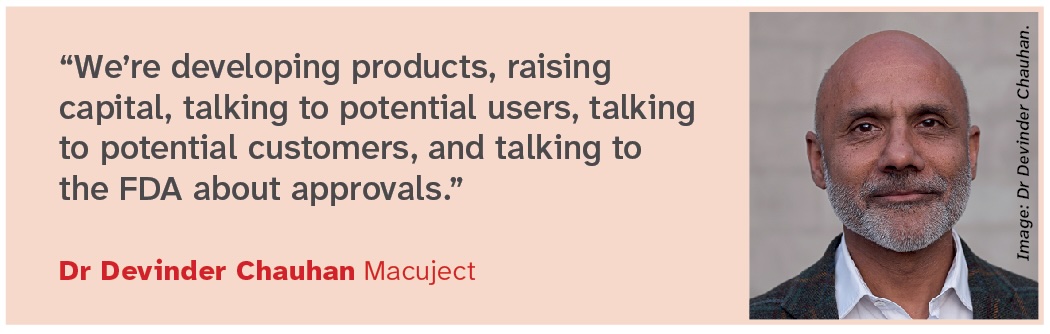
“We’re developing products, raising capital, talking to potential users, talking to potential customers, and talking to the FDA about approvals,” he says.
The company is in its pilot phase along the east coast of the US.
It’s a subscription model, where doctors pay for a monthly licence giving them access to software that supports the decision tree and optimises workflow as an AMD patient moves through their clinic.
Those decisions can change depending on where they are in that process and the drugs they might need, the cost and advantages of which are also factored in.
But the doctors are always in control of that process, says Dr Chauhan.
AI is used to analyse OCT scans for abnormalities, aiding in those decisions.
He says Macuject has different AI models for different OCT devices used, developed and improved over several years – it’s currently on its 18th iteration.
That AI helps doctors find and measure abnormalities in the scans.
“We have a model for wet macular degeneration, to find the abnormalities that are usually dark patches on the scan, which most of the time is fluid,” he says.
“For dry macular degeneration, we have the ability to detect gaps in the photoreceptors and in the RPE (retinal pigment epithelium), which means that we can measure geographic atrophy and intermediate AMD.”
The scans and the AI analysis that supports them help the doctors make their decisions, treat the patient and monitor their progress.
Does AI perform better?
Recent research shows Dr Chauhan and others looking to harness the potential of AI in eyecare are on solid ground.
A study from the University of California San Diego, published in Nature, has demonstrated the accuracy of AI in retinal imaging.
Researchers developed an AI model for classifying treatment response in neovascular AMD (nAMD) using longitudinal OCT-angiography.
Two experienced retina specialists graded the scans for comparison, to see if they classified as improved, unchanged, or worsened.
The AI model did the same thing with accuracies of 74.29% (worsened), 81.48% (unchanged), and 88.64% (improved).
The specialists were some way behind, with a grading accuracy of 61.40%.
“Human graders were significantly more likely to misclassify treatment response than the AI model,” the researchers said.
“These findings demonstrate that AI-based paired OCT-A analysis can provide a more accurate and objective assessment of treatment response in nAMD.”
The attitudes of patients are changing as well.
The Macular Society, a patient support body in the UK, surveyed its members about the use of AI in eyecare.
More than 180 people replied to its poll between May and June 2024.
The research concluded that patients with macular disease found AI to be “acceptable in the assessment of retinal images”.
“The most important factors to patients relate to the accuracy of the decision making,” it said.
A literature review by researchers at Duke University in Durham, North Carolina, reached similar positive conclusions.
After analysing the results from about 150 records they said the integration of AI into clinical practice “holds immense promise for revolutionising the management of AMD”.
“DL (deep learning) models have consistently demonstrated their ability to match or surpass human experts in classification, progression prediction, and treatment optimisation.
“This growing body of evidence strengthens the case for AI’s adoption in real-world ophthalmic care.”
Visual crowding
While Dr Chauhan and others are working to realise the promise of AI in diagnosing, treating and managing AMD, a Sydney researcher is focused on how it can be used to support those living with its debilitating symptoms.
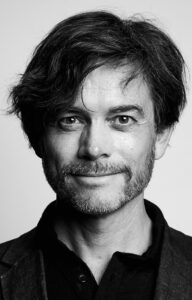
Associate Professor John Cass is the director of the Vision and Cognitive Science Lab at Western Sydney University.
He researches time perception, visual crowding and binocular vision, among other things, and works with industry to “design human-machine systems optimised to the processing capacities of the human brain”.
“I work with defence and emergency services, trying to create systems . . . and displays that are cognitively more digestible than standard approaches,” he says.
As part of that, A/Prof Cass has teamed with Dr Erik van der Burg, from the Faculty of Behavioural and Movement Sciences at the Vrije Universiteit Amsterdam, to find ways of using AI to mitigate the effects of visual crowding in people with AMD, and support the vision they still have.
Their aim is to develop a mobile app that uses AI to enhance reading and emotion recognition in AMD patients.
“Although things like macular degeneration are very much a retinal issue, it has major downstream implications for perception and cognition,” says A/Prof Cass. “I’m interested in the computational principles that the brain uses to segment, to combine, and to make meaning out of the sensory world.”
That meaning becomes harder to find as AMD progresses and people lose vision in the macula, he says.
“If you don’t have a macula, you’re forced to rely on your peripheral vision, and we have poor resolution out there, so that turns out to be deeply problematic.”
Visual crowding can make that worse.
“The natural world is densely cluttered, so you have impaired object recognition due to the presence of nearby visual clutter. These effects of crowding are huge. It is the most significant constraint on object recognition.
“One way to mitigate crowding is simply to increase the spacing between a target in peripheral vision and the surrounding clutter,” he says.
“When objects are further apart, the visual system can separate them more effectively. That extra spacing makes the target easier to see – and the effects can be dramatic”
He and Dr van der Burg research adaptive algorithms and AI systems to help reduce the clutter in that peripheral vision and help people see and read better.
And they are keen to find out if AI and those algorithms can help AMD sufferers on an even more personal level.
“One of the things that people with AMD report as being the most problematic in their lives, the thing that actually determines their quality of life, isn’t the reading and their inability to drive – it’s the inability to see emotions in their loved one’s faces,” says A/Prof Cass.
“It’s surprising and deeply tragic.

“So we’ll be using a similar kind of approach . . . using AI to assist with that emotion recognition, using forward-facing cameras, for example, to capture the footage of the person and to modify it in real time to make the emotional content perceptible.”
As part of that they plan to work with AMD patients through the UNSW School of Optometry and Vision Science.
They are in the process of securing funding for the project and hope to develop apps for mobile phones and tablets over the next two years.
MDFA investment
Macular Disease Foundation Australia has invested about $6.9 million across 42 research grants since 2011 as part of supporting the discovery of new treatments and development of new technologies.
CEO Dr Kathy Chapman says AI is becoming increasingly prominent in those projects.
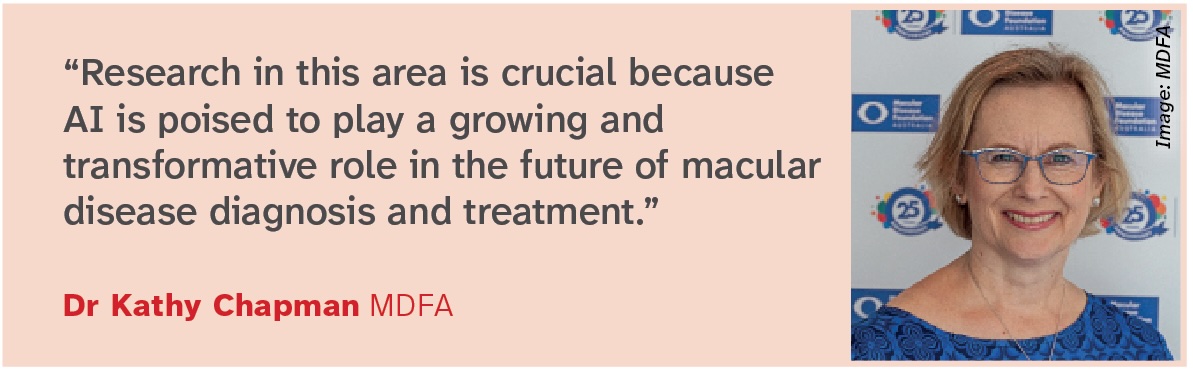
“Research in this area is crucial because AI is poised to play a growing and transformative role in the future of macular disease diagnosis and treatment,” she says.
“In our latest research grants round, we received several proposals involving AI, reflecting both the pace of innovation and the important role this technology can play in helping people living with macular disease.
“We will be supporting one new research project that involves AI-enabled technology in this latest grant funding round.”
Dr Chapman says MDFA is not directly advocating on AI policy at a state or federal level but is closely monitoring developments.
“We see AI playing an increasingly important role in the future of macular disease diagnosis and treatment,” she says.
“It has the potential to enhance diagnostic accuracy through advanced imaging analysis, support earlier detection by identifying patterns in large datasets, and help predict disease progression.”
But there are challenges too – “particularly when new technologies aren’t co designed with people experiencing vision loss”.
“We therefore encourage developers to work closely with people with lived experience to ensure these tools are truly fit for purpose.”
Looking into the future, Dr Chapman believes AI may also enable more personalised treatment approaches and optimise how therapies are delivered.
Emerging technologies like AI are also opening up new possibilities for researchers, she says, allowing them to analyse complex data and refine treatment strategies with a level of precision that hasn’t been possible before.
Scanning the future
Dr Chauhan also sees those grand possibilities.
Right now he’s focused on Macuject and what the company, supported by AI, can do to help people with wet AMD and the professionals and practices that support them.
“We’ll go into dry AMD,” he says. “A similar approach should work for glaucoma, myopia management, diabetic retinopathy, with image and data analysis.
“AI feeds into an established treatment protocol that people do all the time, but that treatment protocol can be configured by the doctors to their own specifications so that they’re comfortable using it.
“And then by doing that for long enough, we can then be in a position to start doing predictive analytics and helping them get even better results.”
A/Prof Cass also sees a big future for AI in eyecare, beyond AMD.
“I think you could have AI definitely assist with the assessment,” he says.
“You’ve got microperimetry, your standard kind of functional approach to measuring which parts of the visual field are affected, and you could speed that up with, with AI, and also just with basic imaging.
“That would mean early diagnosis, early assessment. I think that’s where it could assist.”
Reaching that future will need support, says Dr Chapman.
“Continued investment in macular disease research is essential if we are to realise the full potential of emerging technologies, including AI enabled tools,” she says.
“Australia has world leading researchers, but sustained funding from government, industry and the community is critical to ensure they can keep driving the innovations that will improve outcomes for people living with macular disease.”


