
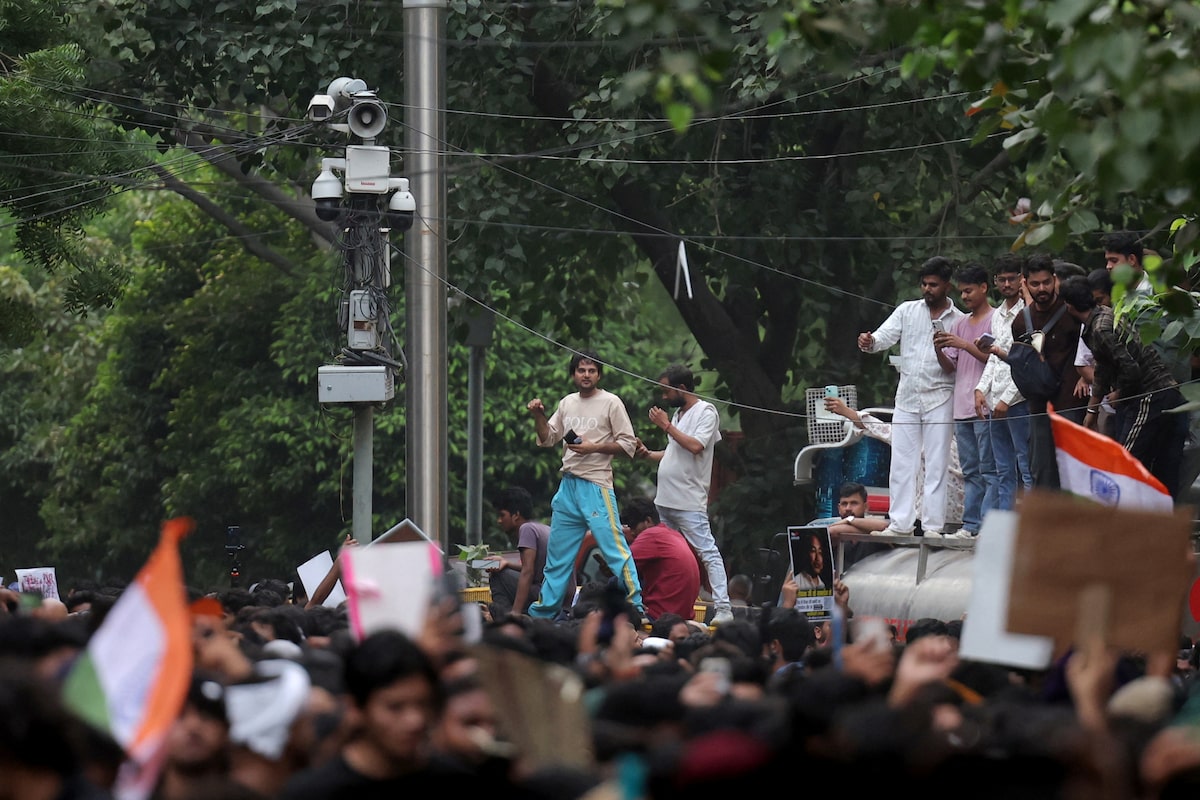
Surveillance cameras at the Jantar Mantar protest venue on July 19.Anushree Fadnavis/Reuters
Activists in India are challenging Prime Minister Narendra Modi’s government over the use of AI-powered surveillance during the largest youth protests in decades, and a court case will test federal power even after the agitation ends.
The surveillance debate erupted during last week’s student protests over leaked exam papers, with demonstrators posting photos on social media of a mobile police surveillance van with a camera mounted on a retractable mast, giving a 360-degree view of the gathering.
One of the protesters, student activist Aishe Ghosh, asked the Delhi High Court to declare the mass surveillance of protesters unconstitutional, order the destruction of all personal data collected during the protests, and create guidelines on how surveillance technology should be used.
Ghosh is pressing ahead with the case despite the resignation of Education Minister Dharmendra Pradhan and the end of the protests, an unusual setback for Prime Minister Modi. Mr. Modi later announced the formation of a committee to overhaul the exam system, which is prone to cheating.
Activists say India has no law regulating the use of facial recognition technology by police, and the surveillance at New Delhi’s main protest site is against the law.
What is the cockroach movement behind India’s protests?
The government says such tests are legal and in the public interest to ensure law and order.
The Modi government has often been criticized by opposition parties and digital rights groups for expanding surveillance powers and tightening controls on digital communications. The government rejected such accusations, saying it was only done in the public interest.
At a hearing on Friday, Attorney General Tushar Mehta defended the actions of Indian police, saying claims of privacy at public gatherings were “ironic” and that the checks were “absolutely necessary” and a “legitimate national interest.”
Police officers pass a surveillance van bearing the Delhi Police emblem and the branding “Ikshana”, which means “vision” in Hindi.Bawika Chhabra/Reuters
In a brief hearing Monday, the justices heard Ghosh’s argument that the intrusive mass surveillance of protesters was unwarranted because he had sought broad disclosure about the state’s surveillance policies during the protests. The court is scheduled to hear the matter on Tuesday.
The Internet Freedom Foundation, a New Delhi-based digital advocacy group, wrote to the Delhi Police chief on July 24, demanding the deletion of biometric data collected at protest sites.
Delhi Police did not respond to Reuters’ request for comment. In a post on social media platform X on Sunday, the force said it “did not restrict anyone’s freedom through the use of facial recognition technology.”
“Even when making national security risk claims, there has to be proportionality. Accountability has to go both ways,” said Akash Karmakar, technology law partner at Indian law firm Panag & Babu.
He said if India is using facial recognition to track protesters, it should also use it to identify police officers who allegedly acted without name tags during the crackdown.
Police were also seen taking note of the Instagram handles of protesters who arrived at the scene. When asked why, Inspector Sunil Kumar told Reuters it was to ensure that people with criminal records did not take part in the protests.
A surveillance van parked at the scene had the Delhi Police emblem and the brand mark “Ikshana”, which means “vision” in Hindi, affixed to it.
India creates special committee to overhaul exam system following protests from Gen Z cockroach movement
Few details about Ikshana have been published online, other than a post from its development partner, Indian CCTV company CP Plus. The company said it is equipped with an “advanced AI-powered” camera, a mobile camera, and a “varifocal bullet camera” with an adjustable lens.
The 2023 posting on the CP Plus website was removed over the weekend and is no longer accessible. CP Plus did not respond to a request for comment.
When a Reuters reporter passed by the van last week, his face was surrounded by a green rectangular box on the car’s computer display, with a “facial accuracy” match metric next to it. Shortly after, a police officer inside the vehicle rolled down the van’s windows.
“The computers here will help us identify people with criminal pasts and highlight them,” police officer Raj Kumar Dahiya told Reuters.
“AI can also help count the number of protesters.”


