Meta is scheduled to announce its second quarter financial results after the market closes today. The company entered this earnings announcement with high expectations from the market, but at the same time, pressure increased on the scale of its investment in artificial intelligence.
So far, investors have been happy with the aggressive spending increases because AI has powered Meta’s most important business: advertising. Improve user engagement, ad impressions, and ad value with better recommendation systems, more effective targeting, and automated campaign creation.
But today, the market expects more. Meta will need to prove that its huge investments in data centers, computing power and the development of its own AI models have the potential to generate new revenue streams in the future.
In recent weeks, reports have focused particularly on Meta’s potential to develop its own AI infrastructure and make its computing power available to outside companies. Such a move would open up new business opportunities similar to AI cloud services and allow Meta to better leverage the infrastructure currently built for its models and products.
There are also reports of Meta developing its own computing chip. In the long term, developing its own chips could reduce Meta’s dependence on external suppliers and make its AI infrastructure more cost-effective. However, at this stage, the market needs concrete information regarding the timeline, scale, and commercialization of these solutions. Announcements alone are not enough to change the economics of such a large investment.
So today’s report will be a test not only of advertising performance, but also of the reliability of Meta’s long-term AI strategy.
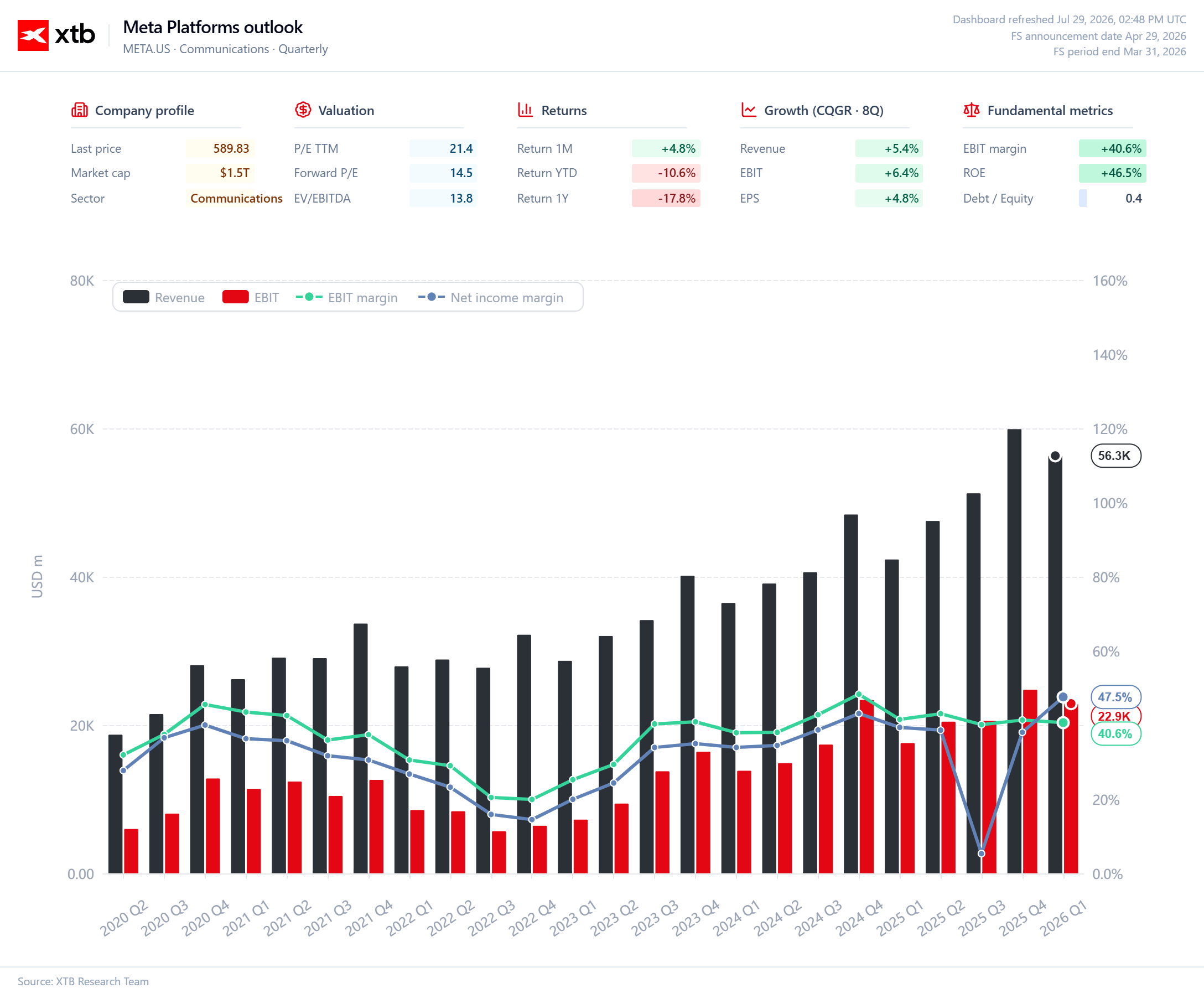
Key financial expectations
-
Revenue: $60.24 billion
-
Advertising revenue: $59.07 billion
-
Operating profit: $21.5 billion
-
App family operating income: $26.11 billion
-
Reality Labs operating loss: $4.45 billion
-
Operating profit margin: 35.6%
-
EPS: $7.15
-
Growth in number of ad impressions: Approximately 14.6% compared to the previous year
-
Average ad unit growth: Approximately 11.7% compared to the previous year
Forecast for next quarter
-
Expected third quarter revenue: $63.17 billion
-
Estimated third quarter capital expenditures: $38.88 billion
-
Estimated full-year capital expenditures: $135.79 billion
-
Estimated total annual cost: $163.02 billion
Consensus points to a very strong quarter
According to market consensus, Meta is expected to have second-quarter sales of approximately $60.2 billion and earnings per share of $7.15. The majority of revenue still comes from advertising, with consensus estimates pegging advertising revenue at approximately $59.1 billion. This shows that despite the growing importance of AI, the foundation of Meta’s business remains the social platform’s scale and ability to effectively monetize its huge user base.
The market also expects an increase in ad impressions and an increase in average ad prices. Combining higher ad volumes with higher prices can increase your revenue quite significantly.
However, such high expectations mean that meeting consensus may not be enough. Investors will be hoping for a clear positive surprise in both revenue and EPS, as well as management’s comments on future quarters. Meta must demonstrate that AI not only supports current advertising models, but also increases the company’s long-term growth potential.
Advertising remains fundamental, AI must increase efficiency
Meta’s most important revenue stream remains its Family of Apps division, which includes Facebook, Instagram, Messenger, and WhatsApp.
The scale of this ecosystem is enormous. According to consensus estimates, the average number of daily users across the Family of Apps services is expected to reach approximately 3.61 billion. Such a large user base gives Meta unique advantages in terms of data, distribution, and ability to deploy AI solutions.
Artificial intelligence can increase the value of Meta’s advertising business on several levels. AI models improve content recommendations, increase time spent on the platform, and help advertisers create campaigns and optimize advertising effectiveness.
The advertising results will therefore be the first test of the economic value of AI. If Meta shows both an increase in ad volume and an increase in average ad price, the market could conclude that its investments in AI models and infrastructure are starting to yield tangible benefits for the company’s most important business segments.
At the same time, investors will analyze whether improved ad performance is a permanent result of AI implementation or primarily a result of favorable conditions in the digital advertising market.
Possibility of “AI Cloud” to generate new revenue sources
One of the most interesting elements of today’s earnings call may be Mark Zuckerberg’s comments about the possibility of making AI’s computing power and infrastructure available to external customers.
Meta builds large-scale infrastructure primarily for its proprietary models, recommendation systems, and AI-based products. By making some of these resources available to external customers, the company could better utilize its growing computing power and potentially generate additional revenue streams.
However, a potential AI cloud business would bring major changes to Meta’s operating model. The company not only needs sufficient infrastructure, but also a product that can compete with the largest cloud providers.
Therefore, the market expects concrete information.
-
whether Meta is already in discussions with potential customers;
-
What forms may access to computing power take?
-
whether Meta plans to provide access to its own AI models;
-
When a new business has the potential to start generating revenue,
-
Whether the infrastructure built for Meta’s own needs can be effectively utilized by external customers.
It must be clearly emphasized that potential AI cloud business is primarily a strategic opportunity at this stage. If management presents a concrete plan, the market may begin to value Meta not only as a leader in digital advertising, but also as a provider of future AI infrastructure and services.
Proprietary chips could change AI economics, but details needed
Meta has recently been in the spotlight due to reports about the development of its own computing chips.
Strategically, such a direction makes sense. By using its own chips, Meta can tailor its infrastructure to specific applications, reducing dependence on external suppliers and potentially lowering the cost of AI processing in the long term.
However, the potential benefits are still far away. Designing and deploying your own chips requires years of investment, access to advanced manufacturing technology, and the right software ecosystem. Therefore, investors should treat current information as part of a long-term strategy, rather than as a factor that could materially change financial results in the short term.
Still, today’s report could provide important insight into the chip’s development timeline, its applications, and its potential impact on future capital expenditures.
Capital investment tests market tolerance
Unless there are big surprises, the biggest risk remains the size of investment spending. Meta previously raised its full-year capital spending outlook to nearly $145 billion. This significant investment shows that Meta is aggressively expanding its data centers and infrastructure needed for AI development.
As with Microsoft, the market may be willing to accept higher capital expenditures if the investments lead to demonstrable growth in advertising revenue, improved operational efficiencies, and the creation of new monetization opportunities.
But if spending continues to rise without similarly clear evidence of a return on investment, investors could begin to question the pace of infrastructure expansion. Therefore, the relationship between capital spending and future earnings growth will be one of the most important topics on today’s earnings call.
High spending isn’t necessarily a problem, as long as Meta demonstrates that it’s building its infrastructure according to real demand and has concrete plans for commercial use.
Reality Labs keeps the pressure on results
Another area that needs attention is the Reality Lab.
Consensus estimates are for sales of approximately $428.7 million and operating loss of approximately $4.45 billion. This sector continues to incur significant costs and remains a burden to overall meta profitability.
However, Meta is able to continue funding these investments thanks to Family of Apps’ high profitability. Consensus estimates project the segment’s operating income to be approximately $26.1 billion.
The long-term vision associated with Reality Labs remains an important part of Meta’s strategy. But in the short term, investors will primarily be evaluating whether cost increases continue to be justified and whether new monetization opportunities are emerging.
Meta must show more than a strong quarter
Three main scenarios could emerge from today’s results.
The positive scenario assumes clear achievement of consensus expectations, strong advertising performance, growth in ad impressions and average ad price, and positive guidance for the next quarter. Additional catalysts could be concrete AI cloud development plans and compelling information about monetizing infrastructure and models. In this case, further increases in capital investment may be seen as positive. The market will conclude that Meta is investing in response to growing demand and has a real opportunity to turn its AI infrastructure into a new revenue stream.
The neutral scenario assumes that results are in line with consensus, advertising momentum is stable, and there is no new information regarding commercialization of AI. Such reports may prove insufficient, especially if management raises its spending forecasts again.
Negative scenarios include weak advertising performance, compressed margins, and continued increases in capital spending without a clear plan for monetizing AI infrastructure. This combination could raise concerns that the cost of developing AI is rising faster than the economic benefits.
Will there be a return on investment?
Meta remains one of the companies best positioned to benefit from artificial intelligence.
The company has a large user base, one of the most profitable advertising businesses in the world, and the ability to rapidly deploy AI into products used by billions of people.
At the same time, the size of investments is rising to a level where concrete evidence of future returns is increasingly required.
In today’s report, we answer some important questions.
-
Will AI continue to improve the efficiency of Meta’s advertising business?
-
Are ad impressions and price growth strong enough?
-
How does Meta plan to monetize its growing computing power?
-
Will the AI cloud business become a new source of revenue?
-
What are the actual plans for proprietary chips?
-
Will the increase in revenue justify further increases in capital expenditures?
Meta can have very powerful results today. But to provoke a definitively positive market reaction, the company will likely need to offer something more: a strong break with consensus expectations, clear confirmation of the effectiveness of AI in advertising, and concrete information about the future monetization of its infrastructure.
Source: xStation5