Legora’s origin story began with a simple observation. A friend of mine spent the summer summarizing the case by hand. Not because the work was too complex, but because there was no software that matched the nature of the legal work. This insight became a company and was honed through partnerships and product iterations, along with the lawyers who use it.
From these early learnings, Legora launched its platform in October 2024, and what has since become one of the fastest growth trajectories in enterprise software history. In April 2026, Legora surpassed $100 million in annual recurring revenue (ARR) in just 18 months, surpassing OpenAI, Anthropic, Cursor, and Wiz.
This places Legora among a rare group of AI-native businesses that have expanded so quickly. The company is setting a new standard for AI growth, recently closing a $550 million Series D round at a valuation of $5.55 billion, bringing total funding to over $815 million.
Today, Legora serves more than 1,000 law firms and in-house legal teams in more than 50 markets, and tens of thousands of legal professionals use the platform every day. Its client roster includes some of the world’s most prestigious institutions, from global law firms such as White & Case, Cleary Gottlieb, Goodwin, Linklaters, and Dentons to large corporations and professional services firms such as Deloitte, Blackstone, Barclays, EY, and Danaher. Over the past year, the company has expanded from 40 to more than 400 employees, with offices in Stockholm, London, New York, Denver, Sydney, Bengaluru, and plans to open new hubs in Houston and Chicago.
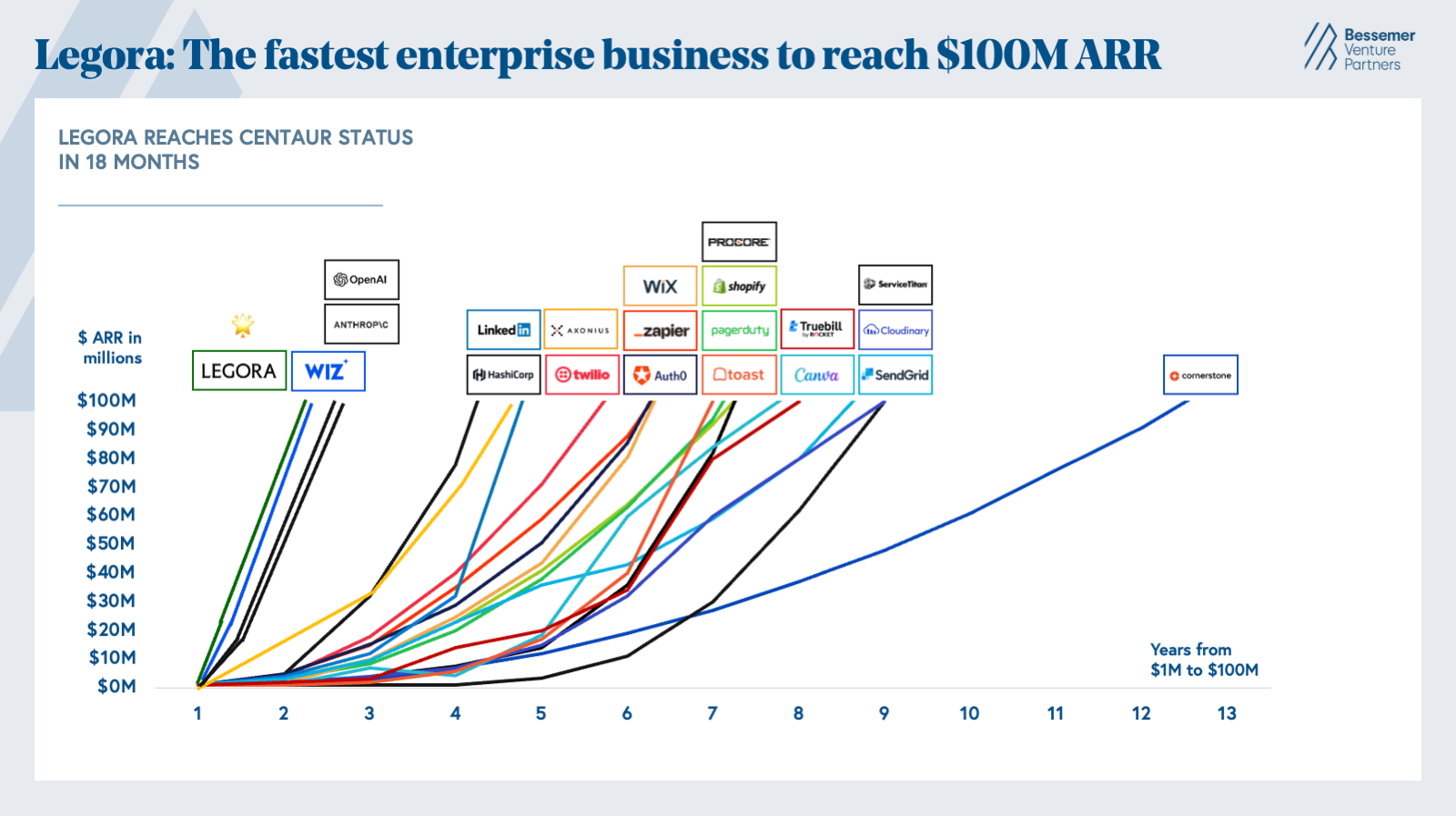
| Centaur status is a rare technology business with annual recurring revenue of $100 million, which is about seven times rarer than a unicorn company. The average Cloud 100 company took 7.5 years to reach this milestone. AI-native companies are getting there faster, on average in about 5.7 years. |
To further put Legora’s efforts into perspective, the team signed its first paying customer at the end of 2023, at the time operating from a small conference room in Stockholm with a team of five. This story is more than just an adoption story. This is a transformation, with legal teams moving from using AI for discrete tasks to incorporating AI as the core infrastructure for doing legal work. This is why the Legora team is so different.
The story behind enterprise software’s fastest growth trajectory
Max Joonstrand did not arrive at legal AI through law. Early paths into engineering and competitive gaming, along with a constant desire to solve difficult problems, shaped his path. He holds a master’s degree in computer science with a specialization in machine learning from KTH Royal Institute of Technology, a bachelor’s degree in business administration from Stockholm University of Economics, and a master’s degree in engineering from the University of Illinois at Urbana-Champaign. This foundation will prove essential to building the intersection of enterprise software and a profession defined by precision.
Before founding Legora, Max balanced a full-time job with roles at McKinsey and venture capital, developing a keen eye for where technology lags behind the scenes in his professional work. He was also a competitive esports player, but ultimately turned down a potentially multi-million dollar gaming career to build Legora. With the spirit of a gamer, Max operates with speed, pattern recognition, constant repetition, and a tenacity to win.
What Max lacked in his legal resume, he made up for in conviction. He saw AI poised to change the way knowledge work is done and believed the legal profession, a trillion-dollar industry still built on billable hours, represented one of the world’s greatest opportunities. He wanted to be the partner law firms needed to navigate this transition.
5 decisive approaches that give Legora an edge
Legora’s competitive advantage comes from a shift away from a traditional SaaS strategy. These five approaches helped the team accelerate product development, establish market leadership, and accelerate revenue in record time.
1. Starting in Stockholm, outside of the Silicon Valley hub, helped the company establish itself as a world leader. While nearly every other legal AI company planted its flag in the Bay Area, Max and his co-founders started by earning the trust of Mannheimer Swartling, one of Sweden’s most prestigious law firms. This early partnership became the cornerstone of the company’s global GTM strategy.
2. Max and the team bet on the model, not against it. When Legora was founded, the conventional wisdom among enterprise AI companies was that to win, you needed to tweak your models or build your own. Max took the opposite approach. They believed that the underlying model had a huge opportunity for improvement and that betting on the model company was a losing strategy. Rather than competing with Anthropic and OpenAI, Legora builds on top of these models with scaffolding, software, and the right user experience, tailored to help lawyers.
3. Legora was built for both human and agent users from day one. While other companies were designing products specifically for humans, Legora was also building products for agent users in its early days. This forward-thinking approach to agent workflows, where AI agents handle complex, multi-step legal processes end-to-end, has given Legora a significant head start as the industry moves towards autonomous legal operations.
4. Legora adopted radical iteration speed. While other companies have experienced long product development cycles and high sunk costs in shipping, Legora has traditionally been known for only fast iteration cycles. As a result, the team was able to safely retire products that no longer provided significant value to users. Where others might plan product roadmaps that span several quarters or years, Legora works on product roadmaps on a weekly or even daily basis. They take their customers on a journey, gather continuous feedback, and ship accordingly. Customers we spoke to cited Legora’s product speed as a deciding factor.
5. Embodied core values set a company apart. Legora leads with transparency, builds publicly, and treats every customer relationship as a long-term collaboration. Max’s founder-led sales approach saw him personally responsible for onboarding Legora’s first 30 clients, which led to the company’s partnership-first GTM model. Known as Legora’s “Legal Engineers,” they perform everything from initial demos and use case design to pilots and full-scale implementations, and are embedded within the enterprise to drive adoption by practice area.
Building a legal OS for the AI era
Legora started with an ambition to empower what Max calls “10x lawyers” and enhance their legal workflows. And now, with ARR reaching $100 million and the fastest growing vertical AI in Centaur history, it’s clear that Legora is on track to scale its AI-powered collaborative operating system for legal practices around the world. At Bessemer, we are in awe of Regola’s growth curve and know that this historic company will become a leading example and author of strategies being rewritten for the AI era.