Today, we are excited to announce that Anthropic’s most advanced Opus model, Claude Opus 4.8, is now available on Amazon Bedrock and the Claude Platform on AWS. Claude Opus 4.8 represents a meaningful step forward, delivering improvements across the workflows teams perform in production, from agent coding and deep knowledge work to multi-step autonomous tasks spanning hours of independent operation. Claude Opus 4.8 on Amazon Bedrock lets you build within your existing AWS environment, maintain enterprise security and regional data residency, and scale inference. Claude Opus 4.8 is also available from the Claude Platform on AWS, providing Anthropic’s native platform experience when regional data residency is not required.
This post describes improvements in Opus 4.8 and practical guidance for AI engineers integrating models into agent systems and production inference workloads on Amazon Bedrock. See the Claude Platform on AWS documentation.
Differences between Claude Opus 4.8
Claude Opus 4.8 is designed to change what teams can hand off to Claude, delivering improved performance across coding, agent tasks, and professional work, and consistency and autonomy for long-term operational workflows. Opus 4.8 allows you to keep plans across multiple stages, better track what you’ve done and what’s left, and adjust your trajectory when something breaks instead of surfacing errors and stopping. This should result in less variation in output, fewer review cycles, and more predictable behavior at scale.
When it comes to coding, Opus 4.8 is designed to help you navigate real codebases, plan before editing, and maintain context over long sessions. Multi-stage tasks can track dependencies and remain consistent over long runs. This same autonomy extends to agent workflows, allowing them to handle complex dependency chains and the use of multi-step tools with less oversight, making them a strong fit for both customer-facing and in-house agents. In professional work, Opus 4.8 integrates long and complex sources into structured deliverables such as summaries, analyzes and reports.
Industry use cases
Claude Opus 4.8’s features are ideal for industries where consistency and depth are paramount. For financial services teams, Opus 4.8 supports investment research and return analysis, delivering context throughout the reporting cycle. For legal teams, it enables contract review, due diligence, and first drafting of motions and memos. In the life sciences, we help with literature reviews, drafting regulatory submissions, and integrating clinical trial data. In cybersecurity, keeping long traces in context and large codebases enhances threat intelligence integration, vulnerability discovery, and incident response.
Getting started with Claude Opus 4.8 on Amazon Bedrock
You can start using Claude Opus 4.8 in the Amazon Bedrock console.
- In the Amazon Bedrock console, testchoose playground.
- Select Claude Opus 4.8 as the model. You can now use the model to test complex coding prompts.
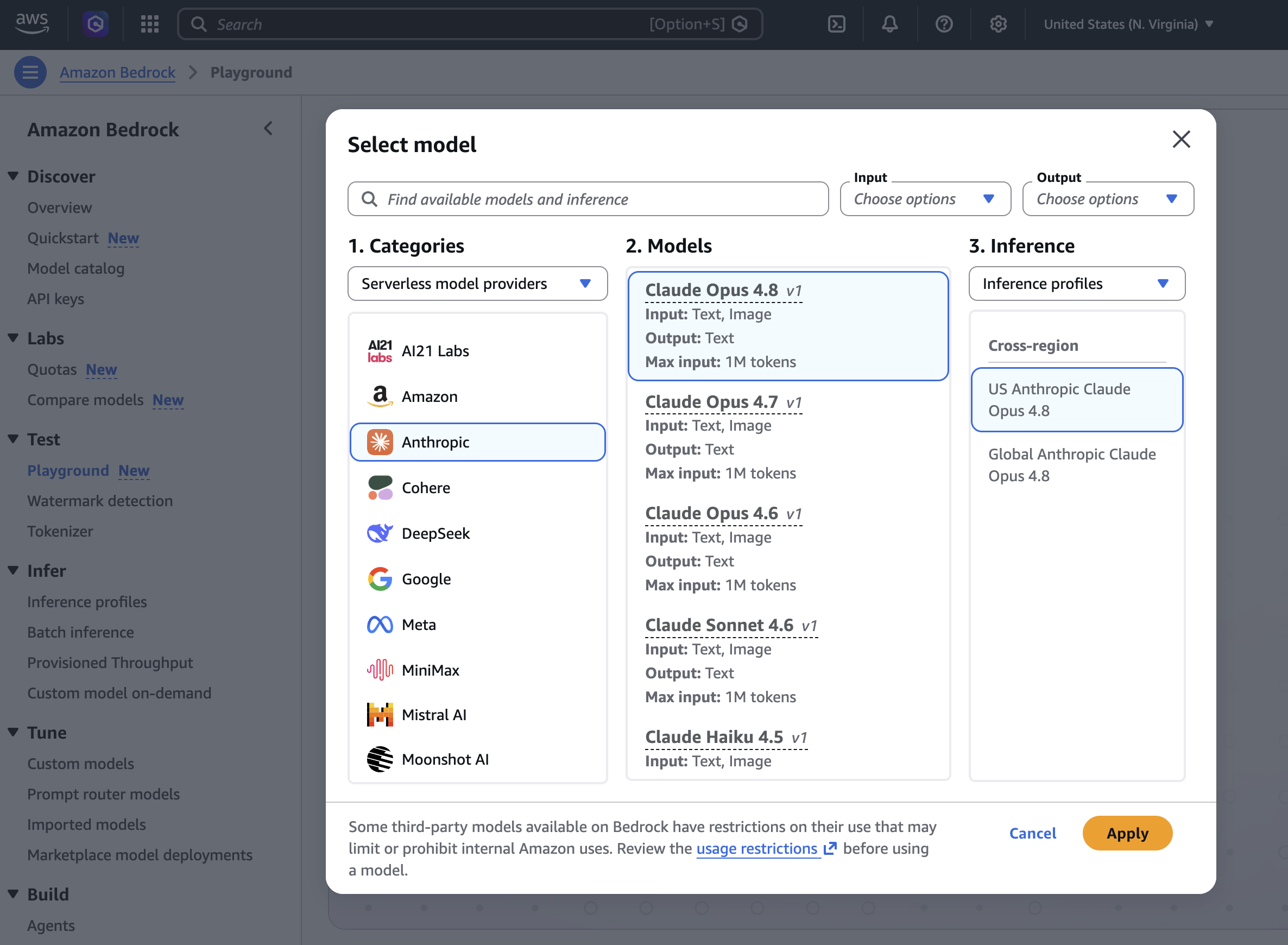
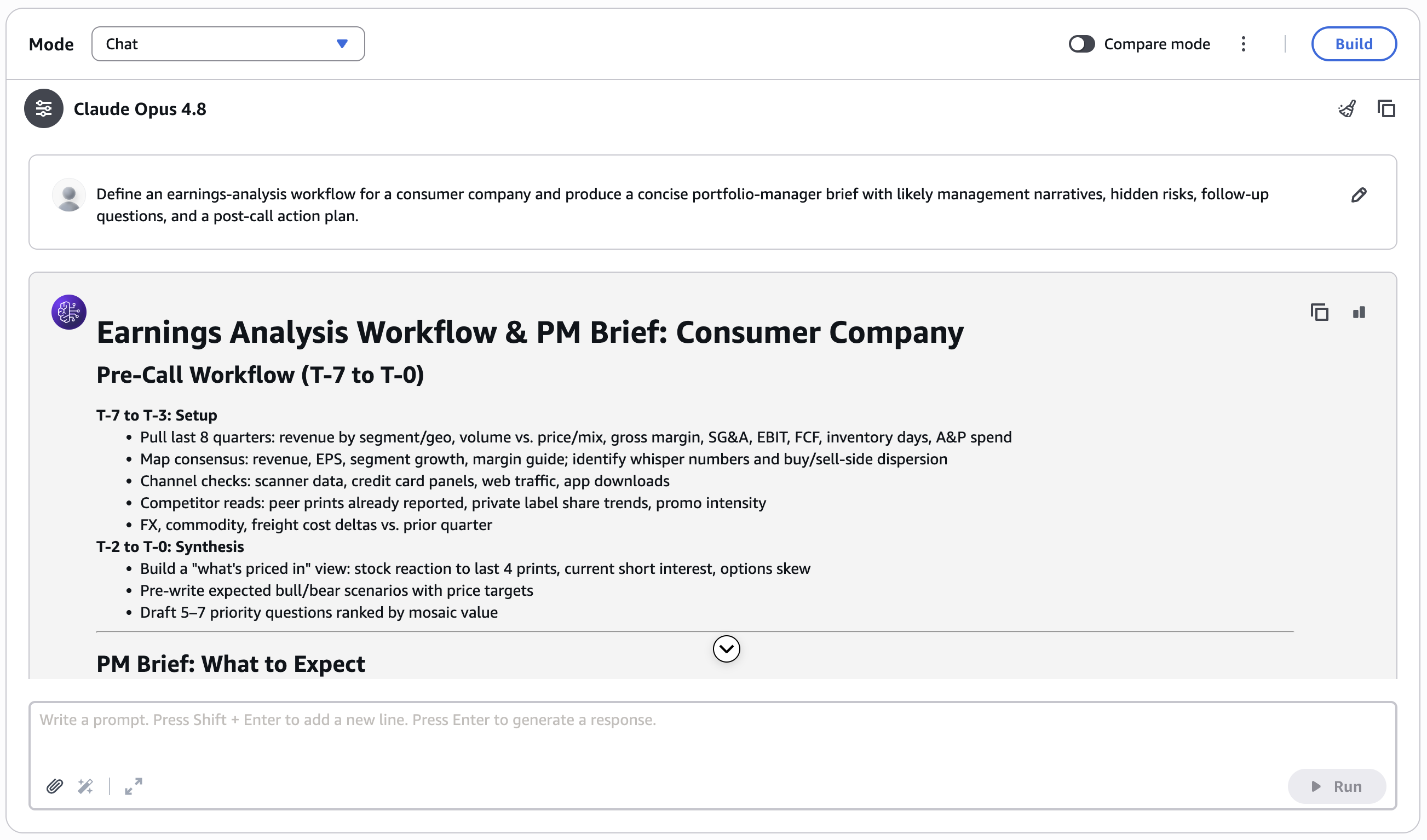
Amazon Bedrock console playground with Claude Opus 4.8 selected
Access models programmatically using the Anthropic Messages API and bedrock-runtime through the Anthropic SDK, or bedrock-mantle Use endpoints or continue using Invoke and Converse APIs. bedrock-runtime Via the AWS Command Line Interface (AWS CLI) and AWS SDKs.
Prerequisites
- An active AWS account with access to Amazon Bedrock
- AWS CLI is installed and configured
- Python 3.8+
- Boto3 is installed:
pip install boto3 - IAM permissions:
bedrock:InvokeModelandbedrock:InvokeModelWithResponseStream
Here’s a simple example using the AWS SDK for Python (Boto3).
You can also use Claude Opus 4.8 and the Amazon Bedrock Converse API for an integrated multi-model experience.
availability
Claude Opus 4.8 is currently available on Amazon Bedrock in regions including US East (N. Virginia), Asia Pacific (Tokyo), Europe (Ireland), and Europe (Stockholm). Please refer to Bedrock documentation for a complete list of supported regions. Claude Opus 4.8 is also available on the Claude platform on AWS in North America, South America, Europe, and Asia Pacific.
Try Claude Opus 4.8 in the Amazon Bedrock console or Claude Platform on AWS, or see the Getting Started notebook on GitHub. You can also use Amazon Bedrock’s Advanced Prompt Optimization to unlock the full potential of Opus 4.8. This takes the current prompt, benchmarks it against the evaluation criteria, and outputs a production-ready rewrite.
About the author
 Amna Najmi is a Senior Specialist Solutions Architect in Generative AI, focusing on human models and operating and managing large-scale generative AI systems on Amazon Bedrock. She helps ISVs use Amazon Bedrock to solve challenges, embrace innovation, and create new business opportunities. In my spare time, I pursue my passion of trying food and discovering new places.
 antonio rodriguez Principal Generative AI Technology Leader at Amazon Web Services. He helps companies of all sizes use Amazon Bedrock to solve challenges, embrace innovation, and create new business opportunities. Outside of work, I love spending time with my family and playing sports with friends.
 Eugenio Soltero is a Senior Product Marketing Manager for Amazon Bedrock on AWS. With years of experience in generative AI, we help customers navigate the evolving landscape of underlying models and generative AI, and deploy solutions that deliver measurable value.
 Sofian Hamiti is a technology leader with over 12 years of experience building AI solutions and leading high-performing teams to maximize customer outcomes. He is passionate about empowering diverse talent to increase their global impact and achieve their career aspirations.
 Ayan Ray He is a Principal Partner Solutions Architect and AI Tech Lead at AWS and serves as the Worldwide Tech Lead for Anthropic on AWS. He works at the intersection of cloud architecture and artificial intelligence, helping organizations adopt and scale Anthropic’s technology on AWS.