Beijing, April 27, 2026 /PRNewswire/ — On April 16, 2026, the JXQ AI Forum 2026, hosted by Beijing Electronic Digital & Intelligence (BEDI), concluded in Beijing. Themed “Empowering Today, Inspiring Tomorrow”, the forum explored practical paths to drive industry development in the context of the early stages of the 15th Five-Year Plan period and China’s National AI Strategy. During the event, BEDI announced Spark AI Cloud 2.0, released the “China Urban Artificial Intelligence Index Report”, introduced the “AI China Tour” initiative, and announced the establishment of an industrial collaboration alliance for AI innovation district. These initiatives outline a new paradigm for industrial and urban integration in the upcoming 15th Five Year Plan period.
The forum agenda included 14 thematic sessions across four key areas.“, “New economy”, “industrial development”, “new trends”. It covers over 100 topics including computing infrastructure, trusted data, smart cities, industrial applications, talent ecosystem, investment and financing, and more. The conference brought together representatives from government, industry, academia, research, and applied fields, including academics from CAE and SAEng, and experts and academics from institutions such as MIIT, SASAC, National Health Commission, Tsinghua University, and CAS. In addition to officials from the Beijing municipal government and Chaoyang district authority, government representatives from several regions also participated. International guests from Kazakhstan, Indonesia, Thailand and the United Kingdom attended. The three-day forum attracted more than 2,200 participants and received more than 7.2 million views online.
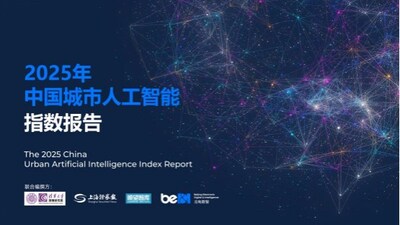
”China Urban Artificial Intelligence Index Report” Establishing a new benchmark for industrial urban development
As AI applications continue to expand across economic and social sectors, China’s urban AI development has moved from a phase led by first-tier cities to a new cycle characterized by both gradual expansion and structural transformation. Given the vast differences between cities in terms of resource endowment, industrial base, and governance capacity, there is an urgent need to establish a scientific evaluation system for targeted guidance.
Against this background, the “China Urban Artificial Intelligence Index Report” was officially announced at the forum. The report was jointly produced by Tsinghua University Institute of Contemporary China (ICCS), Shanghai Securities News, Outlook Think Tank, and BEDI Institute, with assistance from a team of experts including the University of Science and Technology of China (USTC) and the CICC Global Institute.
This report introduces a city AI rating system that covers four main aspects: industrial development, technological innovation, public services, and governance environment. It is also the first to systematically identify a three-tiered structure of urban AI development in China, classifying cities into three different tiers: Leading Cities, Dynamic Cities, and High Potential Cities. Additionally, the report is based on the real experience of benchmark cities and provides clear and actionable development approaches tailored to different city types. It aims to help local governments refine their industrial development strategies, help businesses seize market opportunities and contribute to national efforts to improve regional collaboration.
spark•AI cloud upgraded to 2.0, forming new foundation for China‘urban development
Building on the regional differences and cooperation needs highlighted in the report, BEDI emphasizes that the key to AI development lies in building scalable infrastructure and enabling a coordinated industrial ecosystem, rather than individual technological breakthroughs. Xie Dong, Chief Technology Officer of BEDI, commented, “The transition to large-scale AI adoption is defined by lower barriers to use. Enterprises will be able to deploy and apply AI in a lower cost and easier way, allowing them to continuously transform data into real productivity.”
In line with this vision, BEDI announced Spark•AI Cloud 2.0, a next-generation AI production system, marking the evolution from a computing platform to an integrated AI production environment. At the core of Spark AI Cloud 2.0 is Qianjin AIOS and Xintian AgentOS. It integrates compute, model, and application capabilities into a unified architecture that streamlines the entire process from data and compute to model development and application deployment, providing standardized functionality for real-world business scenarios. The platform is designed to address three common challenges in AI deployment: complex deployment, high cost, and limited scalability. Overcoming these barriers will enable organizations to scale AI beyond pilot projects into real-world operations.
At the application level, BEDI proposes a “one foundation, two breakthroughs” development path. On the one hand, it is helping industries such as manufacturing, cultural tourism, and the consumer sector to develop new growth models. Meanwhile, it will strengthen governance and service capacity in public services such as health, government, and education. Through continuous local engagement and scenario-driven implementation, BEDI is moving AI applications from isolated pilot projects to scalable solutions and accelerating the development of new quality production capabilities.
”AI China Tour” Launches initiative to drive national adoption of industrial-urban integration paradigm
In order to accelerate the nationwide implementation of the new industrial and urban integration paradigm, the “AI China Tour” initiative was officially launched at the forum. The initiative, jointly launched by Shanghai Securities News and BEDI, brings together a group of high-level experts from industry, academia, and research institutions. Based on the principle of “engaging key decision makers to shape the future of the industry”, we leverage the findings and data insights from the China Cities Artificial Intelligence Index Report. The team will focus on empowerment approaches tailored to different regions and industries, work with local governments through AI industry planning consultations, and implement a series of targeted measures to support AI industry upgrades in more cities.
Establishment of industrial collaboration alliance for AI innovation district, fostering new high ground for AI development
As part of Beijing’s broader efforts to become a global AI innovation leader, the city announced its first four AI innovation districts this year, including Guangzhi Space in Chaoyang District. Guangzhi Space is centered on the integration of optical computing and intelligent technology, with a focus on next-generation computing infrastructure and advanced AI applications. It aims to establish a comprehensive AI innovation services ecosystem, accelerate the integration of AI into real-world scenarios, and foster new business models and industry formats.
During the forum, Chaoyang District officially launched the global recruitment of contributors to the AI Innovation District planning guidelines, as well as the global recruitment of the district’s logo and digital mascot. The district also announced the creation of the Collaborative Industry Alliance for an AI Innovation District and launched three major projects, including the integration of quantum-classical computing.. Going forward, BEDI will play an active role in the alliance and be deeply involved in the development of the AI innovation district, providing end-to-end support from technology innovation to industrial deployment, and helping the Chinese government build a major hub for AI industry development.
At the start of the 15th Five-Year Plan period, the JXQ AI Forum continues to serve as a high-level platform bringing together government, industry, academia, and research stakeholders. By facilitating the precise and practical application of AI across diverse local contexts, this forum aims to help every city identify its own path to growth and unleash new momentum for quality development.
Sision
View original content to download multimedia: https://www.prnewswire.com/apac/news-releases/jxq-ai-forum-2026-unveils-new-ai-driven-growth-paradigms-for-industry-city-integration-in-the-15th-five-year-plan-period-302754086.html