
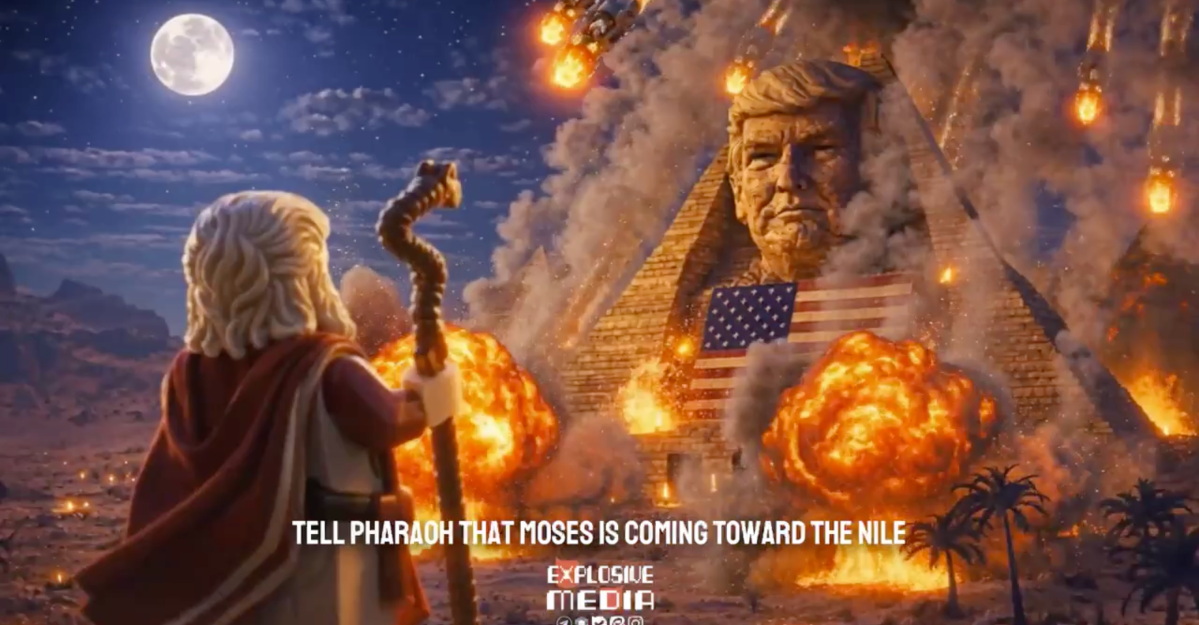
President Donald Trump touted the recent rescue of an airman whose fighter jet was destroyed near the Iranian border as a huge success. But in one of the many viral AI-generated Lego videos produced by Iranian content production group Explosive Media in the weeks since the US and Israel began dropping bombs on Iran, the story is much different. Explosive Media’s music video covers the turn of events, joking that the U.S. military lost multiple planes and helicopters and spent “$100 million just to save one person.”
A video showing a Lego jet exploding into $100 bills and gold coins reinforces the idea that the US is wasting taxpayers’ money just to be outsmarted by Iran’s military. And the accompanying AI-generated lyrics send a clear message that Iran is prepared to do it again the next time the US attacks.
Explosive Media’s content is clearly propaganda. But the simplicity of its message helped turn the group’s video into a viral phenomenon. These videos are being shared on the internet, with people (many of them in the US) praising the way they shamed President Trump and reminding viewers that before this war began, the Trump administration was busy downplaying the president’s relationship with Jeffrey Epstein. On TikTok, the video’s unofficial upload attracted thousands of comments from people who supported Explosive Media and said their video and surprisingly catchy AI song were more useful than what Western media was reporting.
Groups like Explosive Media are helping Iran win the meme-fueled war of ideas and perceptions by capitalizing on the public’s disdain for Trump and his allies. And it looks very much like the Iranian side is dominating Trump at a time when the White House is trying to appear to have a deep understanding of how to shape online discourse.
Explosive Media’s official YouTube and Instagram pages were both recently deleted. YouTube says their videos violate the platform’s policies on spam, deceptive practices, and fraud. But it’s not hard to find the group’s AI-generated shorts slamming the US and Israel’s attacks on Iran. Even if you don’t keep up with war news, you’ve probably seen some of Explosive Media’s work while scrolling through X or TikTok. With Explosive Media consistently releasing new videos almost daily that clearly comment on recent events, despite internet blackouts, it seems possible that the group is a large organization with ties to the Islamic Revolutionary Guard Corps’ content creation machine. This would make the group an extension of the same government structure that turned Iran into an authoritarian theocracy where political dissent is violently suppressed.
But when I recently spoke with members of the group through a Telegram channel linked to multiple Explosive Video accounts, they claimed they were a team of about 10 people operating independently of Iranian state media. Explosive Media claims that they believe that remaining independent and relatable to Gen Z (and their allies) are key ingredients to achieving their larger goals. And representatives emphasized that using LEGO aesthetics to spread the message is an important part of building a global audience.
“Lego is a universal language,” said a member of Explosive Media. “It gets your message across easily, is playful, doesn’t require extreme realism, but can include surprising details.”
Explosive Media’s latest video leans toward dark, absurdist comedy, depicting the American and Israeli heads of state as empathetic minifigures. In one photo, President Trump and Israeli Prime Minister Benjamin Netanyahu nervously draw up a cease-fire request as the Devil sits next to them, smiling. After taking a beat to tease what is happening at the hands of President Trump and draw comparisons between the children killed in the US military attack on Minab’s elementary school and Jeffrey Epstein’s victims, the video cuts to a montage reenacting a number of recent successful attacks by the Iranian military. Another video addresses Pete Hegseth directly, using an AI-generated vocal track similar to Macklemore’s to poke fun at the current Secretary of Defense’s drinking problems and multiple scandalous allegations of sexual assault against women.
You can immediately tell that Explosive Media’s animations are made with AI. But their content feels different from most of the crap that pollutes the internet, and not just because war is unpopular. Each video tells a coherent story with clearly defined characters, and its (general) visual consistency allows you to follow the story even when you’re not watching with the sound on. While Explosive Media maintains an up-to-date list of potential concepts that can be turned into videos, each project begins with a script that is used to generate AI footage and accompanying musical compositions before everything is integrated using post-production software.
A member of Explosive Media I spoke to explained that they are using generative AI “as a tool to present the truth in a compelling way and break down censorship walls” that are negatively impacting people’s perceptions of Iranians. For the group, there is little difference between Gen AI and other types of technology in that it can be used for good or bad, and they believe their video is a prime example of how dynamic Iranian storytelling is.
“For many years, Western audiences have been instilled with a distorted view of our country by mainstream media,” a representative told me, referring to the idea that Iran is an underdeveloped and uneducated country. “When we release these animations, Western viewers are initially surprised that such work comes from Iran. That’s when the misconceptions start to change. And that’s exactly what we aim to do.”
Explosive Media’s content is much more sophisticated and interesting to watch than the White House troll shit or the vulgar videos President Trump regularly posts on his social feeds. But they all reflect how people are using AI-generated content to shape online discussions about serious real-world events. One reason Explosive Media’s video resonates more is the fact that, in addition to making fun of the United States and its allies, it implores Iranians to be seen as a people with a razor-sharp sense of humor who are fighting foreign threats to their country.
In contrast, the White House has used AI “memes” shared through official channels to bash the public and belittle its strict policies. When President Trump posted a video of him using a fighter jet to dump feces on No Kings protesters, House Speaker Mike Johnson claimed that the president was simply “using satire to get his point across.” The point seems to be the blatant dehumanization of Trump’s critics, which is one of the main reasons why meme content in the US feels different from what’s coming out of Iran.
When asked if Explosive Media views its content as being in conversation with the White House’s social media posts, a representative said it “doesn’t compare.” [themselves] Because, “You cannot create works that touch the heart with hands stained with innocent blood.”
Not only is Explosive Media’s meme more convincing, it also highlights a larger problem with the White House’s communication about this war in the first place. US messaging about why it attacks Iran and how much devastation this war is actually causing is incredibly confusing. When President Trump claimed on CBS last month that the US and Israeli bombardment of Iran was “very complete, almost complete,” that was a lie. In a separate speech the same day, Trump said the United States “will not relent until our enemy is completely and decisively defeated,” adding that the war “could go even further.”
“Works that touch people’s hearts cannot be created with hands stained with innocent blood.”
Since then, the conflict has escalated, President Trump has issued death threats against the entire Iranian civilization, and a delicate ceasefire has reportedly been violated by Israeli forces. The lack of transparency from the White House during the war made it nearly impossible to take statements from government officials like Mr. Hegseth at face value. Hegseth has repeatedly exaggerated the effectiveness of the U.S. campaign against Iran, and the Pentagon has been accused of significantly underreporting military casualties.
While Explosive Media seeks to speak to a public that may not think of itself as directly connected to America’s participation in this war, the group also sees its current popularity as a teachable moment that larger, more established media organizations should pay close attention to. The group’s representatives argued that the lesson here is that traditional news outlets have a duty to “bring the voices of people, especially young people and people fighting for their lives, to the world.”
But there’s more to come from Explosive Media’s rise to prominence with Gen AI. This group and others like it produce sophisticated propaganda designed to speak directly to people outside Iran. lego movie (It was never shown in theaters), and used a familiar and accessible visual language. The playfulness and creativity of the videos truly make them popular content on social media platforms. And they make the US government’s sloppy attempts to control online discourse about this war feel sloppy at best.


