NEW YORK—As government regulators and digital platforms begin to require disclosure of AI-generated content, new research from Media Science finds that labeling video ads as AI-generated has no negative impact on ad performance.
The results showed that in all four labeling conditions tested, there was no decrease in performance metrics, indicating an increase in awareness of AI creation. For well-crafted ads, the researchers reported, disclosure was not as threatening as the industry had assumed.
The study comes at a time of increasing regulatory pressure regarding AI in video advertising.
New York’s AI Transparency in Advertising Act goes into effect in June 2026. The EU AI law will introduce binding disclosure obligations in August 2026.
These developments raised important questions for advertisers who were wondering whether compliance and labels affected the performance of their ads.
To address these issues, this study tested four labeling approaches with 900 U.S. respondents that reflect frameworks that are actively being considered by U.S. and EU lawmakers. A text label for the first 3 seconds of the ad, a delayed text label for 4 to 6 seconds, a text label for the entire duration, and an icon for the entire duration. Each was tested against an unlabeled control.
The data shows that none of the label conditions negatively impact ad performance. According to the Media Science study, brand choice, ad memory, brand awareness, brand attitude, ad preference, and perceived production quality all showed no significant differences compared to no-label controls.
“There has been a lot of anxiety in the industry about what would happen if we told people that their ads were made with AI,” said Dr. Duane Varan, CEO of MediaScience. “Data gives us clear answers. If the creative is good, there’s no harm in disclosing information. Advertisers don’t need to fear labels.”
Displaying a disclaimer in the first 3 seconds increased viewers’ perception that the content was generated by AI by 28%. Continuous label placement throughout the ad increased awareness by 36%.
42% of respondents preferred visual icons, but they were the least effective at increasing AI awareness. Regarding ad memory, text labels outperformed control scores of 36 in all conditions. It was 46 for 3-second labels, 40 for delayed labels, and 49 for full-duration labels. Icon scored 38 points, close to control.
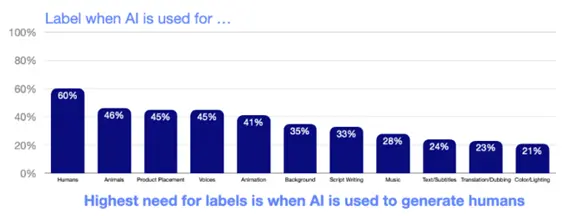
The study also found that viewers feel the need for AI labeling is strongest when humans (60%) are generated, followed by animals (46%), product placement (45%), and audio (45%).
The research was conducted by Media Science in collaboration with the University of Adelaide Ehrenberg-Bass Institute, a marketing science academic centre, and MediaPET.ai, an AI video content platform developed by Media Science.