Explore ways artificial intelligence and machine learning can redefine security for the evolving landscape of things.
Smart devices' magnifying attack surface
Our homes, cars and workplaces are becoming smarter and smarter. This brings unparalleled convenience, but the concept of smart devices often corresponds to “more vulnerable devices,” so Pandora's box also opens.
Internet of Things (IoT) – all doorbells, thermostats, refrigerators, wearables, and even the toothbrushes that make up the world of smart devices extend the attack surface of cybercriminals in almost proportion to the convenience it offers.
With billions of devices expected to come online in the coming years, traditional security solutions aren't enough. Enter Artificial Intelligence (AI) and Machine Learning (ML). This opens two technologies that have opened up new frontiers to protect against evolving threats, especially in environments where human surveillance is unrealistic.
But how do they actually work? And what does their use mean to consumers?
Why is traditional security lacking in the IOT era?
Before we plunge into the promise of AI and ML in ensuring the IoT landscape, it is worth understanding why traditional methods struggle with this challenge.
First, the vast amount of devices makes it impossible to manually monitor all network traffic or patch all vulnerabilities using traditional methods. Next is the diversity of devices. For example, the security needs and flaws of smart toothbrushes are very different from those of smart TVs. Many devices don't have their own software, different hardware standards, or a unified security model.
Finally, limited resources make it impossible to implement traditional security methods. Most IoT devices have minimal processing power and memory, making them unsuitable for traditional endpoint protection tools.
These are some of the most important reasons why smarter and more adaptive protection is needed. This is where AI and ML shine.
Matches made in heaven for the world of AI, ML and IoT
AI and ML systems excel at pattern analysis, anomaly detection, and real-time decision-making. These are all the advantages of a chaotic, ever-expanding IoT ecosystem.
This is what they bring to the table:
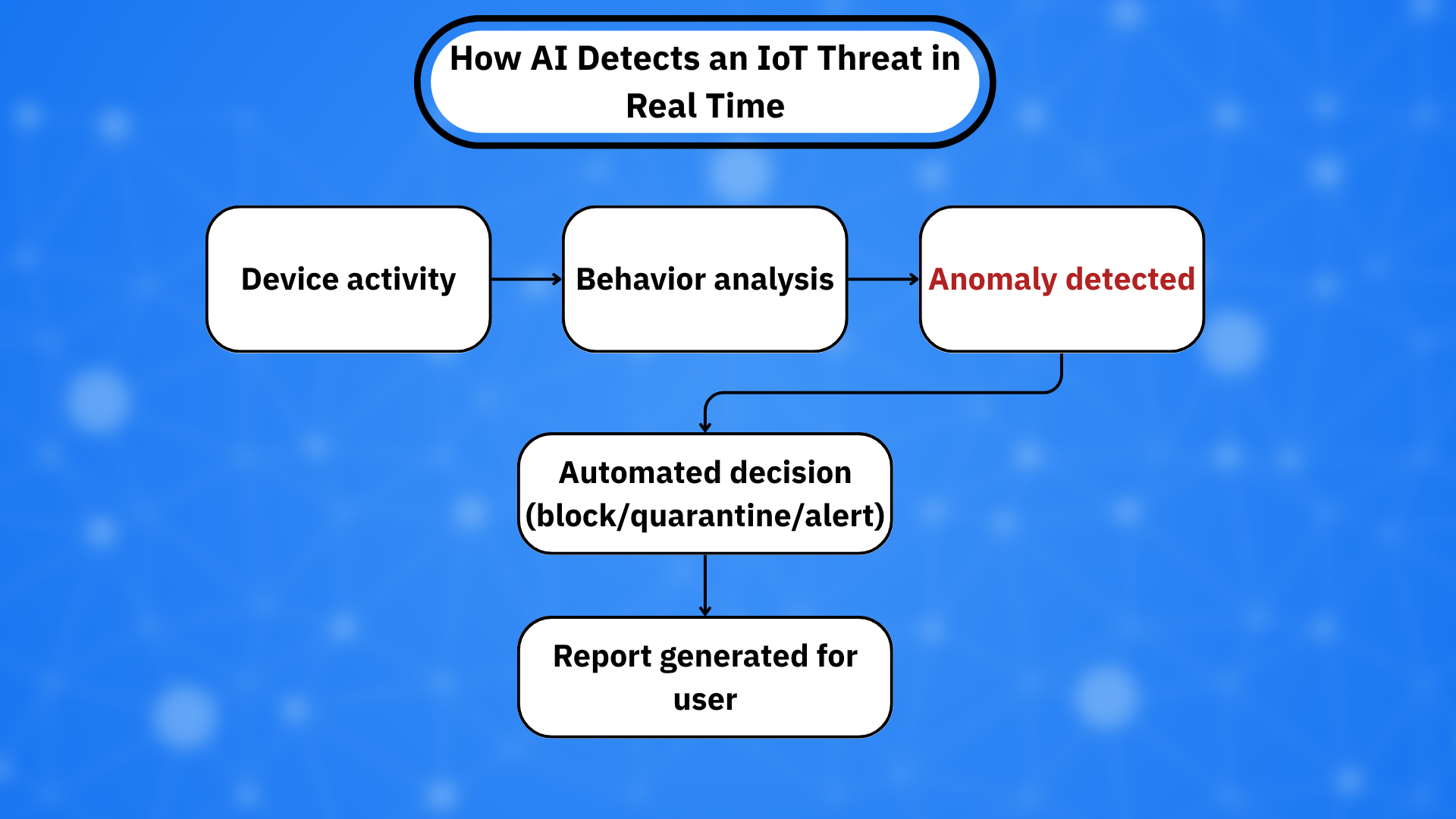
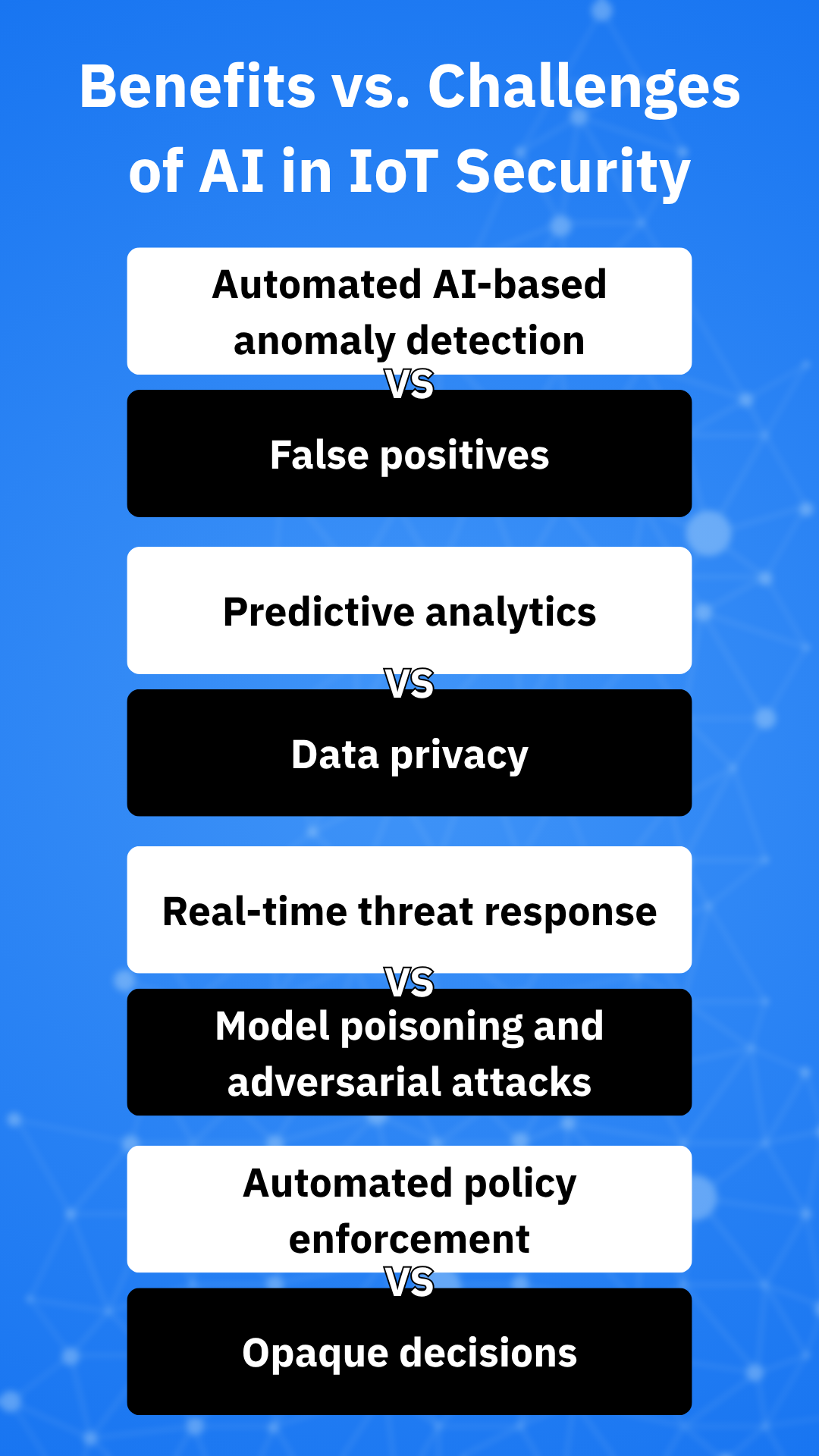
- Anomaly detection: ML algorithms can quickly learn what “normal” behavior of each device looks like and flag activity from their boundaries. For example, a thermostat that tries to contact an unfamiliar server in another country can be immediately flagged as suspicious.
- Real-time threat response: AI-equipped systems can block suspicious traffic or quarantine devices immediately without waiting for human approval.
- Predictive Analytics: By analyzing large amounts of data, ML can predict threats before they arise. For example, the ML system can identify early signs of botnet formation.
- Automated policy enforcement: AI helps adapt access based on context and usage patterns and dynamically manage device permissions.
Common Use Cases for Consumer
Thanks to user-friendly chatbots and other accessible tools, AI is no longer a distant enterprise-only concept. In fact, most people probably use it in some way, even without realizing it.
Below are some real-world applications that leverage AI for IoT security:
- Smart home routers with AI-based intrusion prevention: Certain consumer routers now implement ML functionality to recognize and automatically block out abnormal traffic from devices.
- Intention detection voice assistant: ML helps you identify spoofing attempts and malicious voice commands.
- Security cameras with edge AI: These devices can detect people, animals, packages and even recognize if someone has been hiding outside your door for a long time.
- Wearables with behavioral biometric authentication: A smartwatch or fitness tracker can help you verify your identity based on movement, location, or usage patterns.
They aren't necessarily revealing that, but these technologies aim to provide peace of mind without requiring users to become security experts.
Issues and concerns
Despite its obvious benefits, AI is not all silver bullets in the underlying security challenge. There are still many issues that cannot be addressed, especially from a consumer perspective.
- False positive: Anomaly-based systems can sometimes flag normal behavior as suspicious, causing frustration.
- Data Privacy: AI needs data to learn. Who controls this data? How is it saved? Is it sold to a third party? What happens to data breach?
- Model addiction and hostile attacks: Attackers may try to confuse or corrupt the AI itself with rogue prompts and fake training data.
- Opaque decision: Because decision-making processes are often invisible to the end user, it is often difficult to understand why AI made a particular choice.
What consumers can do today
While we are waiting for a stronger and mature AI model for IoT security, we can take steps to protect our Smart Home ecosystem or wearable devices yourself.
- Change the default password: This will greatly increase your chances of attacks that utilize known default passwords.
- Please update the firmware: Frequent firmware updates (or enable automatic updates) can protect you from critical security flaws.
- Use network segmentation: It helps to segment your network (for advanced users), deploy IoT devices in guest networks (efficient and beginner-oriented methods), and limit the IoT attack surface.
- Disable unnecessary features: Certain features such as remote access and voice control must be disabled if not used.
- Monitor network traffic: Smart routers or security apps such as NetGear Armor allow you to turn your eyes to the IoT ecosystem.
- Audit your smart home: Monthly IoT security audits keep your smart home safe.
Even basic cyber hygiene can go a long way, especially when combined with AI-powered tools.
Smarter systems, smarter homes
AI and ML are no longer buzzwords. They are becoming the foundation of next-generation cybersecurity, especially in complex, distributed IoT environments. For consumers, this leads to smarter protections that quietly deploy, adapt and learn in the background without all micromanagement.
However, consumers should still be on alert. While AI can make great decisions for you, it is still important to understand the risks, make privacy-sensitive choices, and invest in secure devices and services.
As IoT evolves, we hope to see more home ecosystems built around AI threat detection and machine learning enhanced safety features. Just as anti-virus software has become the standard for PCs, AI could soon become the standard for protecting your smart home ecosystem.
Conclusion
The rise of IoT requires a new kind of protection. This allows us to keep up with the very threat we face. Both AI and ML are powerful candidates for the bill.
They are not silver bullets for today's security challenges, but they offer a glimpse into the future of more aggressive and personalized cybersecurity so that consumers can focus on their lives instead of protection.
Frequently Asked Questions about AI and ML in IoT Security
What is the role of AI in IoT security?
Artificial intelligence is often used to enhance IoT security by automating processes such as identifying suspicious behavior, predicting threats before they occur, and automatically enforcing policies.
What is AI ML Security?
AI involves using artificial intelligence to protect data and devices in various ecosystems. Machine learning (ML) is an area of artificial intelligence that involves the development of algorithms and models that perform complex tasks without human intervention.
What is the role of AI and ML in IoT?
In IoT, AI algorithms are designed to process data recorded by devices within the ecosystem. Meanwhile, ML helps bridge the gap between collected data and AI systems, paving the way for sophisticated processes such as real-time decision-making and policy enforcement.