Honeywell is industry AI Insights global This research study captures the current state of artificial intelligence (AI) in the field: only 17% of AI decision makers worldwide are fully executing on their original AI plans, yet more than nine in 10 say they are discovering new and unexpected use cases whether they are prototyping, releasing, or extending their AI implementations.
The survey also found that AI leaders are “obsessed” with AI in industrial applications: Enthusiasm for deeper AI investments is nearly universal, with 94% of those surveyed saying they plan to expand their use of AI.
“There's no doubt that we are living in a pivotal time for AI,” said Kevin DeHoff, Honeywell's chief strategy officer. “With the advent of Gen AI and an increasing number of data sources driven by advanced analytics, industrial AI is poised to grow exponentially, with endless possibilities for revenue growth and improved employee satisfaction.”
AI Unleashes Benefits in the Workplace
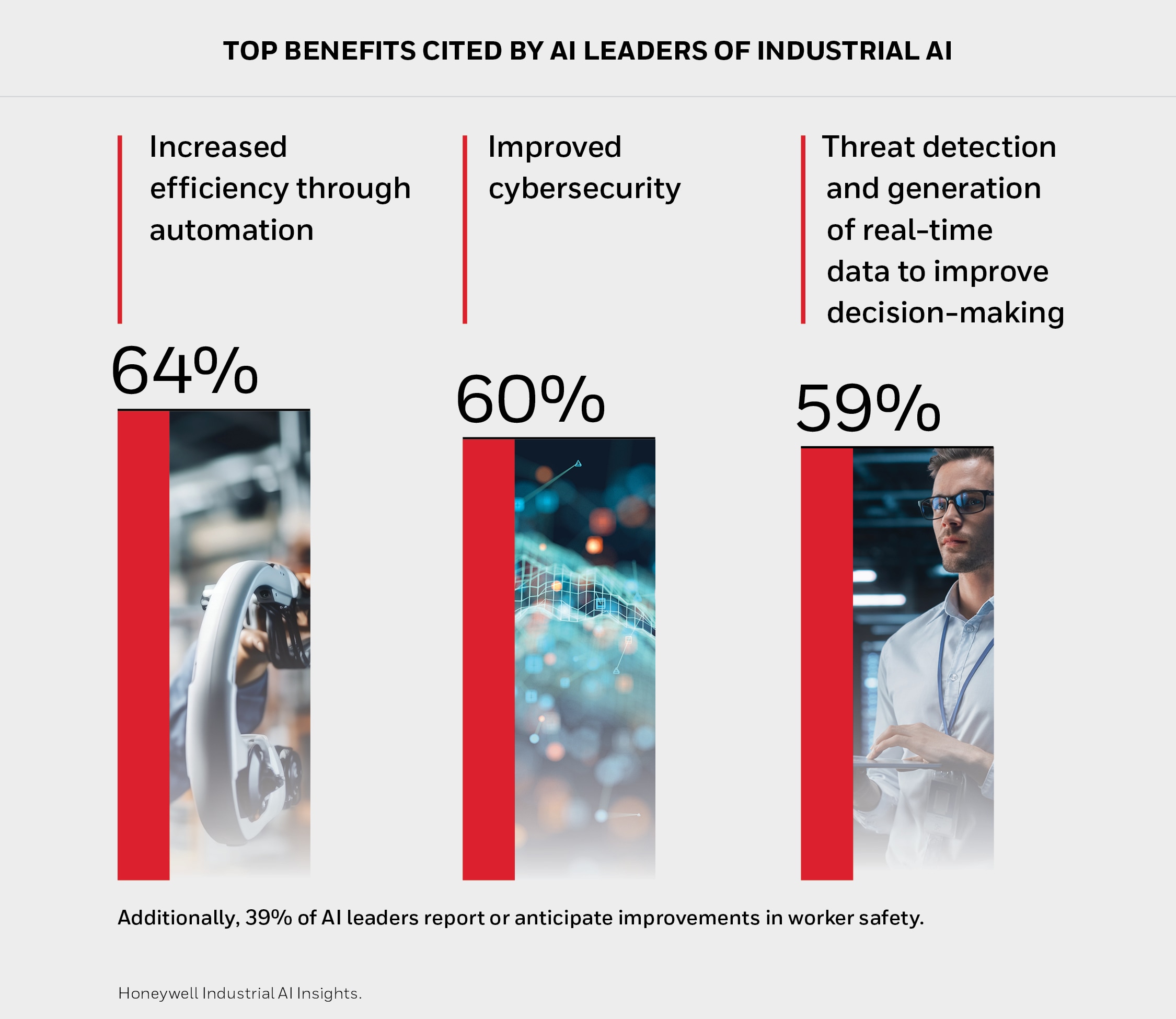
When asked about the impact of AI on their industry, nearly two-thirds (64%) of AI leaders cited increased efficiency and productivity as their most anticipated benefit, 60% said AI has improved cybersecurity and threat detection, and 59% reported improved decision-making through real-time data generation.
Respondents also cited other benefits of AI for workers, including:
- Greater work flexibility (49%)
- Increased job satisfaction (45%)
- More time for skill development and creative thinking (44%)
- Improving workplace safety (39%)
Skills development is critical in today's economy as baby boomers retire and fewer people join the workforce. AI can help employers upskill and reskill workers more quickly. By empowering workers to perform at a higher level, AI can increase productivity, address skills shortages, and improve job satisfaction, transforming industries.
Lucien Boldea, president and CEO of Honeywell Industrial Automation, gave one direct example: “Processing and manufacturing products can require tens of thousands of instruments, devices and valves, and many of the parts we supply to manufacturers require highly experienced technicians to operate and maintain them, but those experienced technicians are becoming increasingly scarce. With AI training and AI as our 'co-pilot,' we can upskill less experienced technicians more quickly and turn them into better professionals who perform tasks based on corporate knowledge and best practices. As a result, human error is significantly reduced and factory operations can run safer and more reliably.”
The future of AI
While enthusiasm for the expansion of AI is clear, challenges remain to full adoption: More than a third (37%) of survey respondents feel their organization's C-suite executives don't fully understand how AI works, and nearly half (48%) say they must continually justify or request the resources needed to implement their AI plans.
“Companies across all industries are recognizing that AI is changing the world and creating new possibilities. For building operations such as hospitals, campuses and offices, AI is clearly the future. By adjusting controls that regulate HVAC, lighting and electrical use, AI can help improve safety, operations and sustainability,” said Bilal Hammoud, president and CEO, Honeywell Building Automation.
All of this suggests that the pace of change will accelerate, driven by compelling use cases that can be measured in terms of improved business performance. As new solutions bring clear benefits to workforce productivity, safety, and reliability, we will see a dramatic increase in AI adoption, with the potential to transform industrial operations.
To learn more about the survey results and Honeywell's work on AI and automation, visit www.honeywell.com/us/en/ai/research.
methodology
Honeywell commissioned Wakefield Research to survey AI leaders around the world. The online survey, conducted April 22-May 2, 2024, included 1,600 executives across 12 markets around the world (United States, Brazil, Canada, China, France, Germany, India, Japan, Mexico, United Kingdom, Kingdom of Saudi Arabia, and United Arab Emirates). All respondents work for companies with more than 1,000 employees that currently use AI to automate processes and tasks. All respondents are influencers or decision makers related to the use of AI within their departments or across their organizations.