Hollywood video game performers have announced they will go on strike after new contract talks with major game studios broke down over artificial intelligence protections, bringing parts of the entertainment industry back on strike. The second strike by video game voice and motion capture performers under the Screen Actors Guild and National Federation of Television and Radio Entertainers Associations will begin at 12:01 a.m. on Friday. The move comes after nearly two years of negotiations over new interactive media contracts with the gaming giants, which include Activision, Warner Bros. and divisions of Walt Disney.
Quick Read
- Hollywood video game performers announced they would begin a strike starting Friday over concerns about artificial intelligence after negotiations with major game studios collapsed.
- The strike is the second for video game voice and motion-capture performers under SAG-AFTRA and comes after nearly two years of negotiations with gaming giants Activision, Warner Bros. and Walt Disney.
- SAG-AFTRA negotiators said there has been progress on wages and job security, but differences remain over AI regulation and performer protections.
- Gaming companies have proposed AI protections, but SAG-AFTRA argues that the studios' definition of “performer” doesn't protect some roles and treats some physical performances as “data.”
- Without adequate protections, the union says, gaming companies could use AI to replicate actors' voices and likenesses without their consent or fair compensation.
- Video game makers expressed disappointment at the union's decision to strike and said they were open to renewing negotiations.
- The video games industry, which generates more than $100 billion in profits annually, has been heavily affected by the strike, which affects more than 2,500 performers.
- SAG-AFTRA members had previously voted overwhelmingly to authorize a strike, and concerns about AI were also a driving force behind last year's film and TV walkout.
- The previous interactive contract, which expires in November 2022, did not cover AI but did secure a bonus compensation structure for voice actors and performance capture artists following an 11-month strike in 2016.
- The union drafted a separate contract for independent and low-budget video game projects in February that includes some of the AI protection clauses rejected by the industry giants. Games under those contracts are not subject to the strike.
The Associated Press reports:
Video game actors go on strike over artificial intelligence concerns
NEWSLOCKS – LOS ANGELES (AP) —
Hollywood video game performers have announced they will go on strike after new contract talks with major game studios broke down over artificial intelligence protections, bringing parts of the entertainment industry back on strike. The second strike by video game voice and motion capture performers under the Screen Actors Guild and National Federation of Television and Radio Entertainers Associations will begin at 12:01 a.m. on Friday. The move comes after nearly two years of negotiations over new interactive media contracts with the gaming giants, which include Activision, Warner Bros. and divisions of Walt Disney.
SAG-AFTRA negotiators say that while the video game contracts have reached an agreement on wages and job security, the two sides are divided over regulating generative AI. Audrey Cooling, a spokeswoman for video game production companies, said the studios proposed the AI protections, but SAG-AFTRA's negotiating committee said the studios' definition of who constitutes a “performer” is key to understanding who will be protected. “The industry has been very clear that we don't necessarily believe that everyone who is performing a movement performance is a performer covered by a collective bargaining agreement,” SAG-AFTRA's chief contracting officer, Ray Rodriguez, said at a press conference Thursday afternoon. He said some physical performances are treated as “data.”
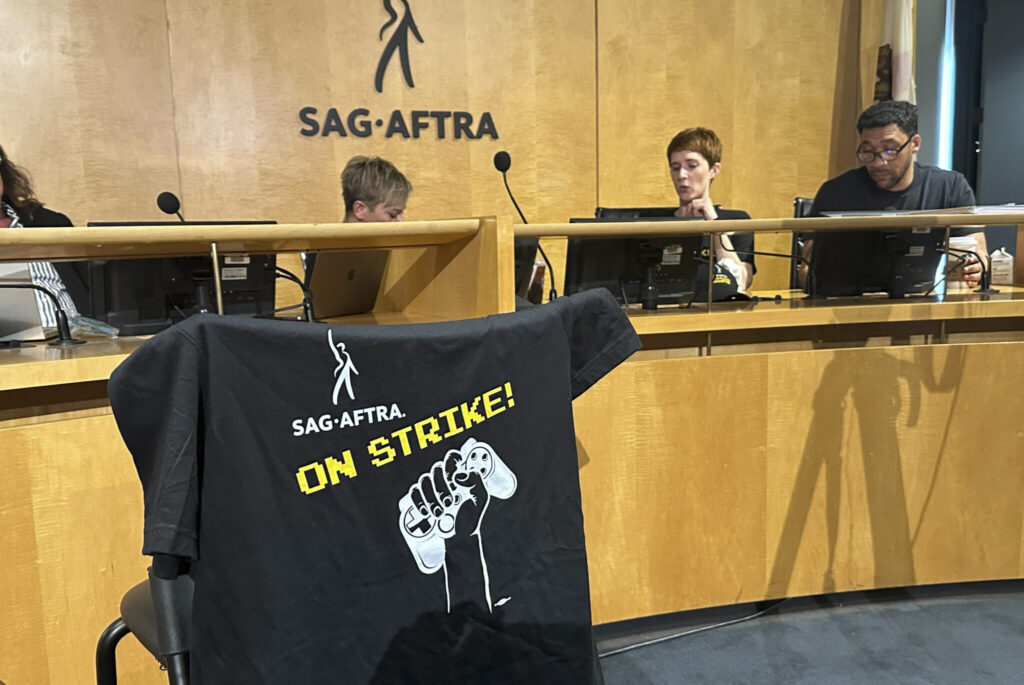
Without guardrails, gaming companies could train AI to imitate actors' voices or digitally create likenesses of actors without their consent or fair compensation, the union said. “We are striking as a last resort. We have taken this process as long as we could responsibly,” Rodriguez told reporters. “We are striking now because we have exhausted other possibilities.” Couling said the companies' proposal “expands meaningful AI protections.” “We are disappointed that the union chose to walk away when we were so close to an agreement. We are ready to resume negotiations,” she said.
Andy Norris, an actor and union negotiator, said stunt and creature performers would still be at risk under the games companies' proposal. “The performers who bring their work to these games create a range of characters and all of that work should be compensated. Their proposal would exclude anyone who doesn't look and sound exactly like me as I sit here, when in fact I'm a zombie, a soldier, a zombie soldier all week,” Norris said. “We cannot and will not accept that a stunt or movement performer who is onstage performing a full voice role next to a voice actor is not a performer.”
The global video game industry generates more than $100 billion a year in revenue, according to games market forecasting firm Newzoo. SAG-AFTRA said the people who design and bring these games to life are the driving force behind their success. Last year, union members voted overwhelmingly to give leadership the power to strike. Concerns about how movie studios might use AI fueled a four-month strike by the Motion Picture and Television Industry Union last year.
The last interactive contract, which expired in November 2022, offered no protections for AI but did ensure a bonus compensation structure for voice actors and performance capture artists after an 11-month strike that began in October 2016. That strike marked the first major labor dispute by SAG-AFTRA since the merger of Hollywood's two major actors unions in 2012. The video game contract covers more than 2,500 “off-camera (voice-over) performers, on-camera (motion capture, stunt) performers, stunt coordinators, singers, dancers, puppeteers and background performers,” according to the union.
Amid tense interactive negotiations, SAG-AFTRA crafted a separate contract in February aimed at independent and low-budget video game projects. The Tiered Budget Independent Interactive Media Contract includes some of the AI protections rejected by the video game industry giants. Games that have signed the Interim Interactive Media Contract, the Tiered Budget Independent Interactive Contract or the Interim Interactive Localization Contract are not subject to the strike, the union said.
More Tech & Science News