
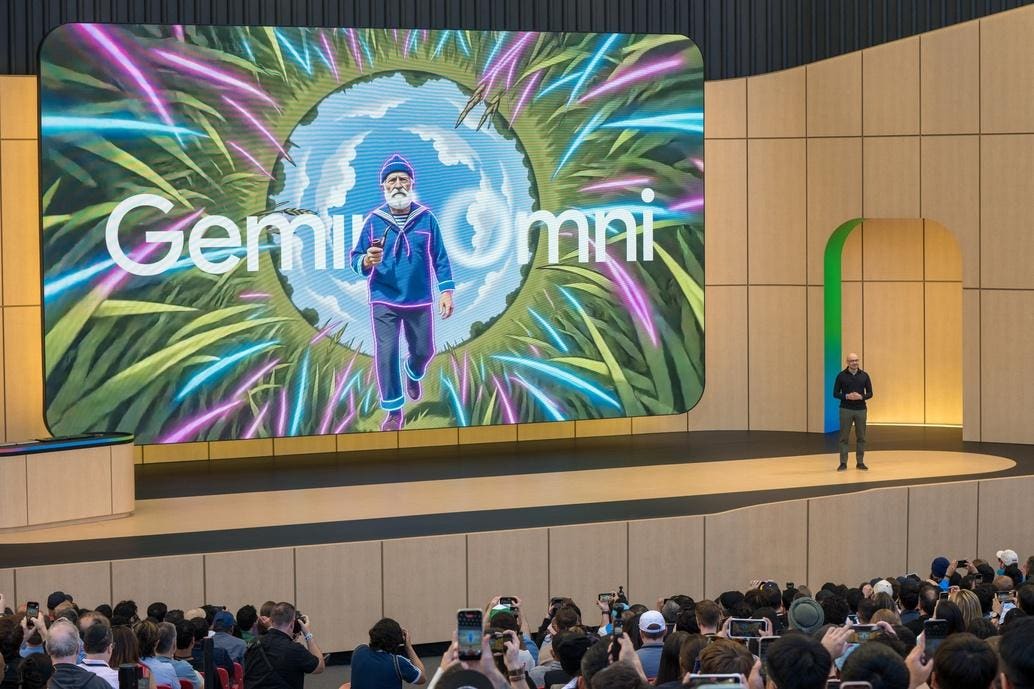

Gemini Omni was announced at the 2026 Google I/O Technology Developer Conference in Mountain View, California on May 19, 2026. (Photo by Karl Mondon/AFP via Getty Images)
AFP (via Getty Images)
For many creative teams, video has always been the most difficult format to sustain. While text can be rewritten in seconds and images can be reworked, resized, retouched and pushed across channels with relative ease, video carries more weight. This means shooting, editing, reviewing, exporting, re-approving, and then a series of cutdowns and localized versions that often feel like completely separate production cycles. Google’s Gemini Omni refers to a different type of creative workflow.
The company describes Omni as a model that builds on Gemini’s knowledge of the world to “create something from any input,” including video, by combining images, audio, video, and text into a high-quality video output. Google also says that this model allows users to edit videos through dialogue, with each instruction building on the last while keeping threads of characters, physics, and scenes consistent.
The language already formed before and after the announcement tells an interesting story. On LinkedIn, people talk about “fluid content,” “video as a conversation,” and “AI video as a mini creative pipeline.” Some of it is the frenzy of launch week, but it captures the parts of Omni that are most interesting for brands, agencies and studios. Video is moving towards something less fixed and more like a “work surface”.
This opens up a new era of possibilities that allows us to examine what happens when video can be generated, modified, restyled, remixed, verified, and redistributed almost as easily as text.
Gemini Omni makes your video your work surface
Most AI video coverage still cycles through the same checklist. That is, how realistic the movement is, how clean the hands are, how convincing the camera movement is, how long the clip can play, etc. While these questions remain important, Omni’s more important contribution is based on its level of control.
Google says Gemini Omni Flash is the first model in the Omni family and will roll out to Gemini apps, Google Flow, and YouTube Shorts. Gemini’s product page describes it as a system that can blend text, images, and video, create 10-second videos with native audio, convert up to five photos to video, and support multi-turn editing.
This rich input option can change the flow of your creative process. Users can start with a concept and request things like changing the background, moving the wardrobe, softening the lighting, precision of movement, changing the camera angle, and more. Google’s own language is surprisingly close to that of a director running a chain of work: “Tell Gemini what needs to be fixed.”
For creative teams, this shifts the focus from one-shot generation tools to a more conversational editing environment. The first prompt becomes your rough cut, and the next prompt becomes your revision cycle. The model becomes part of the process between the idea and the asset, rather than just a machine that creates the initial clip.
This doesn’t make human qualities like taste, direction, and production judgment less important, but it does make the distance between ideas, drafts, and iterations much shorter.
Gemini Omni and the end of locked assets
The most important changes start after the first video is created. In traditional campaign production, videos tend to be locked. Once the master asset is approved, the team creates short edits, vertical versions, localized cuts, social versions, paid media versions, and platform-specific formats, with each new variation adding time, cost, and adjustments.
But with Omni, your branded film can quickly become a series of social variants. Creator clips can be restyled without starting from scratch, product videos can be reworked and optimized for different markets, formats, and audiences, and campaign ideas can go through multiple visual routes before embarking on full production.
This kind of tool is especially useful in an era when brands are being asked to produce more content on more fronts while maintaining consistency and control. WPP’s Production Studio, built on NVIDIA Omniverse, was launched as an end-to-end, AI-enabled production application designed to streamline the creation of text, images, and video for advertisers and marketers. WPP also says it directly addresses the challenge of producing brand-compliant, product-accurate content at scale with human oversight at every step of the workflow.
Adobe is moving in a similar direction with enterprise creative workflows. Firefly Creative Production is built to turn repetitive production tasks into reusable, managed workflows, helping teams scale branded images and videos across channels and geographies. Adobe also describes this as a way to operationalize creative production rather than experimentation by tying reviews, handoffs, asset systems, and approvals into the same content stack.
Rather than being presented as an enterprise content supply chain product, Omni is built into Gemini, Flow, and YouTube, so we approach it from a slightly different angle. Still, it points in the same broad direction: video assets that are editable, adaptable, and remain responsive over time. And this is where agencies and studios should pay attention.
How Gemini Omni impacts agencies
While the “agency killer” question is too blunt to be very helpful, a more practical question considers which parts of the agency model become harder to charge for as video production becomes more conversational.
Simple versioning, background swaps, format changes, first-pass concept films, social cutdowns, basic localization, light reworks, etc. all get more exposure. These tasks are still valuable, especially when done well, but clients will increasingly expect these tasks to be performed faster, closer to the original idea, and with fewer handoffs.
More lasting value moves into creative judgment, brand systems, cultural intelligence, legal procedures, interpretation of performance, and campaign architecture. Models can generate more routes, but powerful agencies still need to understand which routes are important, which fit the brand, which create risk, and which are worth the budget.
This is where Gemini Omni can pose uncomfortable issues for some in the productive economy. If a client wants a more upscale shot, can change the background to Tokyo at night, keep the same character, create three vertical edits, and change the tone of one version, the content production coordination effort begins to compress. Premium is focused on taste, making it difficult to defend that repetition is central to the overall price.
Distribution advantages of Gemini Omni and Google
Google also has an advantage that many AI video companies don’t have. It’s a place where people can already create, search, watch, and share. Gemini Omni is located throughout the Gemini app, Google Flow, and YouTube Shorts. While the creative model within a standalone interface may impress early adopters, the creative model within YouTube could begin to reshape everyday remix culture from its current start.
As reported by The Verge, users of YouTube Shorts will see a “Reimagine” option within Short Remixes, allowing them to convert the clip to a style like anime or pixel art, change what appears in the video, add background actors or costumes, or insert themselves into the clip. Creators can enable or disable this feature, and remixed short videos will include a watermark and a link to the original video.
On the surface of things, this could be an important cultural development, as all videos begin to become potential source material. This can be particularly impactful for brands. Campaign films will become remix templates, product moments will move into more participatory formats, and entertainment assets will be communicated through fan edits on a scale that previously required large-scale media plans.
Conversely, this same opportunity also creates a palpable tension. If every clip becomes increasingly editable, who actually controls the context? And who ultimately benefits from a remix? And what happens when a creator’s identity, voice, gesture, or product placement moves in an unintended direction?
Omni becomes more than just a creative tool, it also sparks a broader conversation about participation, permission, and control in the age of AI video.
Gemini Omni, Avatars, and Trust Issues
Gemini Omni’s new avatar angle makes this subject even more sensitive. According to Google’s own Gemini page, users can add AI avatars to create content that looks and sounds like them without having to upload images each time. Support documents state that users create avatars by recording their face and voice, that avatars currently require a personal Google Account with a Google AI plan, that there are geographic restrictions, and that support is currently limited to English.
For creators and marketers, the appeal is clear. Founders can star in product descriptions without having to re-shoot, and creators can create multiple versions of posts for different regions and demographics. It is also now possible to place brand ambassadors in different contexts with far less friction than traditional shoots.
Not only all the advantages, but also the obvious sensitivities in this regard should be taken into account. Videos that look like someone, sound like someone, and behave coherently within a realistic scene are powerful creative materials, but they also straddle controversial areas such as identity, consent, artificiality, and viewer trust.
Google clearly recognizes this risk, and DeepMind states that content created or edited in the Gemini app, Google Flow, or YouTube’s Omni contains SynthID watermarks and C2PA content credentials. Content can also be verified through the Gemini app, and will soon be available in Chrome and Search.
As AI videos become more realistic and editable, this additional provenance layer becomes increasingly important. This is because it helps people understand whether content was created or modified by Google AI. However, it is also important to note that not all questions regarding consent, compensation, and background will be resolved. While watermarks can identify how something was created, they cannot determine whether the use of the likeness feels legitimate to the creator, brand, or audience.
What live video means for creative work
The phrase “living video assets” may sound like another technology language seeking a market. In this case, you are describing where the medium appears to be moving.
Google DeepMind CEO Demis Hassabis speaks at the 2026 Google I/O conference
AFP (via Getty Images)
Live video assets can be modified, localized, restyled, enhanced, checked, remixed, and redistributed across different contexts. Convey a character, location, campaign idea, style, or brand code in multiple versions. It continues to move and evolve even after the initial output.
For agencies, this means more pressure on production parts that rely on repetition, and more emphasis on creative direction, strategy, and governance. For brands, that means speed and variety, with greater responsibility when it comes to approval, provenance, and consistency. For creators, it opens up new forms of expression, as well as new questions about remixes and similarities. For Google, this gives Gemini Omni the potential to become a creative layer across Gemini, Flow, and YouTube.
Gemini Omni points to a future where video is no longer treated as a locked asset, but as something that can continue to move through campaigns, platforms, and culture. This should excite agencies and brands, but it should also make them more cautious. The ability to revise endlessly is only useful if you still understand what the work is intended to “say” in the first place, who it’s intended for, and where the boundaries should be placed. In the next phase of AI video, the most in-demand skill will not be video generation, but knowing when to stop.


