Researchers from the University of Jyväskylä in Finland have combined quantum mechanical modeling and general-purpose machine learning to reveal how geometry determines the stability of graphene (metalene interfaces). This is an important step toward bringing these promising 2D materials into real-world technology.

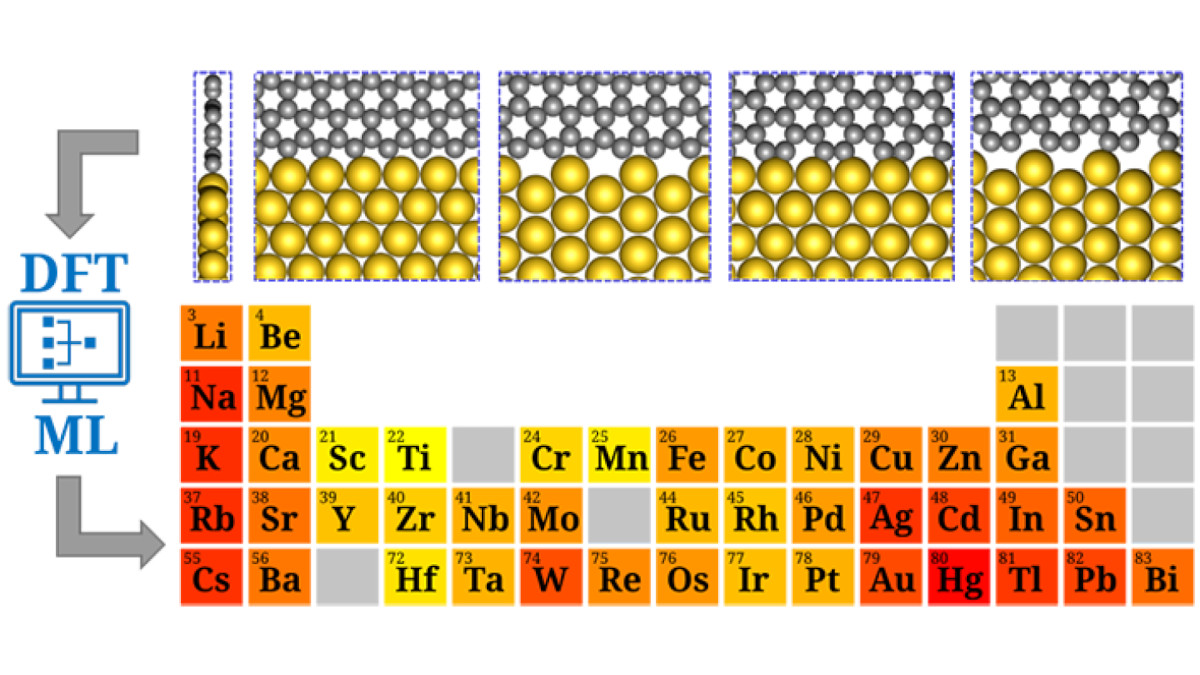
We integrate density functional theory and machine learning to assess the stability of lateral graphene-metalene interfaces. Image credit: University of Jyväskylä
Metalenes are atomically thin, non-layered metal sheets that have great potential for a wide range of applications, from next-generation electronics to energy storage and catalysis. However, strong metallic bonds make them unstable on their own and often require confinement within the pores of 2D templates such as graphene. To address this challenge, Professor Pekka Koskinen's team conducted a large-scale computational study of 1,080 graphene-metalene interfaces, covering 45 different metals and four interface geometries. The researchers used MatterSim machine learning interatomic potentials in conjunction with density functional theory (DFT) to optimize the interfacial structure, analyze its electronic properties, and test its stability under strain, defects, and thermal motion.
Their results show that smooth, aligned geometries (e.g., where a zigzag edge of graphene meets a straight metalene edge) result in the most stable, defect-resistant, and energetically favorable interface. In contrast, irregular or mismatched boundaries destabilize the metal layer, leading to restructuring and collapse. In particular, transition metal metalenes form the most robust and resilient bonds.
“We found that the stability of the interface depends on maintaining a smooth, well-aligned shape,” said Mohammad Bagheri, a postdoctoral researcher who conducted the simulations. “Such clean edges provide strong resistance to defects and mechanical strain, while irregular boundaries promote instability.”
Beyond these physical insights, this study also validates that machine learning is a reliable and efficient tool for predicting complex atomic behavior, enabling rapid exploration of material combinations that were once computationally impossible.
This study establishes basic design rules for stabilizing metalenes with graphene and provides geometric and elemental guidelines to facilitate experimental synthesis. “Understanding the microscopic principles of interfacial stability is an important step towards scalable and high-performance metalene materials,” said Koskinen. This research advances a roadmap for integrating metalenes into practical devices in electronics, energy conversion, and biomedicine by bridging AI-powered materials modeling and quantum-level physics.