General Intuition, a startup building what it calls a foundational model for embodied AI, has raised $320 million at a $2.3 billion valuation based on the hypothesis that robotics is approaching the same inflection point where AI crossed paths with GPT-3. The company’s approach, which involves training using millions of hours of video game data rather than real-world robot telemetry, was detailed by TechCrunch this week.
Basic model betting, porting
Before GPT-3, natural language processing was a cottage industry of bespoke models trained from scratch for narrow tasks. The fundamental model paradigm has disrupted the structure of one generic base with downstream fine-tuning. General Intuition’s CEO argues that robotics is stuck in a pre-GPT-3 stage, with companies collecting their own datasets for each individual embodiment, each environment, and each robot.
The startup’s pitch is that much of that work will be unnecessary. The company positions the generalization of the model itself as a product, and claims that the basic level of reasoning about space and time reduces the need to collect hundreds of thousands or millions of hours of real-world data.
why video games
The training data underlying the model is gameplay labeled with actions (button inputs, timings, and resulting on-screen consequences) and is sourced at scale. According to General Intuition, the company is based on Medal, a platform where players upload gameplay clips. A companion project called MIRA, developed with partners such as Kyotai and Epic Games, is a playable multiplayer world model trained on Rocket League data that runs in real-time.
The bet is that action data can teach us spatiotemporal reasoning in a way that passive video or text cannot. The paper has received support from prominent investors. In the company’s own framework, today’s AI is “book smart” and needs to become “street smart” through a virtual playground where it can make mistakes cheaply.
8 minute demonstration
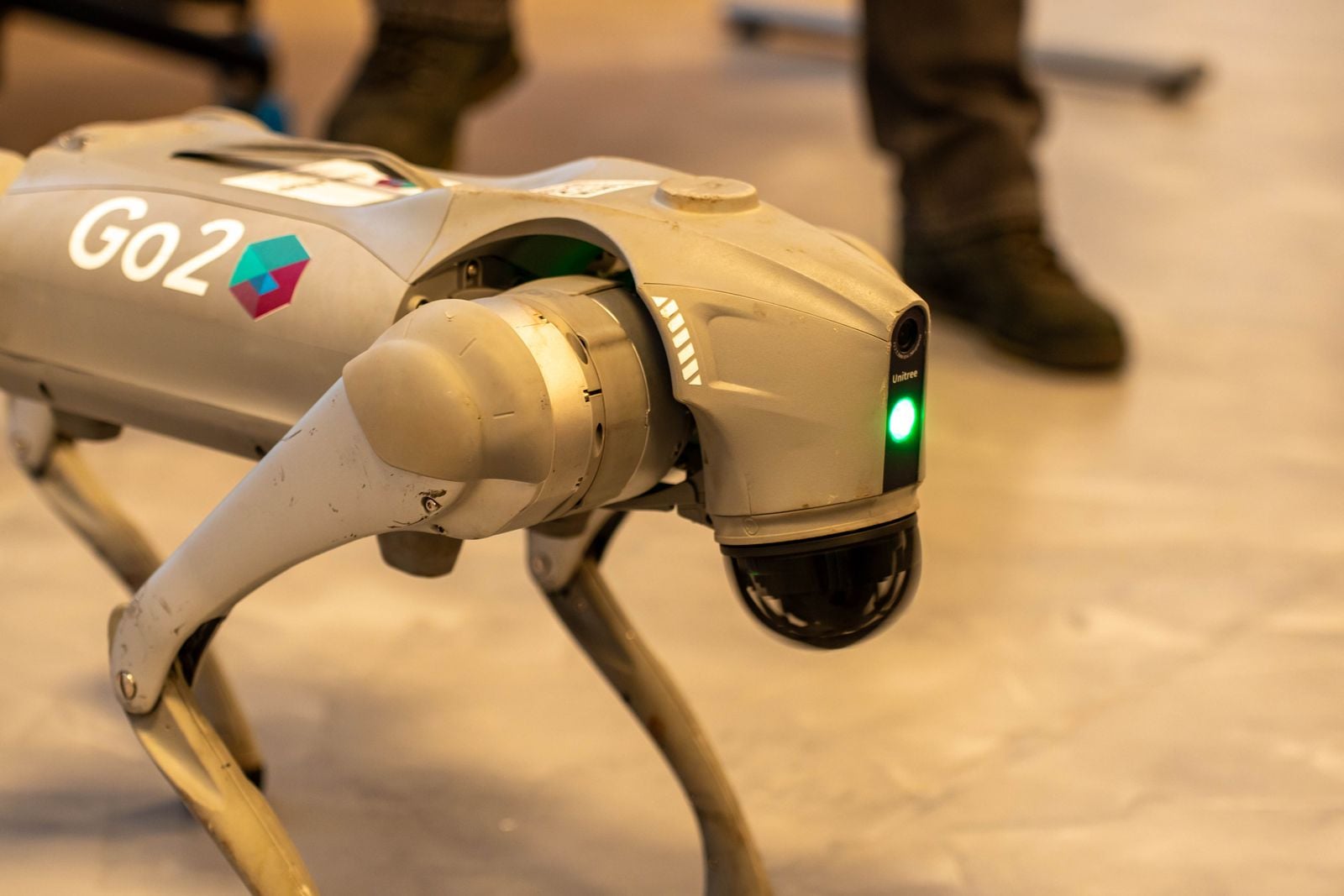
These are proof points that General Intuition uses to sell papers. The fully game-trained model drove a quadrupedal robot after fine-tuning it on just eight minutes of real-world robot data. The robot operated in an office environment where people walk around and objects are introduced dynamically, using only the front camera and no additional sensors.
If this generalization holds true at scale, the economics of robotics will change significantly. Boston Dynamics, Figure, 1X, Tesla, Unitree, and the dozens of other humanoid and quadrupedal startups currently competing to accumulate real-world operational data will find their moat narrowing.
platform play
General Intuition has made it clear that it has no intention of building robots. The company positions itself as an enabler rather than a direct competitor to self-driving car and robot makers. The company says it has begun onboarding early partners to its commercial API across gaming, simulation, and robotics.
The structural similarities to OpenAI are intentional. Whoever provides the base layer captures the margin across all applications built on top of it. This makes underlying model providers the most valuable single layer in today’s AI stacks.

what to see
Two questions determine whether this analogy holds. The first is whether the spatiotemporal reasoning learned in a game engine transfers cleanly to the friction, delay, and noise of the physical world. The 8-minute quadruped demonstration is suggestive, but not conclusive. The second is whether robot buyers will accept reliance on third-party base models, just as NLP teams accepted reliance on GPT, Claude, and Llama.
Base model economics rewards those who control the base layer. If the General Intuition theory survives contact with production robots, the industry’s center of gravity will shift from hardware manufacturers with proprietary datasets to owners of generic models. This is a relocation worth well over $2.3 billion.