

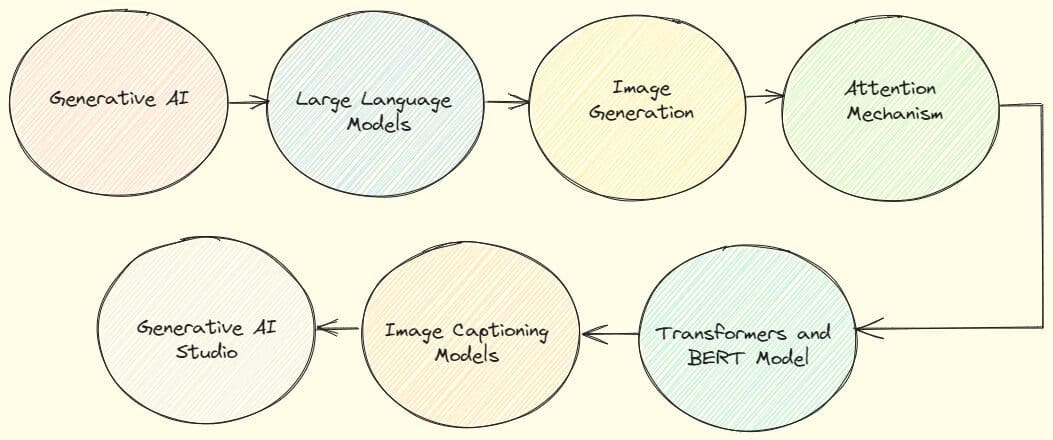
Illustration by the author
Interested in discovering the potential of generative AI models and their applications? Fortunately, Google Cloud has released the Generative AI Learning Path. This is an excellent collection of free courses, starting from explaining the basic concepts of Generative AI to more advanced tools such as Generative AI Studio for building customized generative AI models.
In this article, we’ll explore seven courses available to help you understand the concepts behind large-scale language models that surround us every day and create new AI solutions. let’s start!
Course Link: Introduction to Generative AI
This first course is an introduction to Generative AI by Dr. Gwendolyn Stripling, AI Technical Curriculum Developer at Google Cloud. Learn what generative AI is and how it can be applied. First, we will cover the basic concepts of data science (AI, machine learning, deep learning) and how generative AI differs from these disciplines. In addition, the key concepts surrounding generative AI, such as transformers, hallucinations, and large language models, are explained in highly intuitive diagrams.
Video length: 22 minutes
Teacher: gwendolyn stripling
Recommended reading:
Course link: Introduction to Large Language Models
This second course is intended as a high-level introduction to what language models are. In particular, examples of LLM applications such as text classification, question answering, and document summarization are provided. Finally, it demonstrates the potential of Google’s generative AI development tools to build applications without code.
Video length: 15 minutes
Teacher: John Ewald
Recommended Reading:
Course Link: Image Generation Overview
This third course will focus on describing the most important diffusion models, the family of models that produce images. Some of the most promising approaches include variational autoencoders, generative adversarial models, and autoregressive models.
It also presents use cases that can be categorized into two types: unconditional generation and conditional generation. The first application includes human face synthesis and super-resolution. Examples of conditional generation, on the other hand, include generating images from text prompts, inpainting images, and converting between images with text guides.
Video length: 9 minutes
Teacher: Kyle Steckler
Courselink: Attention Mechanism
In this short course, you’ll learn more about the very important concept behind transformers and large language models: the attention mechanism. This has allowed us to improve tasks such as machine translation, text summarization, and question answering. In particular, we show how the attention mechanism works to resolve machine translation.
Video length: 5 minutes
Teacher: Sanjana Reddy
Course Link: Transformer and BERT Models
This course covers the underlying concept behind the BERT model, the transformer architecture. After describing the transformer, we will discuss what BERT is and how it is applied to solve various tasks such as single sentence classification and question answering.
Unlike previous courses, theory involves experimentation, so prior knowledge of Python and TensorFlow is required.
Video length: 22 minutes
Teacher: Sanjana Reddy
Recommended Reading:
Course Link: Creating an Image Caption Model
This course aims to explain the Image Caption Model, a generative model that takes images as input and generates text captions. It utilizes encoder/decoder structures, attention mechanisms, and transformers to solve the task of predicting the caption of a given image. As with the previous course, there is also a laboratory to put theory into practice. Again, it’s aimed at data professionals with prior knowledge of Python and Tensorflow.
Video length: 29 minutes
Teacher: Takumi Oyama
Course link: Introduction to Generative AI Studio
This final course introduces and explores the Generative AI Studio. We begin by restating what Generative AI is and its use cases such as code generation, information extraction, and virtual assistance. At Google Cloud, we’ll give you an overview of these core concepts, then introduce you to tools that help you solve generative AI tasks without any knowledge of AI. One of these tools, Vertex AI, is a platform that can manage the machine learning cycle from building machine models to deploying them. This end-to-end platform includes two of his products: Generative AI Studio and Model Garden. This course focuses on explaining Generative AI Studio, which allows you to easily build generative models with no or low code.
Video length: 15 minutes
Recommended Reading:
I hope you found this quick overview of the Generative AI courses offered by Google Cloud helpful. If you’re not sure where to start in understanding the core concepts of generative AI, this path covers all aspects. If you already have a machine learning background, there are bound to be models and use cases you can discover from one of these courses. Do you know of any other free courses on Generative AI? Write in the comments if you have insightful suggestions.
Eugenia Anello Currently, I am a researcher at the Faculty of Computer Science, University of Padova, Italy. Her research project focuses on continuous learning combined with anomaly detection.


