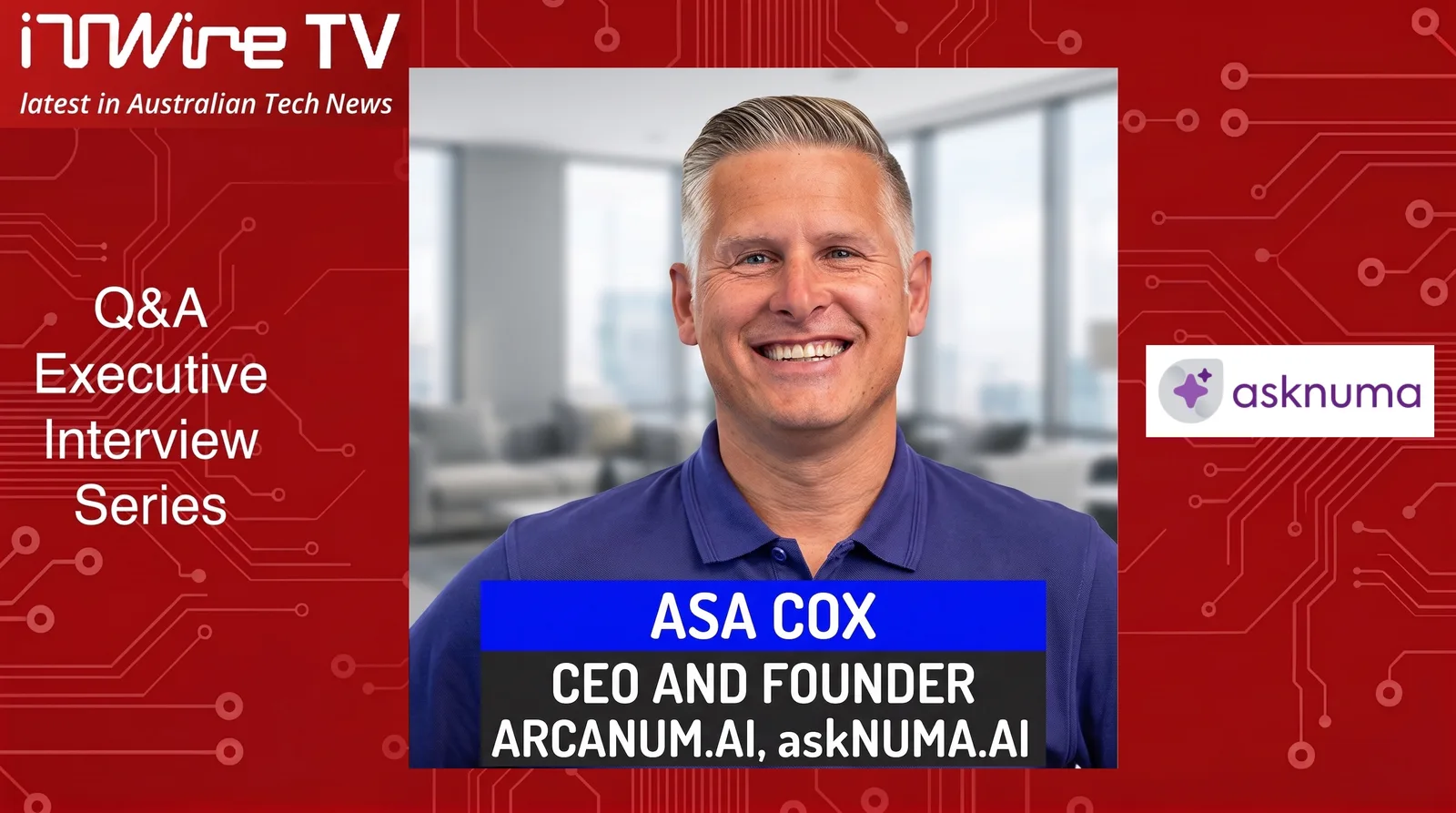
Arcanum AI started out doing invoice processing. It turned out to be the wrong first job, and working out why reshaped the way the company builds everything now.
That admission came about 26 minutes into iTWire’s inaugural Q&A executive interview series, which went live at 11:00am AEST on Thursday 20 August 2026 with Arcanum AI CEO and founder, Asa Cox, (LinkedIn).
I hosted. The audience asked the hard questions, including a cybernetics and systems consultant from the Australian National University who pushed on probabilistic systems and digital prototyping, which turned a great discussion thread in the session.
Arcanum has been building applied AI for small and medium businesses since 2016. Its platform, askNUMA, is pitched as an operating system for companies of roughly 20 to 200 staff, and it’s the product behind askNuma.ai. Arcanum has been an AWS technology partner since 2016 and signed a multi-year strategic collaboration agreement with AWS in 2023.
Here’s what came out of the 45 minutes – which you can watch below now, after which this detailed article continues, please watch, and read on!
Free AI is the expensive option
The first audience question was about safety, and Asa’s answer was blunt.
“If the product you’re using is free, typically you’re the product, and if that means that’s true, then your data is probably the product as well,” said Arcanum AI CEO and founder, Asa Cox. “Safely always requires some degree of payment.”
Anyone paying for Claude, ChatGPT or Grok will have seen the line in the footer telling you your chats aren’t used for training. The free tiers rarely carry that disclaimer, which is the whole shadow AI problem in one sentence: your staff are already pasting client data into something, and you don’t know which something.
Asa’s practical advice was to do more due diligence than you’d normally do when connecting a new SaaS tool. Understand where the data goes, where the models sit, and what the systems on the other end of the connection can see. If you have an IT services partner, that’s the conversation to have with them.
“Back in the day, maybe you did a security check once every quarter, once every twelve months as part of some kind of audit. It can now be done continuously,” said Cox, pointing to AI-driven continuous testing as one of the reasons he thinks software security is in better shape now than it has been.
The invoice job that taught Arcanum the most
The sharpest technical moment came from an ANU attendee asking how you steer a probabilistic system.
Asa’s answer started with a definition for the audience: large language models predict the next token in a way that matches what humans expect, which is exactly why early models could be confidently wrong. Then he told a story against himself.
“We started very early on, and it turns out to be mistakenly, in invoice processing,” Cox noted.
Accounts payable is a precision job. The invoice says $4,382.19 or it doesn’t. There’s no creative interpretation available, and a model built to predict plausible next tokens is the wrong tool for a task where the answer is either right or wrong.
“It’s really hard for large language models because they’re not designed for that precision use case,” said Cox.
The fix is the interesting part. Arcanum now uses AI to write the software that executes the invoice processing, and that software is deterministic. It follows rules. It behaves like every other piece of business software you own, and it’s a lot more accurate than asking a model to read a PDF and hope.
“I think we’re in this moment where AI is the buzzword,” said Cox. “I think next year it’ll just be software which has been powered by AI, and these conversations and concerns that we’re having now will look quite a bit different.”
For anyone evaluating AI vendors right now, that’s a useful test question: is the thing you’re buying asking a model to do the job every single time, or is it using a model once to build something that then runs deterministically?
For those wondering, the Cambridge Dictionary notes “deterministically” means acting or happening in a fixed, predictable way where the exact same causes or inputs always produce the exact same results, with no room for random chance.

Where the quick wins actually sit
I promised the audience quick wins, so I made him name them. He gave three.
Visibility came first. Small businesses have data scattered across accounting, job management, email and spreadsheets, and most owners are steering on lagging indicators.
“If you think about driving a car, it’s kind of like if you had your dashboard covered and you didn’t know how fast you were going, how much oil you had, how much fuel,” Cox advised.
He named the shapes it takes by industry: build costs for a construction company, staff utilisation and profitability for professional services, stock turns and margin for a retailer. He also made a point about accountants that will land with a lot of owners, which is that the information arrives accurate and in a language the owner doesn’t fully speak. AI translates it fast.
Winning business came second. Not response speed, but the gap between an enquiry arriving and a comprehensive quote landing.
“We can have a meeting with somebody, record the meeting, give them a proposal before they’ve got back to their car,” Cox explained.
Third was capacity to explore. Every owner comes back from a conference or a holiday with five ideas and no time to work out whether any of them are worth doing. Research on new markets, customers and products is the kind of work AI does well and businesses skip entirely.

Autonomy is what makes AI different from your ERP
An audience member asked why AI needs different governance from any other technology project. Asa mostly agreed that it doesn’t, then named the exception.
Cox noted, “your ERP system is not going to send an email to your vendor to say the contract’s cancelled. An AI agent misconfigured without the right guardrails could.”
That’s the cleanest one-line case for treating agents differently I’ve heard. Architecture, governance and guardrails all carry over from normal software projects. What’s new is that this software can be given access to your communication channels and permission to act on your behalf.
Another attendee suggested treating agents like employees, with the same risk management you’d apply to a bank teller. Asa said several Arcanum customers have gone further and written AI constitutions.
“A number of our customers now are writing AI constitutions, AI values, not just policies and procedures, but what is the essence of the company and how do you want the AI to interact with the humans to make sure the humans are always in control,” said Cox.
His argument for why this is cheaper than human onboarding is neat: you do it once, and every agent inherits it. You don’t run an induction for each new agent.
Regulation, and the education gap underneath it
A detailed audience question raised the training and certification gap. Formal education hasn’t caught up, and neither have most workplaces, so people are using tools they don’tunderstand.
Australia’s position moved in July. Prime Minister Anthony Albanese announced a new Office of AI inside the Department of the Prime Minister and Cabinet on 15 July 2026, alongside a proposed national framework of mandatory standards for large-scale data centres covering power, water and grid connection costs. Legislation is expected in early 2027. There’s still no Australian equivalent of the EU AI Act.
Asa was warm on the EU model, specifically its line on decisions.
“If it was going to impact somebody’s eligibility for a particular government service or funding and so on, then that was not allowed to be an AI decision. AI could be used to support the decision, but couldn’t make the decision, and I think that’s quite a good distinction,” said Cox.
Below that threshold he’s wary, on the grounds that prescriptive rules about what AI may and may not do inside a business will slow innovation without protecting anyone. What he’d rather see mandated is education.
“There’s still a number of people and organisations that still view AI as just a better Google from when it first came out, or as just another kind of hyped-up technology around automation,” said Cox. His prescription is formal education, on-the-job education, and light-touch regulation.

Wrappers, white labels and the trust problem
Asked whether white labelling AI services is sound, Asa said Numa can be fully white labelled, then added a warning aimed squarely at the consultants and MSPs in the audience.
“If you are presenting yourself as an expert in the field with a whole bunch of technology or services behind, but it’s really a wrapper around somebody else’s technology, then again, you’ve got the challenge of trust, and this market right now is all about trust,” Cox explained.
He traced the trust deficit back through the hallucination era and the Samsung incident, where in May 2023 employees pasted proprietary source code and meeting notes into ChatGPT across 3 separate incidents in about 20 days, and Samsung banned the tool.
Arcanum gives away an AI adoption canvas to consultants who want a framework rather than building one from scratch.
His analogy for the current market was search marketing circa 2016.
“I liken it to the SEO, the search engine optimization of about ten years ago, where everybody suddenly was a Google Ads expert,” said Cox. “Definitely a bit of diligence on checking to see what partners have actually done versus what they’ve watched on YouTube.”
Vibe coding is easy. Running the result inside a business is the hard part
This was the thread the ANU consultant opened, and it produced the most useful distinction of the session.
Asa, who describes himself as a non-developer, can now describe an app or photograph a whiteboard and get working code back. Arcanum has put that capability inside Numa, and has built a direct integration with Anthropic’s Claude so an app built there can run inside Numa.
“You can create a vibe code an app in Claude or Vercel or whatever it might be, but getting it to be safely operational inside of a business is another level of complexity, which those products don’t allow you to do automatically,” Cox added.
He described customers building prototypes off to the side that demoed beautifully and then had nowhere to live. Somebody asks how they can actually use it, and the honest answer is that they can’t.
An audience member made the point that needed making: anyone can build an app now, but building a valuable one still takes skill, scope management and human decisions. Asa agreed and extended it.
“Technology isn’t the challenge, as the audience member said. Is it valuable? Can it be used? How do you get customers? Is it safe? Can you integrate it with different things?” said Cox.
I raised Apple’s App Store submission volumes, which have never been higher. Asa’s read is that the flood makes buying harder rather than easier.
“Actually, the issue of the menu is too big. I’m not sure where to pick or where to start. You do need this sommelier of AI to be able to guide you through this process,” Cox noted.

Taste is the scarce input now. Software developers love building software, non-developers have just discovered they love building software too, and the discernment to tell working from shovelware is the thing humans still supply.
Modernising old code is the flip side of the same capability. A custom application written 10 or 15 years ago that works but doesn’t scale used to mean a 6-month consulting project and hundreds of thousands of dollars.
Advertisement
“AI has been trained to understand what good code looks like, and whether it’s code that was written in the nineteen eighties or code that was written ninety days ago, then yeah, you can still have that kind of capability,” said Cox.
Local models, hybrid architectures and the cost curve
An audience question on local AI landed on the day the model-routing market got repriced.
Numa is architected to be model-agnostic. Arcanum has run OpenAI and Anthropic models, plus open weight and true open source models, and tests new releases continuously for which ones are fast, which handle complexity, and which suit particular jobs.
“We see a future where, geographically, or industry, or functionally, there’s going to be expert large language models, and so we didn’t want to tie ourselves to one particular frontier laboratory,” Cox noted.
On local models he expects hybrid to win, with small models running on ordinary laptop CPUs for transcription and simple tasks, and cloud models called only when the problem justifies it. GPUs are expensive, and most business problems don’t need frontier intelligence.
Advertisement
One attendee reported running Ollama with multiple models on an $8,000 machine, and said Claude’s cost was prohibitive for self-funded use. That’s a real constraint, and it’s why a lot of developers now point Claude Code at local models.
Asa cited the Stripe acquisition of OpenRouter for more than $7 billion, agreed on 16 August 2026 and confirmed 4 days before this session, as evidence that switching between models is becoming infrastructure rather than a project.
His cost claim was that model prices halve roughly every 6 months while frontier labs keep releasing bigger models to hold revenue up. Independent price trackers put the decline steeper than that: TokenCost’s AI Price Index estimates roughly a 300x drop in equivalent capability pricing between 2023 and 2026.
“We don’t all need the biggest and the best. We don’t all need the latest models from the big labs,” said Cox.
What he talks customers out of
I asked which customer ambition he most often has to walk back.
“They do go, can go to the nirvana state of automating everything autonomously and just hoping that they can just sit back on the beach and just wait for the checks to roll in,” said Cox.
The headlines about a billion-dollar company with 1 employee have done real damage to expectations. Most of his conversations are about pulling people back from horizon 3 to the documents and spreadsheets scattered across the business today, which is horizon 1 and where the return actually lives.
On jobs, his position was firm. Arcanum works with companies looking to increase capacity so they can grow.
“If you’ve got a salesperson, they’re spending their time putting information into the CRM, then they’re not selling. If you’ve got somebody that’s delivering a project and they’re doing reports, then they’re not delivering,” said Cox. “It’s really about building healthier companies.”

What Numa actually is, and what it costs
Numa is positioned as a cross-business platform. Lead processing, proposals and contracts, an internal CRM, Kanban boards in the style of Monday or Trello, financial tracking, and the ability to build agents and applications on top.
Arcanum focuses on manufacturing, construction, engineering and professional services, on the reasoning that those industries have acute administrative pain and rarely have internal software developers.
Asa didn’t give a price on air, so here it is from the Numa pricing page, ex-GST:
Starter is listed at $750 a month, or $9,000 a year, for up to 20 users, with all default agents, self-build custom agents after training, self-guided onboarding, and Google Workspace and Microsoft 365 integrations.
Business is $1,500 a month, or $18,000 a year, for up to 50 users, adding 4 custom agents and a setup sprint.
Enterprise is $3,000 a month with custom annual pricing, unlimited users, 8 custom agents, a full onboarding programme, a dedicated customer success manager, and SSO, audit and SLA included rather than as add-ons.
Work the per-seat maths and Starter lands at about $37.50 per user per month, Business at $30, and Enterprise lower again depending on headcount. That’s Microsoft 365 Copilot money for a platform that also carries your CRM, your job boards and your reporting.
Arcanum’s public numbers as of this week: 127 customers, more than 1,600 agents built, more than 27,500 agent conversations in the past 90 days, more than 630 active users, and connections to more than 325 systems including Microsoft 365, Google Workspace, Xero and MYOB.
Named results include Momentum Consulting cutting admin management time 15%, AV Media improving cost of sales by 50%, PCL taking a 2-week job to under 2 days, and Flowerday Homes producing quotes within about 1% of a human estimator. Construction teams average around 4.2 hours saved per active user per month. A tea company, T Leaf T, ran 21 agents over 90 days and recovered roughly 190 hours, doing the build in-house.

How that stacks up against the alternatives
Worth knowing what else an Australian SMB is being pitched right now, because Asa was right that 4 suppliers are probably in your inbox already.
Microsoft 365 Copilot is the default option for anyone already on Microsoft, priced per seat and sitting inside tools staff use daily. It’s strong at drafting and summarising inside Office, weaker at owning a cross-system business process end to end.
Salesforce Agentforce is the enterprise answer, with consumption-based pricing and serious depth, aimed at organisations that already run Salesforce and have people to configure it.
Zoho’s suite is the closest thing to a direct philosophical competitor at the low end, bundling CRM, projects and finance with Zia layered across it at a very low per-user price. The trade is depth of AI capability against breadth of cheap functionality.
Xero and MYOB are both pushing AI assistants into the accounting layer, and Intuit has been shipping agents aggressively. Those solve the finance slice rather than the whole business.
Employment Hero’s HeroForce comes at it from people and payroll. Odoo comes at it from modular ERP.
Numa’s pitch sits in the gap: a company of 40 staff in construction or engineering with no developer, no platform team, and 6 systems that don’t talk to each other. Whether the agent-building layer is genuinely usable by a non-technical operations manager is the thing to test in a trial, and it’s exactly what a free assessment should be used to probe.
The roadmap
Data migration is the piece Asa was most animated about, because it used to require data engineers and data scientists.
“We’re moving terabytes of data and millions of rows of data very quickly from one system into Numa because AI can do all of that kind of data engineering piece,” explained Cox.
He also said customers are moving off Power BI and similar dashboarding products because AI now covers a lot of what they were paying for, which points at software consolidation as a real budget line for 2027.
Next on the build list: vibe coding inside Numa, then voice, including outbound and inbound phone calls and avatars answering them.

His closing advice
Asked for must-know tips, Asa gave a sequence rather than merely a tip.
Decide what you want AI to achieve over the next 12 months, working backwards from company goals. Revenue, efficiency, new products, whichever it is, name it first.
Audit your current software and ask how much of it survives the reset.
Bring your people with you so they aren’t frightened about their jobs.
Then write an actual plan.
“Trying to do ad hoc with some experimentation isn’t going to deliver the kind of results that most people want,” Cox added. “A bit of a plan and a strategy and a why means you are going to have this pathway to getting return on investment, which ultimately is what it’s all about.”
The rest of the series
This was session 1 of 3, run by NEXTGEN and AWS through the AWS SMB Hub, all free, all 45 minutes at 11:00am AEST.
Thursday 27 August is cloud, with Fitzroy IT founder and CEO, Tim Jenkinson (LinkedIn). Flexera’s 2026 State of the Cloud Report puts wasted cloud spend at 29%, the first rise in 5 years, and pins it on AI workloads. Tim has built more than 500 cloud environments and took Future Super’s 4-hour batch job down to 1 hour. Register free.
Thursday 3 September is customer experience, with iCXeed co-founder and chief customer officer, Ryan Rayner (LinkedIn). PwC’s customer experience research puts the share of customers who walk away from a brand they like after one bad experience at close to a third, and almost none of them say why on the way out. Ryan’s team took a photography business to 78% self-service and cut its voice support costs by 70%. Register free.
Attendees of the AI session can scan the QR code from the closing slide to download an AI self-assessment, fill it in, email it to Asa, and get a personalised AI adoption plan on a free 1-hour call.
The bottom line
The most valuable thing Asa Cox said was the thing that made him look worst – at least, at first.
Starting with invoice processing was a mistake, and the mistake taught Arcanum where the boundary sits between what language models are good at and what they aren’t. Most vendors won’t honestly tell you that story, because most vendors are still selling the version where you point a model at a precision task and it works.
Australia has the capacity. AWS is spending AU$20 billion here by 2029 and has trained more than 400,000 Australians since 2017. The ABS reported in June that 11% of Australian small businesses used AI in 2024-25 against 35% of large businesses. Deloitte Access Economics reckons the step from basic to intermediate use is worth 45% more profit, and the next rung another 111%.
What’s missing sits between that capacity and a 30-person business with no platform engineer. On the evidence of 45 minutes of unscripted questions, Asa Cox knows where that gap is, and he was willing to name the places his own product still has to earn its keep.
The recording goes to everyone who registered.
Bring the question you’re actually stuck on to the next one.
Scan the QR code below – or click here – and book your one-on-one session with Asa Cox today!

You can watch the Executive Q&A Video Interview with Asa Cox here:
Sources