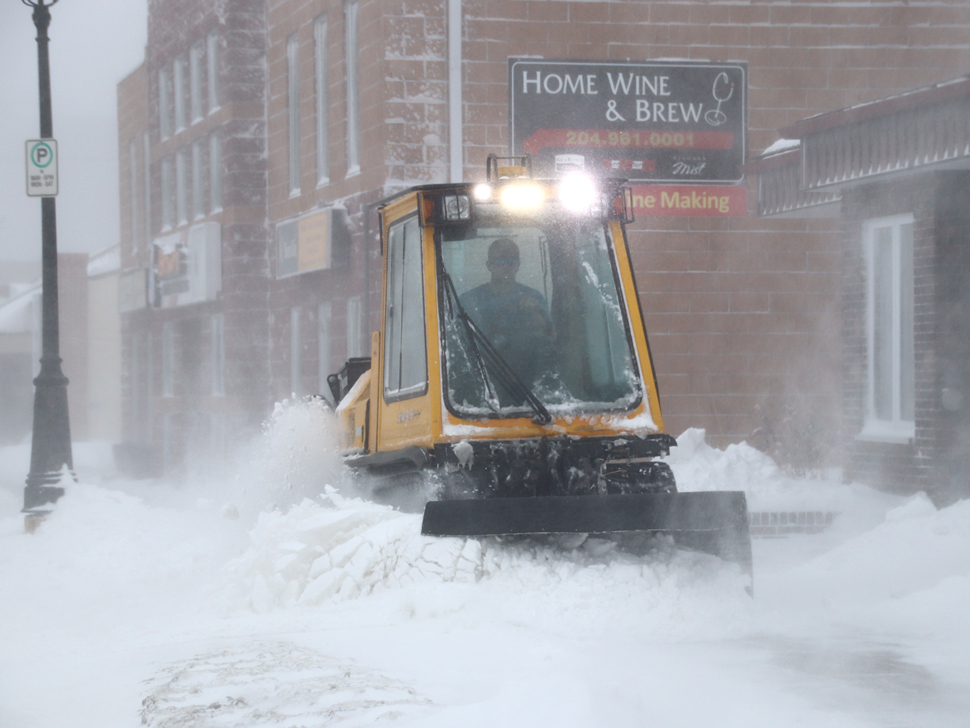
Environment Canada said it is scheduled to be the first launch of its kind.
Jean-François Caron, a research scientist at Environment Canada, says the world’s first weather service to provide public forecasts generated in part using artificial intelligence (AI) may soon be a reality.
Caron explains that weather forecasts are generated by humans. He notes that Environment Canada will begin using AI to issue forecasts, but specifies that this will all happen “upstream” of human intervention. Caron said forecasters base their predictions on the output of weather models. Historically, he said, these weather models have used the laws of physics to generate predictions.
“So we provide (forecasters) with the weather for the day and based on the laws of physics, we give a forecast up to several days in advance,” he added.
Caron says AI models have started to change predictions in recent years. He points out that forecasters are learning how the atmosphere behaves based on past weather, rather than encoding the laws of physics into algorithms. Caron says it uses decades of weather data to learn.
AI that excels in long-term predictions
However, he points out that AI modeling is generally not as accurate as physically-based models. But it is in large-scale weather events that AI modeling can have an advantage. For example, Caron says that for weather systems that cover an area of 1,000 kilometers, AI models are better than physically-based modeling.
“But it lacks fine-scale details such as strong winds, high temperatures, and very localized precipitation,” Caron said of the AI’s inaccuracies. “(AI) has a hard time predicting them accurately.”
So Caron says Environment Canada will introduce a hybrid model that uses a combination of physically-based modeling and AI models. He points out that while large-scale weather events will be guided by AI models, localized forecasts with smaller details will continue to use physically-based models.
“So this is a big change that Environment Canada is implementing next month,” he says.
Predictions will continue to be made by humans, not AI
But Caron emphasizes that the role AI plays in prediction is different from how the average person uses AI.
“When people think of AI, they think of ChatGPT,” he says. “You know, it’s completely different.”
Caron explains that the AI will not generate text for Environment Canada. Rather, they generate data that is then interpreted by humans to make public predictions.
Caron said he spent more than a year in research and development to understand the strengths and weaknesses of this new approach. In this way, he says, it has become recognized that AI is lacking in small-scale predictions, but very good at large-scale predictions.
“That’s when we had the idea to combine the two approaches,” he says. “We will therefore be the first weather service in the world to implement this.”
Official release scheduled for this spring
Caron said Environment Canada plans to release an AI-influenced forecast in late May. He notes that in terms of the quality of the science and predictions, they are happy with how things are going and have been given the green light to proceed. Caron says it’s just a matter of making sure everything is ready from a technical standpoint.
Caron said Environment Canada’s forecasts, which are updated several times daily, will not change in any way after the changes are initiated. What changes is the method used to compile the forecasts. And some of the predictions made with the help of AI are for 3 to 7 days.
“It will actually be available to the public from day 3 to day 7. There will be significant advances in accuracy,” Caron adds. “We’re saying the six-day forecast from the new model is as good as the five-day forecast from the previous model. This is a big change and we’re very proud.”
Environment Canada expects improvements in accuracy of key systems
Environment Canada says the changes will improve accuracy at scale. This is expected to lead to forecasts of major systems such as winter storms, heat waves, and atmospheric rivers from eight hours to more than 24 hours in advance. Environment Canada says it will also improve the accuracy of predicting when certain weather conditions are expected to begin and mapping the path of a storm.
Meanwhile, for those concerned that the use of AI will eliminate the need for meteorologists, Caron says there is no need to worry. He points out that this change will not eliminate meteorologists’ jobs. In fact, he says, real research jobs will be created.