

What if the first solid clues that birds existed were not bones but three-toed footprints carved into ancient mud? A new study suggests that some controversial “bird-like” footprints are closer to modern or fossilized bird tracks than to other dinosaur groups.
The research was led by Gregor Hartmann from the Berlin Helmholtz Center for Materials Engineering and Energy Research, with co-authors Tone Blakesley and Page E. DePolo from the Open University, and Stephen L. Brusatte from the University of Edinburgh, using artificial intelligence that learns the ‘right’ answer without being told. The team has also released a tool called DinoTracker, which aims to allow scientists and hobbyists to compare cryptic prints to large databases.
Why dinosaur footprints are important
Footprints are “trace fossils,” meaning they capture an animal’s behavior rather than preserving the animal’s body. Footprints are more common than bones and can suggest where dinosaurs lived, how they moved, and what their environment was like.
But footprints are troubling evidence. If you’ve ever seen footprints soften in wet sand, you’ve seen how the ground changes shape. Positive identification is difficult in the fossil record, as mud texture, moisture content, and velocity can all reshape dinosaur footprints.
Cleaner machine learning
Machine learning is often touted as a way to classify dinosaur footprints, but many systems require humans to label the training data first. These labels can silently incorporate assumptions into the software when expert opinions differ.
This study uses “unsupervised” machine learning. This means that the program searches for patterns without being told which prints belong to which group. Previous efforts have taken a more guided approach, such as planning for 2022. Royal Society Interface Journal A study trained deep learning on labeled silhouettes to distinguish between theropod and plant-eating dinosaur footprints.
Approximately 2,000 footprints in one dataset
The researchers trained their model on 1,974 footprint silhouettes spanning many species of dinosaurs and modern birds. To enable the system to respond to real-world changes, they generated many modified versions of the same track, mimicking effects such as compaction and small edge distortions in the mud.
The model compresses each footprint into a small set of underlying features and reconstructs the footprint from that compressed “shape code.” The team also tested the system on prints they had never seen during training. This is a basic reality check for tools aimed at tackling new discoveries.
8 functions that separate track types
Rather than creating a single label, the model identified eight main points where the footprints differ. To put it simply, we focus on things like how the foot presses into the ground, how the toes spread, how they connect near the base of the toes, and how the weight of the heel and left and right sides is reflected in the print.
After an unsupervised step, the researchers compared the model’s groupings to expert identification from published studies. The match rate is about 80-93%, and the university’s news release summarizes it as an “approximately 90%” match with human classification.
Bird-like footprints that can rewrite the timeline
The most controversial results include tiny three-toed footprints that look strikingly bird-like, dating from the Late Triassic to Early Jurassic period. If real birds made them, they could have originated some 60 million years earlier than the oldest widely accepted bird skeletons, creating a major shift in the evolutionary timeline of flight.
The analysis found that most of these disputed footprints are clustered closer to fossils and living birds than to non-avian dinosaurs. This doesn’t settle the debate, as footprints reflect anatomy and the ground beneath their feet, but it strengthens the argument that these footprints aren’t just random similarities.
On the other hand, the possibility of convergence remains real, meaning that non-avian dinosaurs may have evolved bird-like feet and left bird-like footprints. Particularly on wet roads, mud can lengthen or narrow the toe impression in a way that deceives the eye. 2023 pro swan A study of bird-like footprints in southern Africa explains how footprints look bird-like, leaving room for other footprint makers.
Scottish Middle Jurassic Puzzle
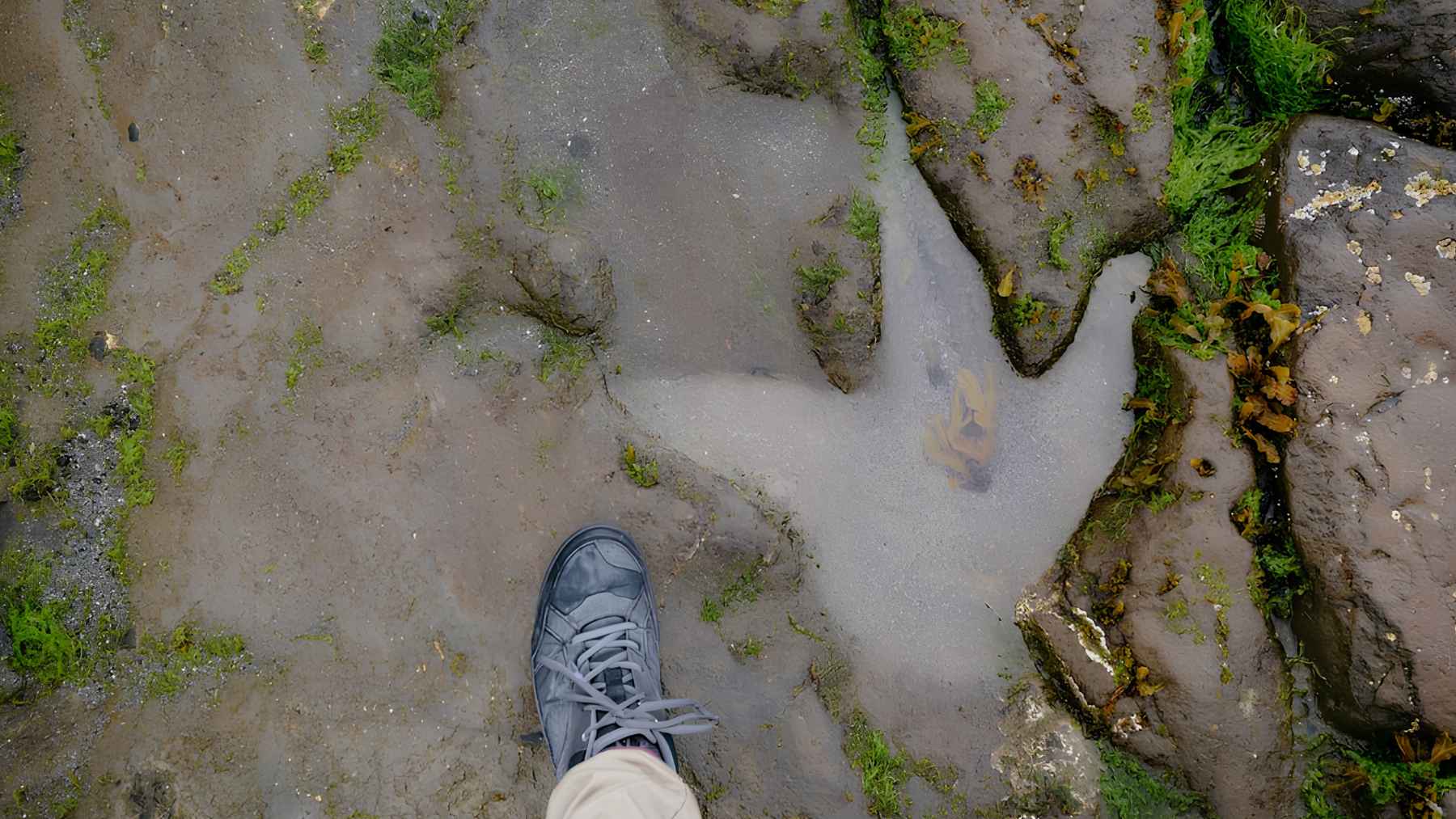
The model also tackled controversial three-toed footprints from the Isle of Skye’s mid-Jurassic rocks, which formed on the muddy edge of an ancient lagoon around 170 million years ago. Scientists debate whether some of the crests belong to carnivorous theropods or plant-eating ornithopods, which later included duck-billed relatives.
This system placed many of the Skye footprints close to theropod tracks, but also suggested that some were located near ornithopod tracks. This idea connects to Sky’s previous work on track sites, including the 2018 track site. Scottish Geology Journal A paper describing the regional characteristics of Brothers Point and the mixture of dinosaur footprints.
DinoTracker and the limits of AI fossils
To make the method easier to use, the team released DinoTracker on GitHub, an app that allows open code and footprint contours to be compared to the study’s database. This is the kind of quick check that can help you prioritize which odd prints are worth a closer look, especially when time and tides are against you at the track site.
The authors stress that the tool is not an omniscient judgment, and that caution is part of the point. This system relies on two-dimensional silhouettes, and the same foot can transform into different shapes due to deposition, movement, and storage.
Still, this approach provides an overview of the 2024 Earth-Science Reviews and the 2024 integrative biology A review of how machine learning can help scientists study biological shapes.
The original study Proceedings of the National Academy of Sciences.


