

Disney began a closed beta of Disney Ad Creative Studio on July 23, 2026, opening an artificial intelligence creative tool inside Disney Campaign Manager to a group of advertisers the company did not name. The product converts logos, product imagery, brand guidelines and previous creative assets into video advertisements for connected television, and it is aimed principally at small and mid-sized businesses that have historically been priced out of streaming inventory by production costs rather than by media costs.
The announcement arrived through a post on the Walt Disney Company newsroom, filed under the entertainment category and carrying no named executive byline. That absence is itself notable. Disney Advertising has typically routed product news through senior figures, as it did on June 30, 2026, when Deborah Armstrong, Senior Vice President of Disney Advertising EMEA, authored the perspective piece that accompanied the migration of EMEA campaigns onto the Disney Ad Server. This time the company spoke institutionally.
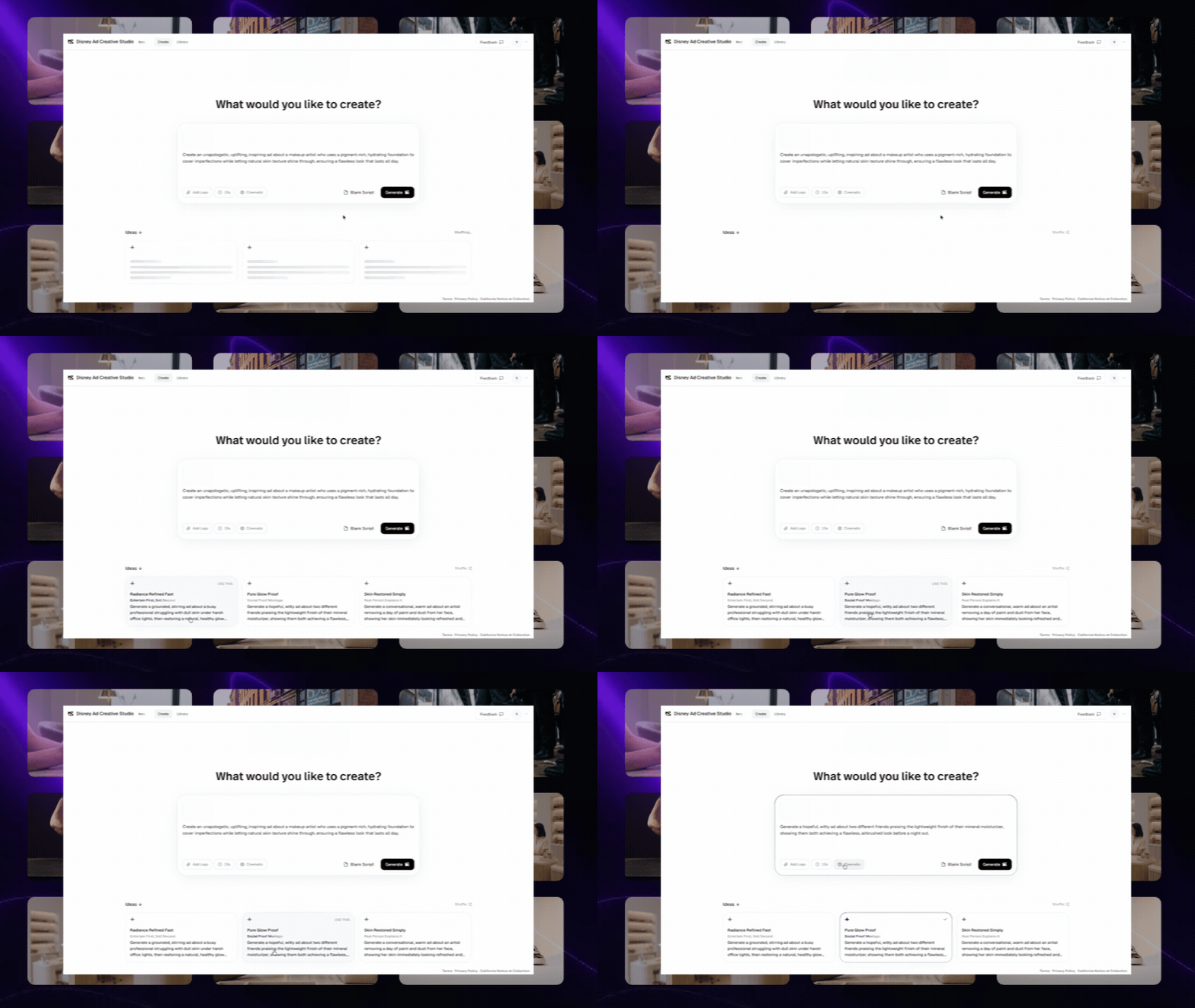
According to Disney, Disney Ad Creative Studio brings together multiple AI models within a single workflow to transform existing brand materials into video ads for connected TV. The materials listed are specific: logos, product imagery, brand guidelines and prior creative assets. The output is video suitable for streaming placement.
The distinguishing claim concerns variation rather than generation. Disney stated that the platform will be able to generate multiple creative variations tailored for different audiences, geographies, content and campaign goals, rather than focusing on a single output. A caption accompanying the product screenshot in the announcement described a workflow in which advertisers generate creative variations, manage approvals and prepare campaigns for activation without leaving the interface.
That last element matters more than the generation itself. Approval routing and campaign activation are the steps where automated creative tools have tended to break down, because generated assets still have to pass brand safety review, legal sign-off and trafficking before they reach a screen. Folding those stages into the same surface that already handles Disney media buying removes handoffs rather than removing labour.
Disney described the tool as one that “unlocks creative access to connected TV for small and mid-sized businesses”, while noting it also gives larger brands and agencies an opportunity to adapt and scale quickly. The company framed the beta as reciprocal: participating advertisers get early access, and Disney gets to test the platform in real-world workflows and refine the product before wider release.
Where it sits in the stack
Disney Campaign Manager is not a new surface. It is the buying interface Disney has been building out as the front end for its own inventory, and its underlying technology already extends beyond Disney’s walls. When Mediaocean announced Prisma Direct on March 31, 2026, the integration with Disney ran through an API connection built on the same technology as Disney Campaign Manager, covering inventory across ABC, ABC News, Disney+, Disney Channels Worldwide, ESPN Networks, ESPN+, Freeform, Fubo, FX, National Geographic, Hulu and eight ABC-owned local television stations.
Placing a creative generator inside that interface therefore has implications beyond the beta cohort. It positions Disney to supply both the asset and the impression from a single account, a configuration that changes the economics of who produces the advertisement.
Two years of infrastructure, one missing piece
Disney’s advertising technology work since 2024 has followed a consistent pattern: remove a manual step, then remove the next one. The company launched Disney Compass on January 6, 2025 to unify first-party data access across its properties. It expanded biddable capabilities to live content on Hulu and Disney+ in April 2025, making live ESPN and ABC News inventory available through programmatic integrations. It documented four interactive formats built on the Disney eXperience Composer on June 4, 2026, an internal creative platform handling the full lifecycle of an interactive ad unit. Measurement followed a similar path, with AudienceProject activating direct Disney+ integration across five European markets in January 2026.
Each of those moves addressed distribution, data or measurement. None addressed the asset itself. Creative development, Disney noted in the announcement, remains one of the most time-intensive steps of advertising.
The scale behind the gap is substantial. Disney’s ad-supported subscriber base stood at 122 million as of early 2026, and the company’s streaming services generated more than five billion dollars in revenue during the quarter ended December 27, 2025, with Entertainment SVOD operating income climbing 72 percent year over year to 450 million dollars, figures PPC Land documented as the platform crossing 5.3 billion dollars. Localisation has widened the addressable pool further: Disney+ added 17 audio languages in July 2026, lifting subtitle coverage to 42 markets.
An inventory pool that large only monetises fully if enough advertisers can supply usable video. That is the constraint the beta addresses.
The crowded race for small advertisers
Disney is late to a contest that has been running for at least two years, and the competitive field is unusually dense.
Amazon started earliest. It unveiled an AI Video Generator on September 19, 2024 that built video from a single product image, then extended Creative Agent to Streaming TV and Sponsored TV formats on November 11, 2025, consolidating creative generation into the unified Amazon Ads console. By May 2026 the company had added Dynamic TV Creative, which personalises Interactive Video Ads on Prime Video at impression time without requiring separate uploads per segment. Third parties have plugged into that stack as well: Smartly connected its creative optimisation to Amazon DSP on March 2, 2026, covering Prime Video and Fire TV.
On the supply side, Magnite acquired streamr.ai on September 9, 2025, bringing AI creative generation and a two-minute campaign setup timeline into an ecosystem distributed through agencies and retail media networks rather than sold directly to individual small businesses. Walmart took the most direct route, agreeing on June 23, 2026 to acquire Vibe.co and its 10,000-plus advertiser base rather than building a self-serve stack internally.
European broadcasters have moved along the same axis. Sky, Channel 4 and ITV set out plans on June 17, 2025 for a unified self-service television marketplace powered by Universal Ads and FreeWheel technology, explicitly targeting the complexity and minimum-spend requirements that have kept smaller advertisers off television. At IAB Europe’s programmatic day in 2026, panellists identified three barriers to small business television advertising: minimum addressable audience size, cost of entry in both media and creative terms, and execution complexity. AI tools were positioned as the answer to the second.
Disney Ad Creative Studio attacks that same second barrier. What separates it from most rivals is that Disney owns the inventory the generated creative will run against, which means the tool has a defined output specification rather than a generic one.
Volume is solved, quality is not
The industry-wide evidence on generative creative complicates the premise. The Interactive Advertising Bureau reported on July 15, 2025 that 86% of buyers already use or plan to use generative AI for video ad creative, with nearly 90% expected to do so by 2026. Adoption, in other words, stopped being the interesting variable some time ago.
What the numbers since have shown is a split between output and outcome. Research published by WARC in partnership with TikTok on July 14, 2026, drawn from 400 marketers in the United Kingdom, United States, Australia and Brazil, found that 88% reported higher creative volume after adopting generative AI while only 45% reported a significant improvement in quality. The study located the constraint in briefing inputs rather than in model capability.
Disney’s product description leans on the same variation logic that produced that gap elsewhere: many outputs tailored to many audiences, geographies and goals. Whether a template drawn from a small business logo and a handful of product photographs produces meaningfully different creative or merely more of it is a question the closed beta exists to answer, and no performance data accompanied the announcement.
Safeguards, and the reason Disney needs them
The section of the announcement dealing with responsibility carries weight that a similar passage from another company would not. Disney stated that safeguards are designed to “respect intellectual property rights and help protect image, voice, and likeness”, alongside advertiser controls, compliance requirements and human oversight, and that these principles will remain foundational as the product comes to market.
Disney has been the most aggressive Hollywood litigant on exactly these questions. The company sued Midjourneyjointly with Universal in June 2025 over AI-generated reproductions of copyrighted characters, then joined Universal and Warner Bros Discovery in suing MiniMax on September 16, 2025 in the Central District of California over its Hailuo service. A company arguing in federal court that generative models trained on protected material cause commercial harm now operates a generative model that ingests advertiser brand assets. The safeguard language is a positioning statement as much as a product feature.
Disney also stated plainly that “human creativity, strategy, and oversight remain essential to the process”, and that technology is only one part of the equation.
What was not disclosed
The announcement withheld a considerable amount. Disney did not name a single beta participant, did not disclose how many advertisers are in the cohort, did not indicate a general availability date, and did not describe pricing, minimum spend thresholds or whether access will eventually be tied to spend levels on Disney inventory. Nor did it identify which AI models are combined in the workflow, or whether any are third-party systems.
Also unaddressed: whether generated creative will carry disclosure of its AI origin, how the approval workflow interacts with Disney’s own creative standards, and what happens to advertiser-supplied brand materials after a campaign concludes.
For marketers, the practical significance of the July 23 announcement is narrower than the product description suggests, and broader than a beta usually implies. Narrower, because nothing is generally available and no results exist. Broader, because a media owner with 122 million ad-supported viewers has now placed asset production inside the same interface where media is bought, which shifts where creative work happens and who captures its value. That shift has been visible across Amazon DSP, Magnite and Walmart Connect for two years. Disney has now joined it, on its own inventory, with legal positions on generative AI that no competitor in the category has to defend.
Timeline
- September 19, 2024 – Amazon unveils an AI-powered Video Generator for advertisers at its Accelerate event
- January 6, 2025 – Disney launches Compass, unifying first-party data access across its properties
- April 8, 2025 – Disney expands biddable ad technology to live Hulu and Disney+ content
- June 17, 2025 – Sky, Channel 4 and ITV announce a unified self-service television marketplace for smaller advertisers
- July 15, 2025 – IAB research finds 86% of buyers use or plan to use generative AI for video creative
- September 9, 2025 – Magnite acquires streamr.ai to bring AI creative generation to small business CTV campaigns
- September 16, 2025 – Disney, Universal and Warner Bros Discovery file a joint copyright lawsuit against MiniMax
- November 11, 2025 – Amazon extends Creative Agent to Streaming TV and Sponsored TV formats
- January 2026 – AudienceProject activates direct Disney+ measurement across five European markets
- February 2026 – Disney streaming crosses 5.3 billion dollars, with 122 million ad-supported subscribers
- March 2, 2026 – Smartly integrates with Amazon DSP, extending AI creative optimisation to streaming TV
- March 31, 2026 – Mediaocean launches Prisma Direct, integrating Disney via Campaign Manager technology
- Earlier in 2026 – Disney sets out its artificial intelligence advertising vision at the Disney Tech and Data Showcase
- June 4, 2026 – Disney details four interactive ad formats built on the Disney eXperience Composer
- June 23, 2026 – Walmart agrees to acquire Vibe.co and its self-serve CTV advertiser base
- June 30, 2026 – Disney moves EMEA campaigns onto the global Disney Ad Server
- July 14, 2026 – WARC and TikTok research finds 88% report higher creative volume from generative AI, 45% report better quality
- July 23, 2026 – Disney opens the Disney Ad Creative Studio closed beta to a select group of advertisers
Summary
Who: The Walt Disney Company, through Disney Advertising, together with an unnamed group of beta advertisers. The announcement carried no individual byline and no executive quotation.
What: The start of a closed beta for Disney Ad Creative Studio, a tool inside Disney Campaign Manager that combines multiple AI models in one workflow to convert logos, product imagery, brand guidelines and prior creative assets into connected television video advertisements, and to generate multiple variations tailored to different audiences, geographies, content and campaign goals. The same workflow covers creative variation, approval management and campaign preparation for activation.
When: July 23, 2026. Disney had set out the underlying vision earlier in 2026 at its Tech and Data Showcase and tested the product internally in the intervening period. No general availability date was disclosed.
Where: Within Disney Campaign Manager, the buying interface for Disney advertising inventory, whose underlying technology also powers the Mediaocean Prisma Direct integration covering ABC, ABC News, Disney+, Disney Channels Worldwide, ESPN Networks, ESPN+, Freeform, Fubo, FX, National Geographic, Hulu and eight ABC-owned local television stations.
Why: Creative development remains one of the most time-intensive steps in advertising and functions as a cost barrier keeping small and mid-sized businesses out of connected television, a channel where Disney holds 122 million ad-supported subscribers. Reducing that barrier increases the pool of advertisers able to buy Disney inventory, while the closed beta gives Disney real-world workflow data before wider release.


