To be announced at ICML 2026: Performance verified with over 1.13 million frames
Expected to be applied to patrol robots and smart crime prevention monitoring
Automatic detection of door opening/closing and object movement
A domestic research team has developed artificial intelligence (AI) technology that can identify only objects that have actually changed in the same space, even if the images are shot at different times or locations. This technological innovation is expected to enable patrolling robots to autonomously recognize past and present environmental changes, and security systems to automatically monitor the movement or loss of objects.
Gwangju University of Science and Technology (GIST) announced on June 2 that a research team led by Professor Kim Eui-hwan of the Department of AI Integration has developed an AI model called VSCDNet (Video-based Scene Change Detection Network) that detects changes in objects in the real world by comparing videos taken at different times and on different routes.
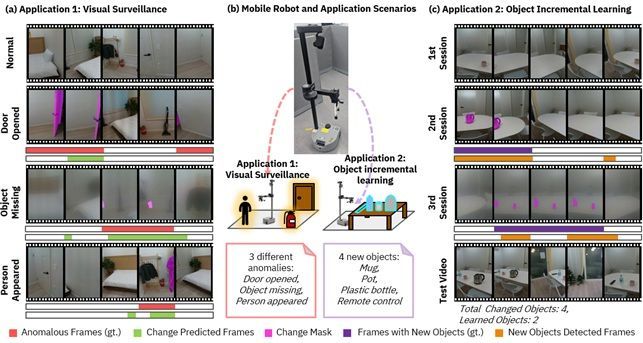
An example of using VSCD in a real robot environment. Mobile robots repeatedly visit the same space and compare the images they take to detect changes, such as doors opening or new objects appearing or disappearing. The detected regions of change can be used for visual monitoring and incremental object learning. Provided by research team
Show original image
Existing change detection technologies typically compare photos taken at similar locations and at similar times, which significantly reduces accuracy when cameras have different positions or travel routes. This has been a major limitation for autonomous or indoor patrol robots to track environmental changes over long periods of time.
The researchers addressed this problem by analyzing the flow of the entire video, rather than comparing individual images. VSCDNet compares past reference videos and current videos to identify corresponding scenes and accurately extracts only the regions where real object changes occur.
This approach allows the system to automatically identify situations such as the disappearance of a laptop, a change in the position of an object, or the appearance of a new object. The areas where changes are detected are visualized as a “change mask” and provided to the user.
To validate the technology, the research team also built a large dataset containing both virtual spaces and real indoor environments. In experiments using a dataset consisting of a total of 1,090 videos and over 1.13 million frames, VSCDNet outperformed existing change detection methods.
In particular, stable detection accuracy was maintained under various conditions, including differences in video length, image quality, and number of changing objects. In actual mobile robot experiments, the system automatically detected situations such as doors opening and objects disappearing from videos taken on various routes, and also demonstrated its ability to memorize and learn from newly appeared objects.

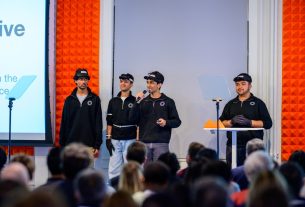
Research team photo. (From left) Professor Kim Eui-hwan of the AI Convergence Department and Yoon Ji-ae, a master’s and doctoral student. Provided by GIST
Show original image
The research team emphasized that this technology is important because it not only allows us to recognize the current scene, but also allows us to understand what has changed compared to the past. Since environmental changes can be detected without the need for separate location information or spatial maps, it is highly applicable to indoor patrol robots, smart security monitoring, facility management, and smart indoor systems that utilize IoT.
Professor Kim Ui-hwan of GIST’s AI Convergence Department said, “VSCDNet is an AI model that not only recognizes the current scene, but also autonomously determines what has changed compared to the past. It is expected to be widely applied in various indoor environmental management fields because it can compare images taken from different routes without additional location information or spatial maps.”
This research was conducted by Jiae Yuon, a master’s and doctoral integration student in the Department of AI Convergence, under the supervision of Professor Uiwhan Kim. This research was supported by the Outstanding Young Researchers Program of the Ministry of Science, Information and Communication and the National Research Foundation of Korea, and the Autonomous Visual Intelligence Technology Development Project of the Institute of Information and Communication Technology Planning and Evaluation (IITP).
Today’s featured products
!["Target price increased from 650,000 won to 1.85 million won" Latecomers to semiconductor substrates rapidly narrow the technology gap [Click e-Stock]](https://cwcontent.asiae.co.kr/asiaresize/93/2026060208222784582_1780356147.jpg)
“Target price increased from 650,000 won to 1.85 million won” latecomer to semiconductor substrates, rapidly closing technological gap [Click e-Stock]
The research results are scheduled to be presented at ICML 2026, the world’s top AI and machine learning conference, to be held at COEX in Seoul next month.
This content was created with the help of: AI translation service.
©Asian Economic Newspaper (www.asiae.co.kr) Unauthorized reproduction is prohibited.