


The privacy debate surrounding artificial intelligence has intensified after recent changes by Google and Meta highlighted how user data can be used to improve AI models. This issue is no longer limited to search queries. AI companies are increasingly interested in the data users create as they interact with their services, including chats, photos, voice recordings, documents, and search activity.Why is this a big issue now?■ Google began rolling out new search service history settings on May 26, separating control of search activity from the old web and app activity settings. The new system stores images, audio recordings, videos, and files used in services such as Search, Maps, Translation, News, and Lens, and may be used to improve our AI systems unless you turn the option off. Google said the rollout will continue over the next few months.Meta’s AI photo tools gained traction in the first week of July 2026 when it expanded its capabilities, including Muse Image, which can use eligible public Instagram photos to create AI-generated images unless the user opts out.What do Google and Meta say?■ Google defended the changes as giving users “more control” over their search history and personalization settings. The company says users can completely disable the search service’s history and choose whether to save images, files, and audio recordings. “We take our users’ privacy seriously and take steps to protect their privacy when we use historical data from our search services to train our AI models,” Google said in a support document.Meta says its AI capabilities are aimed at helping users create and edit images, and users can manage targeted AI settings through privacy controls available on its platform. “You can turn off or allow reuse of Reels, feed videos, and photos across your account at any time,” Mehta said.What platforms may use your data?■ The broader issue goes beyond Google and meta. With OpenAI’s ChatGPT, conversations from many consumer accounts can be used to improve models, unless the user disables the associated training settings. Microsoft Copilot collects prompt, documentation, and usage data to improve our services, but commercial customers have stronger protections. Anthropic’s Claude and xAI’s Grok can also use some consumer interactions and uploads to improve their models, depending on privacy settings and opt-out options.
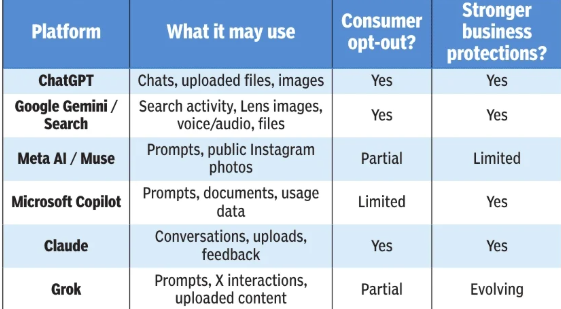
Data used by these AI platforms
Will my data stop if I pay for the service?■This is not necessarily the case. Consumer subscriptions primarily offer additional features and higher usage limits. The strongest restrictions are typically on enterprise, education, and commercial plans, where providers contractually promise not to train models based on customer data.What should users check?■ Privacy experts say users concerned about AI training should review their settings rather than assuming it’s too restrictive by default. For Google services, this means checking your search service history, web and app activity, and auto-delete settings. ChatGPT users can disable “Chat History and Training” if they do not want to use conversations to improve their models.Meta users should review Instagram and Meta AI’s privacy controls and opt out of AI features that use public photos, if available. Claude users can review data controls in settings and disable participation in model improvement if offered, while Grok users should review X’s privacy settings to avoid sharing sensitive personal information.


