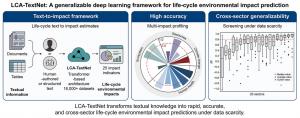
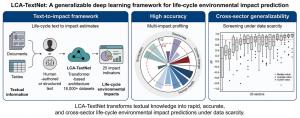
LCA-TextNet converts textual descriptions such as activity names, product information, and technical comments into quantitative lifecycle environmental impact predictions across 20 industry sectors and 25 impact indicators.
Georgia, USA, July 2, 2026 /EINPresswire.com/ — Life cycle assessment (LCA) is the gold standard method for quantifying the environmental footprint of products and processes, from climate change to resource depletion. However, creating the detailed inventories required for these assessments remains extremely time-consuming, expensive, and data-poor. Now, researchers have developed a deep learning framework called LCA-TextNet. The framework predicts 25 life cycle environmental impact indicators across 20 sectors directly from text descriptions. This avoids the need for sector-specific manual feature engineering and provides a scalable shortcut to environmental intelligence.
Traditional LCA faces persistent bottlenecks. Although background databases such as ecoinvent are comprehensive, they often do not cover all activity types within a sector. Even if upstream bulk chemicals are well represented, downstream fine chemicals may lack usable data. To create a lifecycle inventory, each input and output must be matched against corresponding background data. This process is costly, time-consuming, and requires extensive expertise. Existing machine learning solutions have tackled these challenges, but are still limited to single sectors and trained on individually hand-crafted features for agriculture, construction, or chemistry. Because of these limitations, there is an urgent need for generalizable approaches that can bridge sectors and scale across the entire range of industrial activities.
A research team from Tsinghua University, Shanghai E-Carbon Digital Technology Co., Ltd., Shanghai HiQ Smart Data Co., Ltd. (HiQLCD), and the University of Hong Kong, led by Professors Shanying Hu and Zhijun Gui, Kai Zhao and Biao Luo, developed LCA-TextNet, a deep learning model that predicts life cycle impact assessment (LCIA) outcomes from knowledge-based text descriptions. This research work, accepted for publication in Environment Science and Ecotechnology on June 16, 2026 (DOI: 10.1016/j.ese.2026.100724), represents an important step towards cross-disciplinary generalization in artificial intelligence-driven environmental assessment.
The researchers trained a Transformer-based architecture on more than 16,000 activity datasets from the ecoinvent database (version 3.10), using seven categories of textual information as input. The model maps high-dimensional text embeddings into a unified semantic space, rather than relying on domain-specific features such as molecular descriptors of chemicals or parameters for construction. The results are impressive, with LCA-TextNet achieving high accuracy (R² > 0.8) across 70% of sectors and for 17 of 25 environmental impact indicators. The model performs particularly well in data-rich and semantically consistent sectors, such as waste treatment and recycling, and wood products. However, performance varies. Sectors such as transport, water, and land use proved more challenging due to small sample sizes and uneven text descriptions. To address real-world deployments, the team introduced an “applicability domain” rating that flags out-of-distribution predictions, allowing users to decide when to trust a model and when to defer expert review. When tested on newly introduced data from ecoinvent version 3.12 (a realistic scenario in which the model encounters never-before-seen activity), incremental learning reduced the average absolute error in climate change by 70% (from 2.0 to 0.6 kg CO₂-eq per unit).
“The biggest bottleneck in LCA has always been data. Not only was it lacking, but converting scattered process knowledge into structured inventory data required significant effort,” the authors said. “We realized that while inventory data was lacking, descriptive text was everywhere. Product names, process descriptions, technical comments, and more. This information was readily available. Furthermore, human inventory compilation itself is essentially a process of interpreting knowledgeable text and converting it into structured, quantitative data. So we wondered if it was possible to train an artificial intelligence model to read that text and directly estimate environmental impacts.LCA-TextNet is our answer. It’s not a replacement for a rigorous LCA, but it gives you a quick and reliable first estimate when you have the data. There’s nothing else to go on.”
This framework provides a practical path to integrating natural language understanding into environmental modeling. When lifecycle inventory data is available, LCA-TextNet can act as a background data imputation tool to fill in gaps for inventory items that lack matching database entries. When no inventory data is available, the model can predict LCIA outcomes directly from textual functional unit descriptions, enabling rapid screening-level evaluation of early-stage designs, policy research, and environmental, social, and governance (ESG) reports. By exploiting the asymmetry between rich descriptive information and scarce quantitative data, LCA-TextNet transforms textual information into actionable environmental intelligence and has the potential to accelerate green transitions across industries where traditional LCA can stall. The code for the model is publicly available in the HiQLCD GitHub repository (https://github.com/HiQ-LCD/LCATEXTNet), and researchers with a valid LCA database license can retrain and apply the framework to the extent permitted by their data license.
References
Toi
10.1016/j.ese.2026.100724
Original source URL
https://doi.org/10.1016/j.ese.2026.100724
Funding information
This study was supported by the National Natural Science Foundation of China (No. U24B6016).
Lucy Wang
biodesign research
please email here
Legal disclaimer:
EIN Presswire provides this news content “as is” without warranty of any kind. Our company does not assume any responsibility or liability
The accuracy, content, images, videos, licenses, completeness, legality, or reliability of the information contained herein;
article. If you have any complaints or copyright issues related to this article, kindly contact the author above.